Tuesday, April 23, 2013

Has The Melting Pot Melted Away?

The Boston Marathon attack should cause us all to take a step back and consider what lessons can be learned and applied to immigration reform.

Let me say at the outset that I have long been an advocate for sensible immigration reform.  The current system is outdated and ill-suited for the 21st century workplace.  We are a country that was founded and prospered over the years by the infusion of immigrants.  Almost everyone in this country today can trace their roots to an immigrant who came to this country seeking economic opportunity and personal freedom.

Our forebearers left family and friends behind for the opportunity to come to America.  They left everything they had in their homeland for a new and better life in the United States of America. 


Photo Credit: Life Magazine

For most of our history when someone left their home country they really left it.  Those immigrating to America faced an arduous ship passage.  They could communicate with friends and family only by letter once they got here.  It was difficult to get news about what was happening in their home country. There was little chance that they would be able to go back. As recently as twenty years ago, long distance international phone calls were expensive and limited.  Immigrants really did not have much choice other than to assimilate into American society.  It simply was not an option to stay connected to your former country.

We now have email, the internet, inexpensive telecommunications and Skype to communicate.  It is easy to stay connected to family and friends.  News from home is easy to access and it is easy to stay connected. Ethnic groups and clubs and the surge in immigrants (2010 data indicates there are 40 million foreign born people in the United States) have put an entirely new perspective on what immigration means.

When someone immigrated to the United States in the past they were literally 'all in".  They simply had no other choice.  They were coming to America to be Americans.  It was not just the economic opportunity but it was everything else as well.  They did not pick and choose.  They bought the whole loaf.

Can the same be said today?  I think it is an important question.  Are the people coming to America today really coming here to be part of the great "melting pot" that has defined us in the past?  Are they really interested in adopting and assimilating into American culture, tradition, values and our language?  Or are they here just for the economic advantages?

This question seems particularly relevant when considered with some of the information coming out about the Boston Marathon bombers.  You would think both of these young men who be eternally grateful for the opportunity to be allowed to immigrate to this country from their war-torn Chechnya homeland.  Why did they have such hatred?  After ten years in this country how could Tamerlan Tsarnaev say, " I don't have a single American friend.  I don't understand them."?

John O'Sullivan of NRO sees potential parallels in this case with those of the four young Muslim Yorkshiremen who killed more than 50 people in the London subway bombings in 2005.

Local people were amazed that these kids, three of them the sons of successful immigrants and local businessmen, who played cricket and soccer and drank adolescent quantities of beer, should have joined together in a pact to murder innocent people they had never met.

In that case — and I suspect we shall find also in the case of the marathon bombers — the explanation was (or included the fact) that they had been assimilated into a nullity. For almost the entire youth of the 7/7 bombers, the British had acted as if they were ashamed of their national identity and history. So young men, with the usual propensity of young men to want to identify with patriotic and idealistic causes, had been told that there was nothing admirable or heroic about being British. It was a sort of swindle, and one, moreover, that had been perpretated especially upon people of their ethnic backgrounds. They had therefore looked around for a heroic cause they could identify with. The radical Islamists provided them with the cause of radical Islamism — and they embarked on the relatively short road to mass murder.

Just think for a minute about what types of things these two young men heard while living in Cambridge, Massachusetts.  Do you think they were taught about American exceptionalism?  How often did they hear that the United States of America was the last great place for hope in the world?  Did they ever hear it in Cambridge, Massachusetts?

Why does it matter? 

The Hudson Institute recently published a report by John Fonte and Althea Nagia in which they argue that "America's Patriotic Assimilation System Is Broken".

They found that a large "patriotic gap" exists between native-born citizens and immigrant citizens on a number of issues indicating assimilation and attachment to the United States.  Bear in mind, this is data comparing native-born and naturalized citizens.  You can only imagine what the gap would be on resident aliens and others who may be living and working in this country who are not citizens.


By 21 percentage points (65% to 44%), native-born citizens are more likely than naturalized immigrants to view America as “better” than other countries as opposed, to“no better, no worse.”


By about 30 points (85% to 54%), the native-born are more likely to consider themselves American citizens rather than “citizens of the world.”

By 30 points (67% to 37%), the native-born are more likely to believe that the U.S. Constitution is a higher legal authority for Americans than international law.


By roughly 31 points (81% to 50%), the native-born are more likely than immigrant citizens to believe that schools should focus on American citizenship rather than
ethnic pride
.
By 23 percentage points (82% to 59%), the native-born are more likely to believe that itis very important for the future of the American political system that all citizens understand English.

This study makes you wonder about whether the "melting pot" is melting away. It also should send up huge cautionary flags on what has to be done to close this huge "patriotic gap" among natural born and naturalized citizens.


In the final analysis, there can be no comprehensive immigration reform without comprehensive assimilation reform.


We cannot determine immigration policy unless we seriously examine what our assimilation policy should be.


Why is there a patriotic gap between native-born and naturalized citizens? Undoubtedly there are many different reasons. One in particular, however, strikes us as responsible, at least partially, for this gap. Since the 1970s American elites have altered our “de-facto assimilation policy” from Americanization (or patriotic integration) to a multiculturalism that emphasizes ethnic group consciousness at the expense of American common culture.


In short, we have sent immigrants the wrong message on assimilation. It is our fault, not theirs that this gap exists.


I have not yet read the Senate Immigration Bill that the so-called "Gang of Eight" has drafted but I would hope that if we are going to open up new pathways to working and gaining citizenship in this country that we consider these realities. First, many people who come here are not "all in" simply because the world has changed. Second, the message of multiculturalism has pushed what it means to be an American to the back burner. We invite trouble when we ignore these realities. When will we wake up?

Sunday, April 21, 2013

The Healthcare Cost Curve And Its Consequences

Why is it so difficult to convince some people to buy health insurance? 

Consider the story about the health insurance program in Florida that was designed to provide subsidized health insurance to those that could not otherwise afford it.  It was an abject failure signing up less than 1/3 of those it believed it would help.

The ‘if you build it, they will come’ philosophy doesn’t work in health care,” said Linda Quick, president of the South Florida Hospital and Health Care Association.
Quick and others worry similar problems could bedevil the new online health insurance marketplaces that open for enrollment Oct. 1 under the federal health law.  The marketplaces are the main way the health law expands coverage to as many as 27 million people starting next year. 

Getting sufficient enrollment, especially from the young and healthy, is vital to holding down premium costs in those markets. The concern is that if all the sick people flood the exchanges and younger, healthier ones hang back, health care costs will spike, along with premiums.

Yet one of the biggest reasons for the anemic initial enrollment in the county program that began in 2006, called Vita Health, and similar programs is that many healthy people don't believe they need insurance and are reluctant to spend even nominal amounts to purchase it, say organizers.

“A lot of people who are uninsured and can afford it, don’t buy it because they aren’t sick,” said Paul Gionfriddo, a consultant who formerly led an alliance in Palm Beach County to help the uninsured. 

This chart explains what these people already know. The reality is that most people will have very little in healthcare costs in a given year.  A handful of people will have enormous costs.  A few will have very large costs.  The majority will have almost no costs.  The bottom half of the entire population only consumed 2.9% of all personal health care spending in 2009.  The top half consumed the other 97.1%.

Out of almost $1.3 trillion in personal health care spending, only $36 billion was spent on those below the 50th percentile.  The rest was spent on those above the 50th percentile.


The top 1% of healthcare spenders accounted for over 20% of all spending.

The top 5% accounted for almost half of all spending.

This is why most people will gamble if left to their own devices.  They will simply not part with their money today for the chance that they might get sick tomorrow.  That is basic human nature.  Live for today and think about that other stuff tomorrow.

This is why I have always been a big believer in high-deductible catastrophic health insurance coverage.  Anybody could find themselves facing high medical expenses in a given year but the odds are generally against it.  Most will have very low expenses during a typical year.  This is particularly true when you talk about the non-Medicare-eligible population.

Therefore, instead of living with Obamacare, if the people of the United States believe that providing health care is supportive of the constitutional provision of providing for the "general welfare", they should insist that their elected representatives focus first on providing some type of catastrophic insurance coverage.  These are costs that anybody in our society may have to shoulder and almost no one is able to do so without some type of insurance coverage.  This catastrophic coverage could also be scaled so that the attachment point is higher with someone with more wealth.  For example, maybe it is only $5,000 at a minimum level but $100,000 for someone with higher income or wealth.

Due to the fact that this type of coverage would benefit everyone it should also be financed by a general broad-based tax if we want some type of universal health care coverage.  Everyone should contribute to the cost of the coverage as everyone has the potential to benefit.  In this way it would be much like Social Security and Medicare.  This avoids the problem of people deciding they will just not buy the coverage. This is certain to be a problem with Obamacare just as it is today.
.
If it was desired to provide coverage for routine medical care it should be done with some type of health savings account amount that would be provided to everyone annually.  For example, $500 per year that could be used for routine care and which could be rolled over to subsequent years if it was not used.  This provides an incentive for people to use their health care money prudently.

Private insurance could be used to fill the gap between the annual amount and the level of catastrophic coverage. 

Of course, Obamacare is not structured anything like this.  It is the opposite of what a well thought out national health care policy should be in almost every respect. It assumes that people can be convinced to voluntarily sign up and pay for health insurance even though the evidence says this is unlikely. It tries to focus coverage on low end services by providing a lot of free stuff like preventive exams, contraception services and the like.  It does not use a broad-based tax but rather taxes select people or groups (medical device manufacturers, high incomes etc) to fund the free stuff.  It does not do anything to try to align incentives and to make sure people have some "skin in the game".  In summary, it will not do much to address the biggest problems in health care---high costs, affordability and access.

Healthcare reform should have been based on the reality of the healthcare cost curve.  The fact that it was not means that Obamacare will be a hugely expensive program that will likely do almost nothing that it was supposed to do.  In fact, it will most likely make things much worse by further driving up costs.

Consider the recent HHS slide show explaining the challenges of marketing Obamacare that was recently reported on by Investors Business Daily.

It turns out that the Democrats and the Obama administration apparently didn't bother to investigate who these uninsured people actually are before they forced through a $1.8 trillion plan to help them.

What they've learned since is that more than half of the 48 million who the government says are uninsured aren't interested in health insurance, which is why they don't bother to buy it in the first place.

The administration now admits that vast numbers of the uninsured will be unlikely to respond to ObamaCare's marketing pitches.

The biggest market segment identified by HHS, in fact, is what it describes as "healthy and young," who make up 48% of the uninsured population.

They have "a low motivation to enroll" because they are in "excellent to very good health" and so "take health for granted."

Plus, as the HHS has apparently just discovered, most of them say that cost is the main reason they don't have coverage.

Then there are the "passive and unengaged," which make up 15% of the uninsured and also have a "low motivation to enroll" because they "live for today." They also cite cost as a key factor.
Of course, there is one group that will respond to the marketing of Obamacare and that is the 29% who "sick, active and worried" about their healthcare coverage.

If only these people sign up, ObamaCare's premiums will spiral out of control, as the pool of insured gets sicker and more expensive.

And that, in turn, will cause still more of the young and healthy to drop insurance and taxpayer subsidy costs to skyrocket.

Democrats may think that a big, slick marketing campaign can change all this. Our guess is that it will be about as effective as Ford's was for the Edsel.

Until we recognize the reality of the health care cost curve, the fact that many people will avoid paying for health insurance on their own, and the failure to align incentives and penalties, we will continue to be frustrated with the costs and consequences of our U.S. health care system.  Instead of improving a bad situation, Obamacare is only going to make a bad situation even worse.  It's in the curve.  If we really want to do something about health care in this country, we need to first consider the curve or we will continue to see bad consequences.

Thursday, April 18, 2013

Is The Fix On In The Investment Game?

Is the fix on in the investment game?

We have seen the effects of the Federal Reserve low interest rate policy on the bond market.  Despite the fact that the federal government needs to finance annual deficits of $1 trillion, interest rates on treasury notes are at historical lows.  Would this be possible if the Federal Reserve was not buying massive amounts of these debt obligations every month?

We have also seen the effects of the Federal Reserve low interest rate policy on stock prices.  If an investor cannot get any return on fixed income investments what do they do?  For many the answer has been to take money from low yielding fixed income investements and move it into stocks.  This has clearly been one of the objectives of the Fed's low interest rate policy and its quantatative easing program.

We may now see that the Federal Reserve (or another Central Bank) is attempting to manipulate the price of gold.

If you have not been paying attention, the price of gold crashed over the last week.   Here is the chart of the price of gold over the last six months.  In two trading days the price of gold dropped from over $1,550/oz to $1,350/oz.  That is a loss of more than 12% in two days.  How did that occur?


Paul Craig Roberts was the Assistant Secretary of Treaury for Economic Policy in the Reagan Administration.  He knows something about economic policy and he also knows how Washington works. He does not like what he is seeing of late.  He thinks that the Federal Reserve has been rigging the stock and bond markets. He also thinks that the Federal Reserve may now be working behind the scenes to drive down the price of gold.  Consider this recent commentary from Roberts on "The Fed's Assault of Gold".  In my eyes, if even half of this is true, it is very troubling.

I was the first to point out that the Federal Reserve was rigging all markets, not merely bond prices and interest rates, and that the Fed is rigging the bullion market in order to protect the US dollar’s exchange value, which is threatened by the Fed’s quantitative easing.  With the Fed adding to the supply of dollars faster than the demand for dollars is increasing, the price or exchange value of the dollar is set up to fall.

A fall in the dollar’s exchange rate would push up import prices and, thereby, domestic inflation, and the Fed would lose control over interest rates. The bond market would collapse and with it the values of debt-related derivatives on the “banks too big too fail” balance sheets. The financial system would be in turmoil, and panic would reign.

Rapidly rising bullion prices were an indication of loss of confidence in the dollar and were signaling a drop in the dollar’s exchange rate. The Fed used naked shorts in the paper gold market to offset the price effect of a rising demand for bullion possession. Short sales that drive down the price trigger stop-loss orders that automatically lead to individual sales of bullion holdings once their loss limits are reached.
I know this is hard to believe but it has been reported that the big sell-off in gold prices began when someone put in an order to sell 500 tons of paper gold at the opening of the market last Friday morning.  How much is 500 tons?  That is equal to more than 10% of all the gold stored at Fort Knox.  At the opening price on Friday that amount of gold was also worth about $25 billion.  Who has that kind of money to be throwing around? Roberts thinks it could only be the Federal Reserve.
According to Andrew Maguire, on Friday, April 12, the Fed’s agents hit the market with 500 tons of naked shorts. Normally, a short is when an investor thinks the price of a stock or commodity is going to fall. He wants to sell the item in advance of the fall, pocket the money, and then buy the item back after it falls in price, thus making money on the short sale. If he doesn’t have the item, he borrows it from someone who does, putting up cash collateral equal to the current market price. Then he sells the item, waits for it to fall in price, buys it back at the lower price and returns it to the owner who returns his collateral. If enough shorts are sold, the result can be to drive down the market price.
A naked short is when the short seller does not have or borrow the item that he shorts, but sells shorts regardless. In the paper gold market, the participants are betting on gold prices and are content with the monetary payment. Therefore, generally, as participants are not interested in taking delivery of the gold, naked shorts do not need to be covered with the physical metal. 
In other words, with naked shorts, no physical metal is actually sold.
People ask me how I know that the Fed is rigging the bullion price and seem surprised that anyone would think the Fed and its bullion bank agents would do such a thing, despite the public knowledge that the Fed is rigging the bond market and the banks with the Fed’s knowledge rigged the Libor rate. The answer is that the circumstantial evidence is powerful.
That circumstantial evidence gets even stronger when you look at the results of what happend when those 500 million tons of naked short paper gold contracts were put on the market.

What happens when 500 tons of gold sales are dumped on the market at one time or on one day? Correct, it drives the price down. Investors who want to get out of large positions would spread sales out over time so as not to lower their sales proceeds. The sale took gold down by about $73 per ounce. That means the seller or sellers lost up to $73 dollars 16 million times, or $1,168,000,000.

Who can afford to lose that kind of money? Only a central bank that can print it.
That's right, whoever dumped that 500 tons of gold on the market lost $1.1 billion according to Roberts as a result of driving the price down on just the first day.  That position is probably down over double that amount now. Does that make sense for anyone other than somebody who has a larger agenda and an even larger pocketbook?

What could that larger agenda be from the Fed's perspective?

Possibly the Fed fears a dollar crisis or derivative blowup is nearing and is trying to reset the gold/dollar price prior to the outbreak of trouble.  If ill winds are forecast, the Fed might feel it is better positioned to deal with crisis if the price of bullion is lower and  confidence in bullion as a refuge has been shaken.
I see the orchestrated effort to suppress the price of gold and silver as a sign that the authorities are frightened that trouble is brewing that they cannot control unless there is strong confidence in the dollar. Otherwise, what is the point of the heavy short selling and orchestrated announcements of gold sales in advance of the sales?
All I know is that the concept of free and fair markets in the investment world today appears nothing more than a fantasy.  The reality is pretty frightening.  Be careful. Be very careful with your money.  Who knows what the man behind the curtain is doing?

Credit: The Wizard of Oz


Tuesday, April 16, 2013

Carnage and Coincidence

All of our thoughts and prayers are with those who are dealing with the terror attack in Boston yesterday.

It was an unspeakable crime (or act of war) and it is my hope that justice is swift and harsh to those that caused such carnage to innocent people.

What I found interesting is we keep seeing this horrific events in mid-April. Why?  Coincidence?

Consider the following:

Waco siege                                     April 19, 1993

Oklahoma City Bombing                 April 19, 1995

Columbine                                          April 20, 1999

Virginia Tech massacre                         April 16, 2007

Boston Marathon bombings                     April 15, 2013

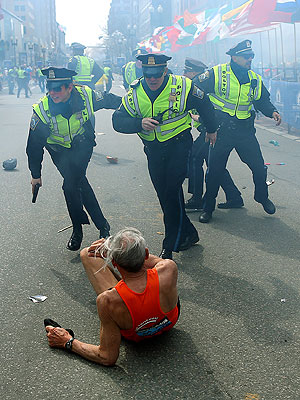
Speaking of coincidences, look at these two photographs that were taken immediately after the two bombs exploded near the finish line of the Boston Marathon yesterday.

This first photo was on the front page of USA Today this morning.

Credit: USA Today/Boston Globe via Getty Images


The second photo was also in the paper but deeper into the news section.  Do you notice anything about the two images that is interesting? You can go here for a larger image.

Credit: USA Today/David L. Ryan, The Boston Globe via Getty Images

What caught my eye is the fact that both pictures (taken by different photographers) were snapped at exactly the same moment.  Look at the three police in the top image and compare to the bottom image.

They are in exactly the same poses.  In fact, you can see the photographer (in yellow) taking the first picture in the second image standing right in front of the police over the fallen runner.  Truly amazing and truly appalling at the same time.

Monday, April 15, 2013

The Masters

I had the privilege of attending The Masters golf tournament this year.

If you are a golf fan it is one event that is well worth attending.  It is a first-class experience in every respect.  The course is both beautiful and immaculately maintained.  The spectators are treated as true patrons which is what Augusta National prefers to call the golf enthusiasts who attend.

Food and beverages are very, very reasonable.  A pimento cheese sandwich costs only $1.50.  A turkey sandwich is $2.50. A soft drink is $1.50.  A candy bar or moon pie goes for $1.00.  A domestic beer is $2.50.


The tournament is run like a well-oiled machine.  Every detail has been thought out and is run efficiently from the concession stands to the rest rooms to the golf shop.  Everyone must pass through metal detectors to gain entrance to the grounds and you must pass 25 security guards on your way in.  Every ticket is scanned.  Every bag searched. Cell phones and cameras are strictly prohibited.  The crowd is polite and knowledgeable.

The biggest problem is getting a ticket for the tournament.  The face value of a tournament pass is $250 but the going value is over $5,000 for the week. At present, there is not even a waiting list you can get on to get tickets.  It is clearly the toughest ticket to get in all of sports.  Your only choices are to know someone who has access to tickets, buy through a ticket broker or register for an online lottery that The Masters opened a couple of years ago for a limited number of daily tickets.  You can go here in a month or two to apply for tickets for the 2014 tournament.

One of the more interesting sites for me was the golf store.  I did not pass it one time when there was not a line to get in the store and it was packed like nothing I have ever seen.  I was told that they sell $1 million of merchandise per hour.  That doesn't seem too far off from what I could see.

For example, here are the famous Masters folding chairs that surround almost every green.  Masters etiquette is such that you can place your chair at your favorite venue early in the morning and tour the course and your chair will still be there for you.  No one will touch it, remove it or sit in it. These chairs go for $30 in the golf store.


Another example is this photo of Adam Scott on the 10th green right after he sank his winning putt in the playoff yesterday. Notice the large number of Masters umbrellas and the total absence of anything else. These all came from that on-site golf store.

Credit:  AP Photo/David J. Philip


The Masters understands the principles of scarcity and exclusivity very well and it is a marketing marvel as a result. The tournament committee really knows what it is doing and does it well.

If you are looking for an interesting summer book I suggest you consider "The Making of the Masters: Clifford Roberts, Augusta National, and Golf's Most Prestigious Tournament". I read the book over ten years ago and it is a fascinating story of the origins of the founding of Augusta National and its guiding force, Clifford Roberts, over the years. It will give you a keen understanding of how "touch and go" it was to even get the club built and financed in the midst of the Depression.

If you are a golfer you can only wish that someone in your family would have signed on the dotted line for Mr. Roberts when he was desperately trying to sell memberships in the club in the early 1930's. As I recall, a membership could have been purchased for a few hundred dollars. Oh, but to think of what might have been.

Congratulations to 2013 Masters Champion Adam Scott and the membership of Augusta National for providing me with a most memorable experience.  There is nothing else like it in the world of sports.


Thursday, April 11, 2013

The Young Can't Get A Job, The Old Won't Give Up Their Job

I have been following the trends in the Labor Participation Rate for the last several years here at BeeLine.  The Labor Participation Rate is basically the percentage of people working as a percent of the total civil population that is age 16 or older.  In March the labor participation rate was 63.3%.  That is the lowest percentage of Americans working since 1979.


I have written before that I am more focused on the labor participation rate than the unemployment rate as a gauge on our economy.  The unemployment rate calculation has become too subjective.  It only counts those as unemployed if they are actually looking for work.  It does not count those who become discouraged and have simply quit looking.  It does not count the young slacker who has dropped out of school and is living in his parent's basement playing video games.  It does not count the older worker who got laid off at age 59 and "retires" because of no decent job prospects.

In the end, every American is a mouth to feed, clothe and shelter.  If there are fewer people pulling the wagon and more people in the wagon, we have a fundamental problem.  The money gets spread around in thinner and thinner increments.  That is just basic economics.

Some people might look at the increasing numbers of persons not in the labor force and attribute it to our aging population of Baby Boomers.  However, the reality is that the percentage of the population over the age of 55 working today is greater than at any time in the last 50 years.  At the same time, there are fewer 16-24 age workers than at any time in the last 60 years.

The young are getting stuck with all of the current federal debt that is being accumulated that will need to be paid off.  They also are not getting needed job experience to prepare them for the future.  When is this group going to realize that they are being taken advantage of by the President they supported in a significant way in the last two elections?

This chart by calculatedrisk.com shows the labor force by selected age groups since 1960.  You can clearly see that more and more people age 55 and over staying in the workforce and fewer and fewer in the younger cohorts are working.


This chart by dbshort.com shows the growth shares since 2000 for selected age groups.


The falling labor participation rate has nothing to do with " baby boomers retiring".   Baby boomers over age 55 are working in record numbers. However, their children are not and that is a big reason that almost 4 out of 10 people over the age of 16 are not working today.

What do you do if you can't find a job?  One answer is to get more education.  That is generally a good thing.  However, looking at the amount of student debt that has been taken on over the last few years raises even more concerns for the younger generation.  How are they going to pay off their student loans, the federal debt and also pay for the Social Security and Medicare of their parents?

Student loan balances now exceed both credit card and auto loan debts.


Student loan debt has tripled since 2004 and has increased by 50% since 2008.


There is a lot of scary data here for younger Americans.  It is just as scary for older Americans.  Those that have a job are clinging to it because of uncertainty about the future.  The low interest rate policy of the Fed means that they can't get a decent, safe return on what retirement savings they have.  What is going to happen to their Social Security and Medicare benefits in the future?  What do they do if we get hyperinflation?

What does it all mean?  The young can't get a job because the old won't give up their job.

Tuesday, April 9, 2013

When Is It More Profitable To Be A Non-Profit?

Where do you think you get the most affordable hospital care?  In a non-profit hospital or a for-profit hospital?


You would think the non-profit facility would have significant cost advantages in that it is operating with an altruistic attitude.  It is also typically exempt from local property taxes and federal and state income taxes.  These are very significant advantages and you would think these would benefit the patient's pocketbook.  You would be wrong.

This link provides the average hospital costs per day for non-profit and profit hospitals by state.

Here are the average costs per day nationally for the most recent reported year of 2010.

Non-Profit                       Profit
  $2,025                           $1,629                             

Brett Joshpe recently wrote about the "Non-Profit Healthcare Myth". 

Steven Brill’s recent Time article, “Bitter Pill,” should refocus attention on non-profit hospitals, which have long deserved increased scrutiny. The exposure comes at an opportune time, as America is grappling both with a healthcare and budget crisis and Congress is discussing long-term budget measures that may include eliminating tax loopholes. If closing tax loopholes, from individual and business deductions to carried interest is all on the table, then the tax exempt status of certain non-profits, particularly hospitals, should be as well.

As Brill and others before him rightly point out, the “non-profit” designation that projects an air of selflessness, benevolence and charity, in many cases, is undeserved. When people hear “non-profit,” many naturally assume that money is not the primary motivation behind the institution.  In reality, however, non-profits, particularly in medicine, have become a huge business in America. Not that there is anything wrong with that, only that we should consider why taxpayers subsidize these entities and what we are getting for that subsidization in return.

In the case of non-profit hospitals, which comprise over 60 percent of the hospitals in America (for-profits and public tax-exempt hospitals make-up the remainder), the answer is not enough.
Joshpe asks the fundamental question that should be asked.  What is the public getting for the non-profit designation that has been given to these facilities?  Has something been lost compared to their original purpose?

Under the Internal Revenue Code (Section 501(c)(3)), non-profit hospitals are eligible for federal tax exemption if they fulfill a charitable purpose. These organizations are also typically exempt from property taxes, are able to accept tax-free donations, and are able to issue tax exempt bonds that lower their cost of capital. Prior to 1969, IRS regulations required that non-profit hospitals actually provide, to the extent of their financial capability, charitable care for those who could not afford medical services. But the IRS relaxed those requirements, and now hospitals need only promote the health of the community at large to meet their tax-free exemption obligations.
As a result, non-profit hospitals often inflict devastating financial pain on individuals that lack insurance or are under-insured. What is particularly troubling too is that these non-profit hospitals are providing virtually no price transparency to patients, one of the fundamental assumptions behind any free market.  Hospital chargemasters create bills seemingly out of thin air, after-the-fact, making the enormous invoices often sent to uninsured or under-insured patients and resulting in financial ruin even more sinister.
Meanwhile, many non-profit hospital executives make millions in salary annually. The non-profits have also embarked on an aggressive M&A spree that has consolidated supply, raising healthcare prices further, and making real consumer choice tougher. Overall, the average, non-profit hospital operates at a profit margin that is comparable to for-profits while receiving billions of dollars in tax subsidies per year.  HCA, one of the largest for-profit hospital operators, alone paid nearly $900 million in income tax in 2012.
We often hear about evil for-profit enterprises.  This is a constant refrain in health insurance as we hear liberals argue that we need Medicare-for-all.  Or all insurance companies should be non-profits.  Everything would just be great if it were not for those blood-sucking, greedy for-profit health insurance companies.  However, looking at the numbers in the hospital world, costs are actually higher for non-profits than with the for-profit hospitals.  In case you hadn't noticed, hospital charges are also the largest component of healthcare spending in the United States.

Joshpe sees a big reason for the higher costs with non-profit hospitals is the lack of accountability.  They are not accountable to tax collectors, shareholders, and most particularly, patients (due to our third party payment system where it is rare that the bill is paid by the person receiving the treatment).

Another reason to reconsider the special status of certain hospitals is the odd paradox that greed may infect the non-profit healthcare model—at the expense of patients—more than the for-profit model.  That is because for-profit hospitals are at least accountable to somebody, namely tax collectors, and, more importantly, shareholders. Shareholders have an incentive to police executives who may otherwise loot an enterprise with high salaries and perks and engage in overly aggressive capital expenditures. While for-profit institutions are primarily concerned with the bottom line, as opposed to charity, they at least must be somewhat cognizant of how the public perceives their business practices.  Ostensibly, non-profits should be as well, but with no shareholders to report to, boards, and therefore executives, are less accountable.

One more example that the world often does not work the way it is supposed to work.  My experience is that when this is the case, the incentives are misaligned.  It seems to me that the tax-exempt status of non-profit hospitals needs to be looked at much closer to insure that they are serving the public good.  If they are not, they should not be given the significant benefits they are receiving.

Monday, April 8, 2013

One Shining Moment

Tonight is one of my favorite nights of the year.

Sure, I will enjoy watching Louisville and Michigan battle for the NCAA Div 1 basketball championship.  However, what I really enjoy is after the game when CBS puts together its annual rendition of "One Shining Moment".  This is the montage of some of the great images of this year's NCAA tournament set to the music of the great song, "One Shining Moment".

I recently came across this video and the story of how this great tradition came about.  It is probably not surprising that the inspiration had its roots with a pretty girl and the song came to national prominence due to an old friendship and a little bit of luck.

The song's composer is David Barrett who wrote it in 1986 and who also sang the original rendition of the song that was used on CBS from 1987 to 1993 and again from 2000 to 2002.  Luther Vandross, Teddy Pendergast and Jennifer Hudson have also done vocals of the song for the finale of the Final Four weekend over the years.  They still use the original sound tracks of the song that was recorded in a small studio in Ann Arbor, Michigan.

The song is great but it really is special due to the great editing done on the piece by the CBS Sports production staff.  It always concludes with images of that night's game.  It must be a sight to see the staff put the finishing touches on the video in the minutes after the game.


Here are several YouTube videos that provide some of that wonderful history of a number of shining moments.


2012 One Shining Moment sung by Luther Vandross


1999 sung by Teddy Pendergast.  My personal favorite because it was the year my beloved Miami RedHawks made it to the Sweet Sixteen. Miami and its star forward, Wally Szczerbiak, get a lot of coverage in that year's version of "One Shining Moment."  Look for Wally's big smile, Miami celebrating its big win against #6 ranked Utah to get to the Sweet Sixteen and Wally's dazzling spin move and dunk.


1987 sung by David Barrett.  The very first time the song aired and the start of a wonderful tradition.  This was the year that Indiana won with the great shot by Keith Smart at the end.  Watch closely and you can see Providence coach hugging his star player, Billy Donavon.  Who knew that both of them would make so much Final Four history?  Maybe even tonight, 27 years later.


I think Rick Pitino is a great coach but how can I not root for a coach named Beilein?(for those that don't follow basketball it is pronounced bee-line).  BeeLine will be behind John Beilein's Michigan Wolverines tonight but I will really be waiting to see "One Shining Moment"once again.

Thank you, David Barrett, Armen Keteyian, Doug Towey and a pretty waitress in East Lansing, Michigan that inspired it all.


This is David Barrett's website, www.oneshiningmoment.com


Here are the lyrics to the popular anthem:
The ball is tipped
and there you are
you're running for your life
you're a shooting star
And all the years
no one knows
just how hard you worked
but now it shows...
(in) ONE SHINING MOMENT, IT'S ALL ON THE LINE
ONE SHINING MOMENT, THERE FROZEN IN TIME
 
But time is short
and the road is long
in the blinking of an eye
ah that moment's gone
And when it's done
win or lose
you always did your best
cuz inside you knew...
(that) ONE SHINING MOMENT, YOU REACHED DEEP INSIDE
ONE SHINING MOMENT, YOU KNEW YOU WERE ALIVE
 
Feel the beat of your heart
feel the wind in your face
it's more than a contest
it's more than a race...

And when it's done
win or lose
you always did your best
cuz inside you knew...
(that) ONE SHINING MOMENT, YOU REACHED FOR THE SKY
ONE SHINING MOMENT, YOU KNEW
ONE SHINING MOMENT, YOU WERE WILLING TO TRY
ONE SHINING MOMENT....


Words & Music: David Barrett Hodges Song Supply/ASCAP

Friday, April 5, 2013

Fun and Glum Trivia

Three tidbits of trivia to amaze friends and family over the weekend or for idle cocktail party chatter.

Which NCAA Division 1 basketball roster this past season had the highest average height?

Syracuse University, which is in the Final Four, has the second tallest roster with an average height of 6-6.  However, the tallest roster was a surprise to me.  Princeton University's team not only towers over everyone else in height but most everyone else in brain power as well.


Credit: Princeton University


The Tigers average 6-6-3/4.  They only have one player under 6-2.  They actually could put five guys on the floor with the following heights-6-10, 6-11, 6-11, 6-11 and 7-1.

Baseball season opened up this week and do you realize that the total payroll of the Houston Astros at  $22.1 million is below what the New York Yankees will pay Alex Rodriquez ($29 million) alone?  The total Yankees payroll is $228 million.  That makes Houston's player payroll only 10% of the Yankees.  Now that is what I call income disparity!


$29 million


$22 Million


That is enough fun. It is time to get back to reality.  Yes, Barack Obama is still the President of the United States and things are not getting much better.  Remember how horrible we heard everything was with George W. Bush?  The terrible economy.  The poverty among children. The hatred for the United States in Muslim countries. All that we needed was a little hope and change with Barack Obama to fix things.  How has that worked out?

Do you realize that even if you doubled actual GDP growth under President Obama, it would still be the worst record of any President in the last 60 years.

This is an except from a column by Peter Ferrara in American Spectator.
Bush’s second term suffered the Great Recession for more than a full year, or more than 25% of Bush’s entire second term, while the recession covered only the first 5 months of Obama’s first term. Prior to Obama, Bush’s second term suffered the worst real GDP growth of any full Presidential term since the Depression, with an average of just 1.9%. But average annual real GDP growth during Obama’s entire first term was less than half as much at a pitiful 0.8%.

Indeed, not only was economic growth during Bush’s awful second term more than twice as high as during Obama’s entire first term. Even Jimmy Carter produced 4 times as much economic growth during his one term as Obama did during his entire first term. In fact, real GDP growth under Obama has been the worst of any President in the last 60 years, as observed by Jeffrey H. Anderson, a senior fellow at the Pacific Research Institute, in Investor’s Business Daily on January 13.

But it’s even worse than that. As Anderson further observes, Obama’s real GDP growth has actually been less than half as much as the worst of any President in the last 60 years. In other words, even if you doubled actual GDP growth under President Obama, it would still be the worst record of any President in the last 60 years!
Do you realize that there are now more people in poverty than at any time since the 1960's?

The U.S. Census Bureau puts the number of Americans in poverty at levels not seen since the mid-1960s when President Lyndon B. Johnson launched the federal government’s so-called War on Poverty. As President Barack Obama began his second term in January, nearly 50 million Americans — one in six — were living below the income line that defines poverty, according to the bureau. A family of four that earns less than $23,021 a year is listed as living in poverty. The bureau said 20 percent of the country’s children are poor.
Do you realize that the United States has less support today in most Middle Eastern countries than when George W. Bush had when he left office?
According to the latest survey by the Pew Research Center's Global Attitudes Project, confidence in Obama in Muslim countries dropped from 33% to 24% in his first term. Approval of Obama's policies declined even further, from 34% to 15%. And support for the United States in Egypt, Jordan, Lebanon and Pakistan is lower today than it was in 2008 in the closing year of George W. Bush's administration.

Only 19% of Egyptians have a favorable view of the United States, for Turkey it is 15% and in Jordan and Pakistan a mere 12% now have positive views about the country of which Barack Obama is President.

Here is the foreign aid that we provide each of these countries and their overall rank based on what we provide other countries.  It does seem ironic that Egypt, Pakistan and Jordan are all in the top 6 countries that receive our aid but the people really do not have a favorable opinion of us. 

Pakistan          $2.1    billion      #3     
Egypt              $1.6    billion      #5 
Jordan             $ .7     billion     #6
Turkey           * less than $5 million

That is enough to make me glum.  Have a great weekend.

Wednesday, April 3, 2013

Obamacare Is Still Dangerous For Democrats

We only have six months until the Obamacare health insurance exchanges are available for enrollments. Most of the provisions of what I call the "Unaffordable Care Act" go into full effect on January 1, 2014.

I think it will be very interesting to see this play out.

As an outside observer who knows a good deal about the health insurance marketplace, I would have serious concerns if I were the Obama administration and the Democrats.  This is one that can't be blamed on Bush, the right-wing Republicans or the Tea Party if it does not go well.  And there are many ways it could go wrong.


Credit: Reliapundit.com

There are three big areas where I think things could go very wrong for Obama and the Democrats.

  • Exchange Chaos 
  • Sticker Shock
  • Economic Armageddon

Exchange Chaos

The first question I have is whether the health insurance exchanges will be ready and will function as intended?  I believe there is a good chance that the entire process could be chaotic and confusing for the public.

The fact is that the information technology challenge to establish the exchanges is considerable.  This challenge has become even more pronounced since so many states have decided to forego establishing their own exchange and have delegated that responsibility to the federal government.

Therefore, the federal government is tasked with creating on-line healthcare exchanges in over half of the states.  Those exchanges must be availalble online in less than six months and have interfaces built with the IRS, HHS, SSA, Medicare, Medicaid, Insurance companies and the like. They must be able to indentify the participant and be able to determine that individual's eligibility for coverage based on where they live as well as the amount of federal subsidy for the coverage.  It is a monumental task and if that system is not already being tested right now I don't see how it could operate smoothly.  See this Michael Barone column for a sense of what has to be done from an IT perspectivve.  Here is another Barone column that calls this an impossible endeavor based on comments from a 35-year IT industry veteran.
“Wow, what can go wrong here? Let me assess this based on my years of experience in this industry. The federal government is going to build 50 exchanges, using a data hub that doesn’t exist physically and in fact, the design hasn’t been solidified, and must be accessible to a variety of data processing technologies that range from archaic to old.

Each of the 50 states have different eligibility rules, and with a significant number of states opting out, the federal government now has to learn the intricacies of each state’s Medicaid eligibility models which then scale to different applicability rules for different members of a given family. The thousands of pages of bureaucratic rules that will drive requirements haven’t been completed yet, and those requirements are needed to drive design not only for the application programs, but for the entire processing architecture. The issue of network, processor, and storage performance has to be decided, modeled and tested.
In addition, an early draft of the online application that must be filled out to apply for health insurance in the state exchanges is 61 pages!   Does government ever do anything in a simple way?  The application form even asks the applicant if they want to register to vote!  After all, if you are a Democrat you need to make sure you can keep getting people to vote for what they think is free stuff. 

How much is all of this IT and other development work costing the federal government?  Who knows?  However, to give you idea, California alone has already received $909 million in federal grants to help it establish and open its individual state exchange.

So where’s all the money going? A big chunk is going to the infrastructure and information technology components—building out the website and database technology necessary to manage the law’s subsidies and facilitate enrollment in the exchange-based health plans. But a lot of it is just going to marketing and enrollment. As Laszewski notes, the state is launching a two-year, $250 million marketing campaign intended to get people to sign up for the exchange. The state is also paying 20,000 part-time "enrollers" $58 an application for each person they sign up. In contrast, California Blue Shield serves 3.5 million members with just 5,000 employees. 
If you think I am offbase on where this could be headed consider this report from The New York Times yesterday.  This tells me that there are big systems problems and this may not be the end of the story. 
Unable to meet tight deadlines in the new health care law, the Obama administration is delaying parts of a program intended to provide affordable health insurance to small businesses and their employees — a major selling point for the health care legislation.
Tight deadline?  It has been over three years since Obamacare was signed into law.  These small business healthcare exchanges were a fundamental rationale for the law and the main incentive for these businesses to support the law.  Should we expect other delays?

I thought this comment from Henry Chao, who is the deputy chief information officer for the Centers for Medicare and Medicaid-which is setting up the federal exchanges-was very telling. It tells me that chaos has a good chance of reigning come October.
We are under 200 days from open enrollment, and I'm pretty nervous. The time for debating about the size of text on the screen or the color or is it a world-class user experience, that's what we used to talk about two years ago. Let's just make sure it's not a third-world experience.
If Obamacare gets off to a rough start with the public due to chaos and confusion with the health exchanges this could signal deep problems for the program going forward.  It is hard to recover from poor first impressions, especially if media attention picks up on it.   A compliant Obama-friendly media is not likely to play up any problems, however, if they jump on the bandwagon if things go poorly it will be difficult to turn around the public's perception of the program.


Sticker Shock

The second big area for trouble with Obamacare is with potential sticker shock.  This could cause problems from two perspectives.  First, I believe that a substantial number of Obama/Democrat low-information voters believe that Obamacare is going to provide them free coverage.  What will be the effect when the reality sinks in that this is not the case?

Let's take the case of a 27-year female who makes $35,000 per year.  Under Obamacare she is required to purchase health insurance coverage that is estimated to cost $3,391 per year.  She would be eligible for a government subsidy of just $66.  She would also be responsible for up to $4,167 in additional out-of-pocket costs for the year.

How about a family of four making $85,000?  They would be required to purchase health isurance coverage that is estimated to cost $14,245.  They would be eligible for a government subsidy of $6,170 reducing their net cost to $8,075. They would also be responsible for up to $8,333 in additional out-of-pocket costs for the year.  However, if their annual income increased to $94,000, they would no longer be eligible for any subsidy.  In effect, $9,000 in additional income would cost the family $6,075 in subsidy not to mention the additional tax costs they would pay on that income.  So much for the incentive to work harder.

You can check out all sorts of Obamacare subsidy scenarios with this online tool that was developed by the Kaiser Family Foundation.

Of course, what is the penalty  tax if someone does not buy the required coverage?  For that young female the tax penalty would be the higher of 1% of her income or $95 in 2014 increasing to $325 in 2015.  What do you think she will do?  Pay $350 or pay $3,325 ($3,391- $66 subsidy)?  Of course, if she gets sick she will want to buy the coverage and there is nothing to stop her since the law requires guaranteed issue. 

This is exactly what has happened in Massachusetts where 40% of all the healthcare policies issued at the Harvard Pilgrim plan are in effect for less than five months.  Claims on those plans average five to six times the expected actuarial cost meaning people get in the plan when they are sick and get out of the plan when they are not.  The result is the overall cost of the plan skyrockets due to adverse selection which then hurts the people in the plan who play by the rules.

This is the other piece of sticker shock.  The fact is that Obamacare will increase the cost of healthcare thereby making it less, rather than more, affordable.  I wrote about this last week in "The Unafforable Care Act". This is exactly the opposite of what we were told was the objective of the law.  Where will most of these costs fall?  A lot will fall on individuals and businesses who were already doing the responsible thing by having coverage.  These are the people who will be hurt the most as their health premiums increase even faster due to a mix of mandated benefits, higher usage, adverse selection and other effects of Obamacare. 

The Obama administration now admits that costs are going up but they argue that federal subsidies will soften the blow for many.  However, at what cost?   It is interesting to note that the CBO recently raised the estimated cost of the Obamacare subsidies by $233 billion over the next ten years.  This was largely driven by an increase in the average cost of the required subsidies due to higher expected premium costs.

This is a chart that shows how the CBO has consistently been increasing the estimated amount of the average subsidies that will be required as the true costs of Obamacare have become better understood.  The CBO now estimates that 7 million workers will also lose their employer-provided healthcare.  That is double the original estimate.  These people will need to get coverages in the exchanges and the federal government will need to provide the subsidies.


Credit: National Review Online

Sticker shock is also going to be a factor in the public perception of Obamacare.

Economic Armageddon

The final big risk that Obamacare poses to Obama and the Democrats is the effect it is going to have on the economy and the federal budget.  You can get a sense of the potential budgetary effects from looking at the CBO revisions below.  Obamacare is going to be enormously more expensive than was originally estimated.  It is going to make our fiscal problems even worse even though we were told that it would make them better.


The bigger concern is what type of distortions is it going to have on the overall economy.  You have seen above how it could affect the incentives for a family of four whose income exceeds the subsidy level.  There are even bigger effects on businesses.  The law is written in such a way for businesses to avoid hiring full-time workers. If a business grows beyond 50 full-time workers it must provide healthcare coverage of pay a penalty.  The obvious answer for many businesses is only hire part-time workers.

For a real-life look into how a business sees the risks of Obamacare take a look at this excerpt from a prospectus for the recapitalization of a restaurant chain that I saw reported on in PowerLine.  Bear in mind that this is not a political statement, this is a legally-required disclosure on the risks to this business of Obamacare as deemed necessary by its attorneys and accountants.

If you don't want to read the whole excerpt let me summarize-in order to deal with increased costs with Obamacare they are cutting back the number of full-time jobs, they expect even higher health care costs in the future but they will either reduce benefits under the plan or raise menu prices to cover the extra cost.

Although [XXX] already offers health care, there is expected to be an increase in costs associated with the affordable health care act (“ACA,” see “Risks” section). To mitigate this cost, employees that were working more than 30 hours per week, but less than 33, have moved down to 29 hours per week, reducing the “full time” pool requiring health insurance from 1100 to 835 employees. Those full time employees will be offered health care insurance through the Company’s program or may obtain it through the state Exchanges or expanded Medicaid programs. The Company cannot estimate the number of enrollees in the future program but based on several discussions with Health Insurance Agencies and the experience of restaurants in other states instituting mandatory health insurance, many are expected to turn it down or seek other publicly funded options. According to an NFP study of the Company’s health insurance and potential impact of the ACA, the total cost increase to the Company in 2014 is estimated to be $400,000 (or a 33% cost increase) which we have factored into our Projections. We believe this cost will continue to increase as the ACA is modified over the next several years but that most of the impact can be managed through cost reducing the plan or offset through menu price increases. Management does not agree with some in the industry that want to make a political statement by adding a line item to every check. Given their broad menu and ability to control portions, we believe the company has substantial control to raise prices at a time when everyone else in the industry will also try to raise prices or somehow otherwise improve margins.
Replay this scenario thousands of time across the economy and it will have a substantial negative effect.  

Conclusion

The ultimate test of Obamacare is just over the horizon beginning later this year with the open enrollment process.  Obamacare took a real body blow with the 2010 elections but gained new life with the Supreme Court decision upholding the law and it seems to be here to stay thanks to the Obama victory in last Fall's election.  However, I am not prepared to say the final story has yet to be written quite yet. 

I want to see how the public reacts once they really see what is in the law.  If I were the Democrats I would have serious concerns of what that reaction will be once the provisions are really understood and we start seeing the real-life effects.

At the same time, money talks and Obamacare, like all federal programs, is spreading a lot of money around.  Health care companies, technology providers, hospitals and others are already putting that money in their pockets.  Look no further than the pressure that the hospitals and other groups are putting on various governors and state legislatures to expand Medicaid under Obamacare. 

Betsy McCaughey recently wrote that the reality of Obamacare is adding up to a disaster for Democrats in 2014.  I think that is premature at this point.  There is risk from all of the factors I describe but we need to see how this plays out.  I will watch with a lot of interest between now and the 2014 mid-term elections.
Since only Democrats voted to impose ObamaCare on America, there’s no question who voters will blame for this colossal mess. The chances for a new Pelosi speakership are minuscule; we’re more likely to see Republicans win control of the Senate.
The GOP only needs to pick up six Senate seats to do that — and three seats the Republicans will target are in Iowa, Virginia, and Arkansas — the states set to be hit with the highest premium increases in the individual market.
Of course, all that may not be enough to repeal ObamaCare — it may take a few more elections before the will of the people prevails. But the system the Obama health law sets up is so dysfunctional, there’s an excellent chance voters will persevere until they get their way.
It’s not over til it’s over.
My view is that Obamacare is still dangerous for Democrats but it is not time to write their obituary. Money talks and as long as the money keeps flowing, they are alive and well with the voters.  What happens when the money stops is the unanswered question.