Tuesday, September 17, 2013

Constitution Day

Today is the 226th anniversary of the signing of the U.S. Constitution.  The Constitutional Convention had convened on May 14, 1787 and work was finished and the delegates signed the Constitution on September 17.

Credit:AnnenbergClassroom.org

The Constitution was then sent to the 13 states for ratification.  Nine were required for the Constitution to fully "unite" the states.  That did not occur until June 21, 1788 when New Hampshire became the ninth state to ratify the document.

In the interim, the Federalist Papers were written to explain the theories, rationale and reasoning of our Founders.  Alexander Hamilton devised the idea to write and publish this series of papers in an effort to enlist support for ratification in the states and to answer the many criticisms that were lobbied against the Constitution.  This was particularly the case when it came to defending the need for a federal government at all.  Oh, how times have changed!

Hamilton enlisted James Madison and John Jay to join him in writing the series of essays.  Hamilton ended up writing 51 of the 85 articles.  John Jay fell ill and ended up writing only five papers.  This left the remainder to Madison who is know today as the "Father of the Constitution".  By the way, Madison was just 36 years old and Hamilton was 32 when they were writing the Federalist Papers.

What is truly amazing in reading the Federalist Papers is how well our Founders understood human nature and the efforts they took to provide safeguards in the Constitution against human fallibilities and foibles.

I have written about the Federalist Papers before and it being Constitution Day I thought I would once again highlight what is perhaps my favorite blog post since I started writing BeeLine.

If you have any doubt about the brilliance of our Founding Fathers and of the Constitution they drafted read on about "Improper and Wicked Projects" in the Federalist Papers.  What were Improper and Wicked Projects?

This is their list.  I kid you not.

A rage for paper money 

A rage for the abolition of debts 

A rage for an equal division of property

A little eerie?  Read it all and send it on to others.  The answers to our problems are already in existence.  It was written down 226 years ago today.   We just need the good sense to return to these founding principles.

Improper and Wicked Projects (originally posted August 22, 2011)


Power, politics, greed, bias, conflicts of interest, oppression.  There is nothing going on today that our Founders did not anticipate.

Due to the intelligence and insights of our Founding Fathers they wrote a document that considered all of the above and more in writing the U.S. Constitution.  They knew that instability, injustice and confusion within the institution of government had caused many to fail.  They were determined to build a governmental structure that could endure for the ages.

Federalist Paper #10 was written (by James Madison) to describe "How the Union Will Act as a Safeguard Against Domestic Division and Rebellion". The Founders understood that opposing political factions were the greatest potential threat to any government and that in many governments the only redress was violence.  They wanted to insure that factions could not wield power that would be dangerous to either the rights of other citizens or the common good.  What did they see as the most common and tangible source of faction?  The conflict between rich and poor. Here are the exact words from #10.

The most common and durable source of factions has been the various and unequal distribution of property. Those who hold and those who are without property have ever formed distinct interests in society. 
Where did they see the most danger for a majority to trample on the rights of a minority?  Taxation.

The apportionment of taxes on the various descriptions of property is an act which seems to require the most exact impartiality; yet there is, perhaps, no legislative act in which greater opportunity and temptation are given to a predominant party to trample on the rules of justice. Every shilling with which they overburden the inferior number, is a shilling saved to their own pockets. 
They understood that those that governed us had to be a cut above to balance and mediate these conflicting interests and put the public interest above any special interests.  However, they also knew that this was naive. The Common Argument modern translation puts it this way.

Enlightened statesmen will not always be in power, and even if such mediation could happen, it would rarely take place with long-term interests in mind, since the immediate "here and now" interests of the party in power would most likely win the day at the expense of the rights of the other party, or the good of the whole.
Our Founding Fathers were one smart group.

They also knew that there was little they could do to prevent factions from occurring.  That could only be done by limiting liberties or insuring every citizen has the same opinions, feelings and the same interests. Neither was acceptable to the Founders.  They had no interest in preventing the causes, which is what Communist and Totalitarian governments do.  They focused on controlling the effects of factions.  Thus, they constructed a republican governmental framework with an ultimate goal of securing both the public good and private rights against the dangers of an oppressive majority faction.  Everything in the Constitution was built on this foundational principle. 

They built a government which derived all of its power directly or indirectly from the People, administered by representatives who hold their offices at the pleasure of the People, for a limited period of time, or during good behavior.  Using different time periods for holding office, including the separation of powers between the three branches of the federal government and limiting the power of the federal government relative to the states were all important foundational principles to achieve their overarching goal of facilitating majority rule but protecting minority rights.

Perhaps most applicable to today is what Federalist #10 says in the second to last paragraph.  It explains why they set up the republican form of government we have and not a democracy or parliamentarian system. It literally stopped me in my tracks when I read it.  I re-read it several times in The Original Argument and then went to the actual Federalist Papers to read it exactly as it was written.  There could not be a better example to show how far we have deviated from the path the Founders established and why they set up safeguards in the Constitution to protect the People.  It reads as follows with the bold emphasis being mine:

The influence of factious leaders may kindle a flame within their particular States, but will be unable to spread a general conflagration through the other States. A religious sect may degenerate into a political faction in a part of the Confederacy; but the variety of sects dispersed over the entire face of it must secure the national councils against any danger from that source. A rage for paper money, for an abolition of debts, for an equal division of property, or for any other improper or wicked project, will be less apt to pervade the whole body of the Union than a particular member of it; in the same proportion as such a malady is more likely to taint a particular county or district, than an entire State.
How much more relevant can you be to what we have seen in recent years in this country, most particularly in the Obama Administration?  The Founders found all of these to be "improper or wicked projects"by dangerous factions.  These were the types of government abuses they were trying to prevent. 


  • a rage of paper money (what is the Federal Reserve doing?)
  • an abolition of debt (what was done to the secured creditors in the GM and Chrysler bankruptcies or with the bailout of Wall Street?)
  • for an equal division of property (Redistribution of income and wealth through a focus on taxing the rich)
Isn't it interesting that each of these "improper or wicked projects" is also at the core of what has motivated the Tea Party?  Terrorists?  I think not.  These are the sons and daughters of the Founding Fathers united against the very factious leaders our forefathers warned us about.  

Sunday, September 15, 2013

By The Numbers

A few interesting numbers that I came across this past week.

3 out of every 4 jobs of the nearly 1 million hires this years are part-time positions per Reuters.  You don't think Obamacare has anything to do with this, do you?


6.6% of the private sector workforce is in a union. 35.9% of the public sector is unionized.  In 1973 private sector union membership was about 25% while public sector membership was 23%.  Declining union membership has forced the AFL-CIO to now offer membership to anyone.  It does not matter if they do not have a union affiliation.  They simply need the money. Lee Saunders, president of the American Federation of State, County and Municipal Employees (AFSCME) supported the change and stated, "The freedom to choose to be part of this movement must be a freedom available to every worker".  That has to be one of the funniest statements I have heard this year as AFSCME opposes "Right to Work" laws that give workers the freedom to not join a union.  AFSCME also does not want public sector union workers to have the choice to stay out of a union.
http://thehill.com/business-a-lobbying/321225-labor-opens-doors-to-non-workers-to-bulk-up-as-membership-declines


10  The number of Nobel prizes won by the entire Muslim world. By contrast, graduates of Trinity College,Cambridge in the U.K. has produced 32 Nobel laureates by itself. In fact, the Muslim total drops to 4 compared to 31 for Trinity if you do not consider the Nobel Peace Prize. As another reference point, Harvard graduates have won 67 Nobel Prizes.
http://fullcomment.nationalpost.com/2013/09/06/mark-steyn-blunt-words-about-muslim-backwardness/


14% The percent of Americans who believe the United States is more respected in the world today than it was five years ago. 48% believe the U.S is less respected. I thought President Obama was going to fix the negative view of us around the world caused by President Bush?
http://www.foxnews.com/politics/interactive/2013/09/09/fox-news-poll-voters-say-us-less-respected-since-obama-took-office/


40% Approval rating for President Obama in recent Fox News Poll. This ties the lowest positive approval in his Presidency (with December, 2010). His disapproval is now 54%, the highest since he took office. http://blogs.telegraph.co.uk/news/nilegardiner/100234866/flailing-obama-slumps-to-lowest-ratings-of-his-presidency-as-us-voters-see-him-as-a-weak-and-indecisive-leader/


48% The percent of births of babies in the United States that were paid by Medicaid last year. We are challenged by falling birth rates and the poor are having this many babies? This does not bode well for the future.
http://articles.washingtonpost.com/2013-09-03/national/41716418_1_medicaid-coverage-health-law-state-federal-health-insurance-program


57%   The percent of houses purchased so far in 2013 in all cash transactions according to Goldman Sachs. In 2005, only 19% of home purchases were in cash. This clearly shows that Wall Street is buying Main Street. What happens when this money is no longer fueling the housing market and interest rates begin to rise?
http://www.moneynews.com/RobertWiedemer/housing-bubble-sales-cash/2013/09/05/id/523993?s=al


262,000  The number of Federal government workers who are age 60 or over. In 2000, it was only 94,000. This looks like a great opportunity to reduce the federal government payroll through natural attrition. That is what a private sector business would do if it was running deficits every year. Does anyone think like that in Washington, DC.?
http://www.washingtonpost.com/politics/wave-of-retirements-hitting-federal-workforce/2013/08/26/97adacee-09b8-11e3-8974-f97ab3b3c677_story.html


Wednesday, September 11, 2013

How Many States Are In Our Future? 57, 54, 49?

We all know that there is a lot of political division and unrest across the country.  A lot of this seems to stem from a fundamental difference in the outlook and values of those who live in urban settings and cities as opposed to rural areas and towns.

For the last 30 years, those of like minds have increasingly decided to live closer together.  It really is a case of birds of a feather flocking together.

You can readily see the effects of this political polarization by looking at the results of Presidential elections since 1976 as Bill Bishop and Robert Cushing did in their 2008 book, The Big Sort.  Consider the differences in voting between 1976 and 2000 as pointed out by Jonathan Last in his book, What To Expect When No One's Expecting.

In 1976, only 26.8% of the counties in America went for either Jimmy Carter of Gerald Ford by a margin of 20 points or more.
In the razor thin race between George W. Bush and Al Gore in 2000 it was not even remotely close in nearly half of U.S counties (45.3%) as either Bush or Gore won by more than 20 points.  
In 2004 the '"landslide counties" increased to 48.3% of the total. 

Last observes that this "sorting' is not an accident.  People are more mobile today than in years past and they increasingly move to find areas where people have similar lifestyles, attitudes, values and political views.  That is why Arlington County, Virginia has become overwhelmingly Democrat (Obama 69%, Romney 29% in 2012) and Collin County, Texas is overboard for Republicans (Romney 65%, Obama 34%).  Arlington is populated by a bunch of young, single, liberal Yuppies.  The northern suburbs of Dallas are filled with married couples with families who go to church and like July 4th fireworks displays.

These demographic changes are a big reason that there is so much polarization in our politics today in Congress.  Districts are likely to be solidly Democrat or Republican because there is not a lot of diversity of thinking in most locales compared to 35 years ago.  Politicians that walk down the middle of the road today get run over by the electorate because of the Big Sort.

This polarization is also showing up in state politics.  For example, twice in the last month I have seen stories about groups that want to form a new state because they are dissatisfied with the representation they are getting in their current state.

The first example is in Northern Colorado.  Voters in several rural Colorado counties will be asked in the November elections whether they want to form a new state tentatively named "Northern Colorado".

The Siskiyou County Board of Supervisors in far Northern California have the same idea.  They want their county to join other Northern California and Southern Oregon counties in the establishment of a new state called Jefferson.

Establishing a new state by seceding from an old state is permitted under the U.S. Constitution.  Article IV, Section 3 requires that the proposal must first be approved by the existing state(s) legislature.  It then must also be approved by Congress.

A state breakup is not without precedent. Maine used to be part of Massachusetts.  It did not become a state until 1820. West Virginia used to be part of Virginia.  It became a separate state in 1863.

However, the fact that you need both the consent of both the state legislature (who would be giving up land and power) and Congress makes any such effort a long shot.

One of the more interesting historical factoids on this subject involves the state of Texas.  It seems to have special privileges not provided to the other 49 states.  When Texas was being wooed to join the union in 1845 (it was then an independent country), Congress wrote into the resolution granting it statehood that Texas could later slice itself up into two, three, four or even five distinct states without the subsequent approval of Congress.  Texas would only need to have its state legislature agree to the split.  This clearly was done due to the sheer size of Texas compared to other states at the time.

I always have wanted to write a political thriller based on this little known historical footnote where Texas used this power to effectively add eight senators to represent its people in Washington to change the balance of power on a major issue (for example, oil and gas) that was critical to the state.  Oh, to find all the time I need to do everything I want to!

There are some that have even gone to the trouble to propose borders and names for what The Five States of Texas might look like.  The picture below is from a site called "Fivethirtyeight" which also projected what the county by county face off between Obama and McCain in 2008 would have looked like in the five states of Texas.


Source:Fivethirtyeight

Our Founding Fathers also thought that it was possible that two or more states might also be formed by the junction of two or more states, or parts of states at some point in the future.  This has not occurred yet but might it be a possibility if a state found itself in dire financial straits or in bankruptcy?  Could we eventually see state mergers much like corporate takeovers or mergers?  It is allowable in the Constitution.  How about a future in which we have Chicago,Wisconsin or Detroit, Indiana?

The Wall Street Journal had an interesting story several years ago on some of the history of "Altered States" that provides more background about past efforts to establish new states.  It also provided this map of some of the proposed states that never quite made it.  The states of Lincoln (Western Washington and Eastern Idaho), Acadia (Northern Maine) and Chesapeake (Eastern Shore of Maryland) are just a few examples.


You can go to an interactive map to get details on the background and history of each of these proposed states.

When President Obama was running for office in 2008 he made one of his famous "off Teleprompter" remarks and referred to the fact that he had visited 57 states during the campaign.

All of this shows that he may actually be proven right one day.  At some point we may very well see success from one or more of these state secession efforts.  Its been done in the past.  There is no reason that it might not occur again. I never ignore history.  It may never repeat, but it does rhyme.

Monday, September 9, 2013

Participate or Perish

The headline unemployment rate has dropped to 7.3%.  There should be cheering in the streets as is the lowest it has been in almost 4-1/2 years.

However, a closer look at the numbers is cause for real concern.

I have written before that I am more focused on the labor participation rate than the unemployment rate as a gauge on our economy. The unemployment rate calculation has become too subjective. It only counts those as unemployed if they are actually looking for work. It does not count those who become discouraged and have simply quit looking. It does not count the young slacker who has dropped out of school and is living in his parent's basement playing video games. It does not count the older worker who got laid off at age 59 and "retires" because of no decent job prospects.

In the end, every American is a mouth to feed, clothe and shelter. If there are fewer people pulling the wagon and more people in the wagon, we have a fundamental problem. The money gets spread around in thinner and thinner increments. That is just basic economics.

The labor participation rate in August slumped to a 35-year low of 63.2% last month. The last time we had a lower percentage of working age Americans employed was in August, 1978. Of course, in 1978 there were many fewer women working outside the home.


Here is a chart from Zero Hedge that shows the rise and fall of the labor participation rate since 1978.


More sobering is this chart (also from Zero Hedge) that shows the number of people not in the labor force.  That number is now a record 90.5 million Americans!


Let's put that in perspective.

There were 144.2 million Americans that were employed in August.  This is 1.9 million fewer than were working in the pre-recession high over five years ago.

There were 11.3 million that were unemployed in addition to the 90.5 million that are not considered in the labor force.

Therefore, of those of working age, 101.6 million Americans are not working and 144.2 million are employed.  That means that for every 10 people that are employed, there are 7 Americans of working age that are not working.

Keep in mind that these numbers also do not take into account children and the elderly that are not of working age.  The estimated population of the United States is approximately 316 million. Considered from this perspective, every worker, on average, is supporting about 1.2 other Americans.  The wagon is indeed getting heavy.

This number makes the worker to social security ratio look like nothing.  Right now every worker is only supporting about .36 Social Security beneficiaries.

Another interesting piece of data I found in the BLS data is the labor participation rate between those foreign born and native born.  Those foreign born actually have a higher labor force participation rate (66.9) than those native born (62.8).

In fact, 78.5% of foreign born men are working compared to only 68.9% of native born men.  On the other hand, 55.7% of foreign born women are working compared to 57.5% of native born women.

What about the labor participation rate based on race?  63.4% of whites are employed, 60.8% of blacks and 66.3% of Hispanics.

The labor participation rate based on educational attainment is also telling.  Only 45.4% of those with less than a high school diploma are working.  This rises to 59.0% for high school graduates, 67.3% for those with some college and 75.4% for those with a college degree or higher.

What do I make of all this?  We need more people working.  There simply are not enough people pulling the wagon to meet the expectations and obligations that were established in past years.  We really need to get more labor participation or we will see many dreams perish.  There is simply too much on too few to keep the wagon rolling.

The roads of the Welfare State are always paved with good intentions.

Unfortunately, those good intentions often lead us on a road to ruin.  That appears to be the path we are on right now.

Where and when does it end if we do not see the labor force participation rate start to increase? 

Tuesday, August 27, 2013

They Are Crying Wolf, But The Wolf Is Us

A number of you reached out to me and told me that you liked my recent post on maps.

I came across another interesting map last week that the Tax Foundation put together.  It shows the interstate movement of income over the past decade (2000 to 2010) caused by people moving from state to state.  When a person moves to a new state, they also move their income producing abilities.  That results in a net gain in income that can be taxed in the new state and a net loss in income that could have been taxed in the state he or she left.

This map shows the net gains (green) and net losses (red) in aggregate adjusted gross income from people moving between 2000 and 2010.


The five states that gained the most net income from people moving into the state.

Florida              +$67 billion
Arizona               +$18 billion
Texas                    +$18 billion
North Carolina        +$16 billion
Nevada                      +$11 billion


The five states that lost the most net income from people moving out of the state.


New York             -$46 billion
California                -$29 billion
Illinois                      - $20 billion
New Jersey                -$16 billion
Ohio                            -$15 billion


There are many reasons that people move.  Job opportunities, family connections, climate and the like.  I don't think you can ever point to any one thing.  However, it is interesting that if you look at the individual income tax rates in these states, it is hard to not conclude that taxes are not an important factor in these relocation decisions.

Top Marginal Tax Rate of Gainers

Florida                0%
Arizona             4.54%
Texas                  0%
North Carolina  7.75%
Nevada               0%


Top Marginal Tax Rate of Losers

New York          8.82%
California           13.3%
Illinois                 5.0%
New Jersey         8.97%
Ohio                    5.93%

In looking at the lists above it is also hard not to notice that the states that are gainers are also generally considered to be much better for business.  They are all right to work states.  The states that are losers are all forced-union states and are considered less business-friendly.  More regulations.  Higher taxes.

The result of too much government is too much regulation, too many taxes and fewer jobs.  People eventually follow the jobs.  This is a tremendous problem for those states that are controlled by liberals and the big unions.  Eventually, you can't raise taxes any more on the people who are left and the money dries up.

This is exactly what the French Socialist government has discovered.  This is the headline that I noticed in The Telegraph last week.


France cannot take any more taxes, government admits

France's Socialist government has admitted that the country cannot cope with any further tax rises and promised no more hikes just days ahead of the country's largest ever tax bill.


Remember that President Francois Hollande was elected last year by promising to lower the annual deficit to below 3% of GDP in 2013 by raising taxes on the wealthy while also promising to improve France's economy and create more jobs.

He did raise taxes on the wealthy but he also has seen some of the rich flee. The net result of his tax increases on the rich appears to have raised less than $10 billion in new revenue.  Of course, a variety of tax increases have also been implemented on all French households. In the meantime, employment has risen to over 10% since Hollande took office.
“The government thought that by continually raising taxes, they could raise returns but they are now realising, rather belatedly, the error of their ways,” said Marc Touati, economist at ACDEFI consultancy. “Today in France, we are approaching 47 per cent of total tax pressure compared to GDP.
That is the observation of an outside observer.  What is more interesting are the quotes from some of the leaders of the Socialist French government.

Pierre Mosovici, the finance minister, told France Inter radio: “I’m very sensitive to the French getting fed up with taxes We are listening to them.” Laurent Fabius, the foreign minister followed suit, warning Mr Hollande to be “very, very careful” as “there’s a level above which we shouldn’t climb”.
One Socialist told Les Echos newspaper that the hand-wringing was totally hypocritical as “they are crying wolf, but the wolf is us.”
I hope we are listening to sounds of the wolf.  It is getting closer to our door every day.  In some states more than others.  Yes, you can move to another state.  I've done it before, I could do it again.

However, I don't want to even think about leaving the United States of America.  That is why I keep crying wolf.  Is anybody paying attention?


Thursday, August 22, 2013

Student Debt Disaster

President Obama is in the midst of a two-day tour through New York and Pennsylvania speaking about student loans.  He is touting a new government rating system that will score colleges in areas such as average tuition, student loan debt and what graduates earn after earning their diplomas.  The rating would then determine which colleges would get more federal financial aid.

Student loan debt not exceeds $1.1 trillion. Here is a debt clock that shows the approximate amount of student loans outstanding up to the minute.  For perspective, total student loan debt was only $763 billion in 2009.  Student debt has increased almost 50% in the last four years.  All other forms of personal debt, mortgages, auto loans and credit cards, have declined during the Great Recession as I wrote about last year in "Degrees in Debt."

This chart by dshort.com shows all household debt growth (reductions) since 4Q, 2007 to illustrate the explosive growth in student debt in the last few years.


As I also pointed out last year, loan payments are currently being made on just 38 percent of student loans.  The sad reality is that over 50% of recent college graduates are unemployed or underemployed as detailed in this AP story from last year that I cited.  If you have no money coming in, it is difficult to make payments on a loan.

About 1.5 million, or 53.6 percent, of bachelor's degree-holders under the age of 25 last year were jobless or underemployed, the highest share in at least 11 years.
Out of the 1.5 million who languished in the job market, about half were underemployed, an increase from the previous year.

Broken down by occupation, young college graduates were heavily represented in jobs that require a high school diploma or less.

In the last year, they were more likely to be employed as waiters, waitresses, bartenders and food-service helpers than as engineers, physicists, chemists and mathematicians combined (100,000 versus 90,000).
There were more working in office-related jobs such as receptionist or payroll clerk than in all computer professional jobs (163,000 versus 100,000). More also were employed as cashiers, retail clerks and customer representatives than engineers (125,000 versus 80,000).

Underlying all of this is the fact that there is no segment of the U.S. economy that has seen costs grow at a faster pace than tuition and fees for higher education in recent years.  Health care cost increases look modest when compared to the increase in the cost of a college education over the last three decades.  College costs have increased at about twice the rate of health care over that period.  Overall, college costs have grown at about five times the rate of inflation.

Credit: David L. Jones, Jr.

College costs could not go up without a supply of money to pay for it. Just as is the case with health care costs, college costs have become heavily dependent on the flow of federal money into the system.  Health care costs generally tracked overall inflation in the economy until Medicare and Medicaid were introduced and normal market forces were disrupted beginning in the mid-1960's.  The same has been true with student loan money.  As more student loan funds became available, the easier it became for colleges to raise tuition costs.  Ironically, a program that was designed to assist students to afford college seems to be making it more unaffordable with each passing year. 

Such is what occurs over and over when a well-intentioned "liberal" idea meets the real world.  A desire to do good by government ends up being the undoing of the very people it was intended to help.  

Matt Taibbi of Rolling Stone magazine chronicles the dismay, despair and damage that the federal government's student loan program is doing to our young people (and economy) in "Ripping Off Young America: The College Loan Scandal."  

Taibbi places blame on most everyone involved in the process-colleges and universities who live off the subsidies, the private sector contractors who profit by building palatial dorms, rec centers and athletic facilities, the federal government's predatory lending practices, Democrats, Republicans, naive students and clueless parents. It is worth the read.

When I went to college and law school in the 1970's, student loans were almost unheard of.  In college, a good percentage of my friends worked part-time jobs during the school year to pay the bills.  Almost everyone worked summer jobs.  A good paying summer job and part time work could be enough to finance most of what you would need for the year.  That is no longer possible because of the high costs of college.  And the high costs of college would not be so high without the massive amount of federal student loans.

At one time, colleges could not get away with costs that vastly outstripped incomes because they would not be able to attract students.  My grandfather dropped out of college after one year because his family simply could not afford it.  My father worked in a washing machine factory after he graduated from high school.  College was simply out the question for him financially.  He only was able to make it through due to the GI Bill and a number of part time jobs.  Today you simply  sign your name and you are good to go.  Until you have to start paying it back.  And the federal government goes to extraordinary lengths to make sure you pay it back with no relief even in bankruptcy.

At the same time, you now are considered practically disadvantaged if you don't study in Europe over the summer or take a winter break trip to China.  And we keep telling our children to follow their dreams rather than tell them to prepare themselves to be able to sustain and support themselves in a world where they are competing with a couple billion other young people on the planet.  People who want the lifestyle and luxuries that your children grew up with. However, the same lifestyle for them is in doubt  over their own lifetimes if merely due to student and other debts that will be left to them to pay. 

Taibbi sums it up this way.

In a way, America itself is violating the Truth in Lending Act. It's cheering millions of high school graduates toward college every year, feeding them into the debt grinder under the banner of increased opportunity, when full disclosure would require admitting that there isn't a hell of a lot waiting for them on the other side, where the middle class has nearly vanished and full employment is going the way of the dodo.
We're doing the worst thing people can do: lying to our young. Nobody, not even this president, who was swept to victory in large part by the raw enthusiasm of college kids, has the stones to tell the truth: that a lot of them will end up being pawns in a predatory con game designed to extract the equivalent of home-mortgage commitment from 17-year-olds dreaming of impossible careers as nautical archaeologists or orchestra conductors.


It think it is great that President Obama is paying some attention to the student loan issue. However, it seems like it is many days too late after many more billions and billions of dollars have been wasted. I am not optimistic about any near-term solutions.

If any good is to come from this it should be to consider this as yet another example where the most well-intentioned government plans results in unintended consequences. We see it over and over and over again. Ronald Reagan said it well and we should remember it.

"Government does not solve problems; it subsidizes them".

Truer words have never be said.

Monday, August 19, 2013

Map It To Remember It

I like visuals.  They can convey a lot of information at a glance.  They usually allow you to also put that info or data in context.  Maps are like that.  I still like an old fashioned map anytime over the digital versions you get today.

Neuroscience research also indicates that visuals have six times the recall within the brain as written or spoken words do.

A loyal BeeLine reader (thanks to JWA) sent me this link to a collection of 40 interesting maps that will help you make sense of the world from TwistedSister.com.

Below you will see a few of the info maps that I found most interesting.  Check out the link above for entire selection.


Countries That Do Not Use The  Metric System
I guess that it goes without saying that the United States is a little out of sync on this one.


The Only 22 Countries In The World Britain Has Not Invaded
I guess that they didn't call it the British Empire for the heck of it.  In addition to the above, Britain also did not invade Sao Tome and Principe which are not shown on the map.  That is news to me. I didn't even know they were countries!


Paid Maternal Leave Around The World
Another issue where the United States seems to be out of sync.  Will declining birth rates cause a change of thinking on this policy at some point?  See my earlier post, "What To Expect When No One's Expecting".


Worldwide Driving Orientation By Country
The United States is "right" on left side driving based on this graphic.


Visualizing Global Population Density
That is a lot of mouths to feed and house in a relatively small area of the world.


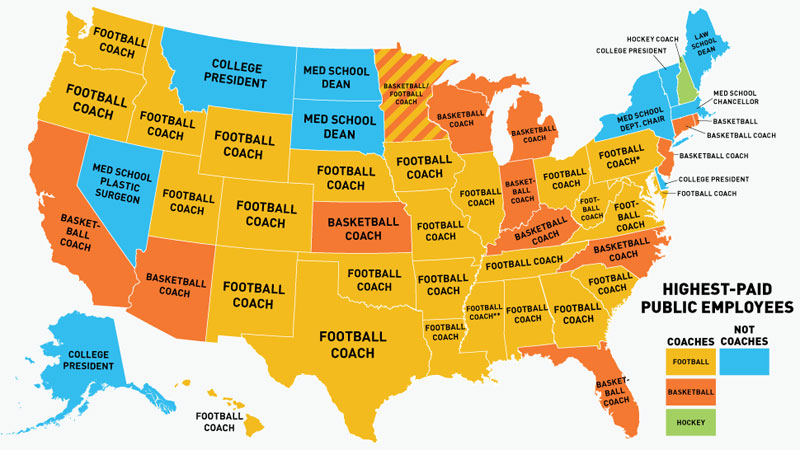
U.S. Map of the Highest Paid Public Employees by State
After all, with sports the wins and losses are there for every one to see. Not as easy with other state employees.


World Map Tattoo With Countries Visited Colored

My only question on this one...Is there a crack in middle of the ice cap on Antarctica?

Thursday, August 15, 2013

There Is A Better Way To Defund Obamacare

There is a lot of debate on how the Republicans should try to limit the damage of Obamacare to our country and the economy as the critical date of January 1, 2014 looms.  This is the date that most of the key provisions take effect (unless President Obama unilaterally finds more provisions to simply ignore).

There is a large contingent of Republicans that want to defund Obamacare in the coming budget battle and debt ceiling debate that must be addressed in September.  Their thinking is that they will pass a budget and debt ceiling increase that will keep the government running but exclude funding for Obamacare in the process.  Therefore, if President Obama wants to avoid a government shutdown, he will need to sacrifice Obamacare in the bargain.  They also believe that he will take the blame for the shutdown with the voting public if it comes to that because it was his choice.  This school of thought is driven by principles.

While I also want Obamacare repealed and I understand where they are coming from, I think this strategy is risky.  There is a better than even chance that the Republicans, not President Obama, would be blamed for a government shutdown.  The President still has the media in his pocket and that is a powerful advantage to begin with.  Unfortunately, that is the current political reality we have been living the last five years.

In addition, I believe that the attempt to defund Obamacare in this way is going to look to many voters as simply sour grapes at this point.  There have been numerous votes for repeal that have failed.  The Supreme Court ruled (no matter the circumstances) that the basic thrust of the law was constitutional.  President Obama won re-election despite the unpopularity of the law in individual polls.  These all work against the defunding strategy.  This is the public relations challenge.

I am of the opinion that there is a good chance that Obamacare will fall and fail under its own weight.  The Republicans don't have to kill it.  It may well die on its own as the public further questions the law and the fundamental flaws that plague the statute become more and more apparent.

The Obama administration fully understands this and that is why they are unilaterally delaying and waiving parts of the law that they have no authority to do.  They know they are taking legal and political risks in ignoring the law.  However, they understand that the far bigger risk is that Obamacare is at very real risk of losing all credibility with the public if they move forward right now with these serious flaws.  This would either drag down the entire Democratic party or (more likely) you would start to see substantial defections from the ranks of Democrats in defending the law. This could lead to a repeal vote that would get substantial bi-partisan support that could prove devastating to the legacy of Barack Obama.

Due to the fact that I think Obamacare is very weak in the first place, I see no need for the Republicans to risk a frontal assault on the law that has little chance of succeeding anyway.  They would be better served in staking out the high ground in the budget debate by using an  approach that would be viewed as more reasonable, less extreme and tougher for Obama and the Democrats to defend against with the voting public.  This approach would use the budget numbers that the Democrats used to pass the law asa weapon against them in the budget debate.

What am I talking about?

Remember when Obamacare was passed we heard how they were going to do all these miraculous things in health care and it was going to cost us very little?  In fact, the CBO estimated on March 20, 2010 that the law would actually reduce the budget deficit by $143 billion in the 2010-2019 period when taking account of changes in Medicare spending and revenues.

Anyone that understood the numbers knew it was all smoke and mirrors but the official CBO estimate was that the law was going to cost $898 billion over 10 years for Medicaid expansion and subsidies in the exchanges.

The reality today is far different.  The most recent CBO estimate is that the law is going to increase spending in these areas by $1.6 trillion over the next 10 years.

This chart from Heritage.org shows how the 10-year cost estimates have changed.


Let's look specifically at the 2014 fiscal year.  In CBO's 2010 budget projection of the bill, Obamacare was actually projected to reduce the budget deficit by $51 billion in 2014.  I kid you not!

The CBO provided an estimate to House Speaker John Boehner in July, 2012 on the budget impact of H.R. 6079, the Repeal of Obamacare Act. In that estimate the CBO estimated that repeal of Obamcare would increase the deficit by $24 billion in 2014.  Based on these CBO numbers, at a minimum, Obamacare is projected to put us $27 billion worse off today compared to the original projections.

This provides an opportunity for the Republicans to exploit in the coming budget discussions.

My thinking is that the Republicans should not go for the jugular here and cut all funding to Obamacare.  Obamacare is already in life support.  It merely needs to be deprived of a little oxygen in order to hasten its death. Their demand should be merely that the funding in 2014 should be no greater than in the original projections when the law was passed.  Accordingly, Obamacare would be funded to the full extent of the original projections but not a penny more. This would cut $27 billion out of this year's number for subsidies, Medicaid outlays etc.

The Republicans would merely be asking that Obamacare live within the original cost projections.  What could be more reasonable that that?  If Obama did not want to live within the original budget he would be the budget buster.  If he refused, he would be the one that was being unreasonable for not living within the original budget.  This is a much stronger position for the Republicans to play their hand in the upcoming Obamcare/Budget debate.

Lest you think that $27 billion is a trivial number, consider the fact that the February, 2013 CBO report on the budget effects of Obamacare estimated that the total cost of all of the exchange subsidies would cost $28 billion in 2014.  In effect, this strategy could deprive Obamacare of all of money needed to fund the subsidies for the exchanges.

There is a better way to undo Obamacare.  I think this may be a strategy that could appeal across all of dimensions that are in play-principles, politics and public relations.

We can only hope that someone, somewhere in Washington is paying attention to the game they are playing.  It is time to play chess, not checkers when it comes to Obamacare.


Monday, August 12, 2013

What Are We Thinking?

As I review the news it is often hard to not ask, "What are we thinking?"

A few examples.

Fort Hood Murders

Major Nidal Hasan is on trial for killing 13 unarmed soldiers and wounding another 30 others at Fort Hood, Texas in November, 2009.  Despite the fact that Hasan shouted "Allahu Akbar" as he opened fire and there was evidence he held extreme Islamic views, the Defense Department classified the case as one of "workplace violence".


In his opening statement Hasan, acting as his own counsel. stated, "The evidence will clearly show that I am the shooter."

It has also taken almost four years to bring Hasan to trial during which time he has continued to draw full military pay.

What are we thinking?

Afghanistan Contracts

A second example is the report that the Pentagon is moving forward with a $772 million purchase of aircraft for the Afghanistan army.

Of course, there are two simple problems with this.

First, the Special Inspector General of the Afghan reconstruction warned in a recent audit that the Afghans do not have the personnel or expertise to operate or maintain the aircraft.

Second, $554 million of the aircraft purchases are for a contract for 30 Mi-17 Russian helicopters!

Credit: World Tribune.com


If this was not bizarre enough, the same Inspector General reported that the U.S. Army had refused to bar 43 individuals or companies in Afghanistan from getting U.S. contracts despite information that they supported the Taliban.  The Inspector General concluded in his report, "In other words, they may be enemies of the United States, but that is not enough to keep them from getting government contracts."

What are we thinking?

Obamacare

Finally, Obamacare's main objective was to reduce the number of uninsured Americans without health care insurance.  But 59% of the uninsured are under the age of 35.  This is also the adult age group that is the least costly to insure.

However, the structure of Obamacare actually will increase the cost of healthcare for this age group in order to subsidize the cost of those older and that have expensive pre-existing conditions.  That is because the law dictates that the old cannot be charged more than 3 times the annual premium for coverage than is charged to the young.  The problem with this is that actuaries will tell you that the normal cost factor is about double this (someone in their 60's will average 5 or 6 times the cost of someone in their 20's).

The result is that Obamacare greatly increases the cost of healthcare insurance coverage for exactly the group that is most likely to be uninsured.

This chart from Forbes projects that younger individuals will see increased premiums in 45 of the 50 states.


That is why you have seen reports of premium increases from Washington state (+34%-80%), to Ohio (+88%) to Georgia (85% to 198% for a 25-year old man).  You can expect more of the same from many more states.

Obamacare supporters argue that these premium increases will be offset by government provided subsidies to reduce the actual cost of coverage to the individual. However, as I pointed out in my post, "Obamacare Is Still Dangerous For Democrats", the subsidies are not as large as many might expect.

For example, under Obamacare, a 27-year female who makes $35,000 per year is required to purchase health insurance coverage that is estimated to cost $3,391 per year. She would be eligible for a government subsidy of just $66. She would also be responsible for up to $4,167 in additional out-of-pocket costs for the year.

Does anyone really think that this young lady is going to buy health care insurance at this cost considering the penalty tax for failing to do so (if they can collect it) would be just $350?

We passed a 2,700 page bill that has resulted in 20,000 pages of regulations to end up with this?

What are we thinking?

Sunday, August 4, 2013

Three Interesting Charts From Last Week

BeeLine's antennae are always up looking for interesting charts that convey interesting information.

Here are three that I landed on as I was scanning the data landscape over the last week.

This knowledge, that is as sweet and delicious as any nectar, is delivered to you free of charge compliments of BeeLine.

If you don't fully understand how much Ben Bernanke and the Federal Reserve have been meddling in the economy look at this chart prepared by Zero Hedge.  This chart also shows the projected tapering the Fed suggested they might undertake beginning in 2014-2015.  Keep in mind that when Bernanke hinted that this might occur several weeks back it promptly sent the markets into a panic.

This is cause for a little concern, wouldn't you say?  It is if we have built a glass house, on a mound of sand sitting atop the San Andreas Fault.


I am always worried about a young child running out into the street chasing a ball without looking.  This Wall Street Journal chart indicates I have it all wrong.  I need to be looking out for the youngster's grandfather.

Persons over the age of 70 are 7 times more likely to be a pedestrian fatality than a child under the age of 13!  The good news is how far pedestrian deaths have fallen over the last 35 years.  It should be pointed out men are almost 3 times as likely to be a pedestrian fatality.  That is why I am more concerned about grandpa than grandma.


Finally, consider that singe-mother families make up over half of all households in poverty.  In fact, 58% of the children in single-mother households live in poverty according to this chart from FamilyFacts.org.

Reducing out of wedlock births should be one of the highest priority public policy issues in the country.  And yet no one really seems to talk about it.

I think it is especially ironic that there is so much energy being devoted to enabling gay marriage when we pay so little attention to getting heterosexual people married before having a child.


Thursday, August 1, 2013

Mothers, Young Muslims and Old Movies

In my last post I provided an overview of Jonathan Last's book, "What To Expect When No One's Expecting", which looks at the challenging consequences to society of declining birth rates.

This book is not only a page turner but you will also end up highlighting a good portion of the book for later reference with its endless string of information and insights.  I know did.

Here are a few from both categories that I thought worthy of highlighting as I read the book.


  • In 1965, when the average woman had three children and was a stay-at-home mother, she spent 10.6 hours per week on the kids. The average mother worked 6 hours per week. The average married father dedicated 2.6 hours per week to the brood. 

  • Today, even with 60% of mothers working outside the home (an overall average of 23.6 hours per week), they are putting in an average of 12.6 hours per week with the kids and fathers have cranked it up to 6.5 hours per week.  No wonder parents are so stressed and frazzled today.  There are still only 24 hours in a day!
1960's Mother


2013 Mother
Photo Credit: webmd.com


  • American women say that 2.5 children, on average, is the ideal family size but 20.4% end their childbearing years with no children, 16.9% have just one and 34.4% end up with two.  

  • Declining birth rates do not immediately translate to lower population.  You don't see the effects of population declines until the last above-replacement generation dies.  In the case of the United States, that is the Baby Boom generation.  Some European countries are already there.

  • The average age of first marriage for women increased from 20.3 years in 1950 to 26.0 in 2007.

  • At age 24, a woman's chance of being infertile is 3%.  At age 34 it is 8%.  By age 35, half of women trying to get pregnant over an 8 month period will not be successful.  By age 39, a women has a 15% chance of not being able to conceive at all.  At age 43, her chances of getting pregnant are near zero.  Delaying childbearing is a direct challenge to human biology.

  • In 1960, only 5% of all births were out of wedlock. In 1980 it was 18%.  In 2008 it was 41%!


  • Since Roe v. Wade was decided in 1973, 49.5 million babies have been aborted in the U.S.

  • In 1976, 20% of women had five or more children and another 16% had four children.  Today, only 1.8% of mothers have five or more children.

  • During the Depression through World War II, housing starts averaged less than 100,000 per year.  There were more housing starts in 2005 (2.1 million) than during that entire 16 year period between 1929 and 1945.  We have averaged about 700,000 housing starts per year since 2008 in "The Great Recession".


  • As the number of children born to a couple decrease, "the little dears become more dear".  Societies with low birth rates are very reluctant to endorse wars that their leaders might want to wage because of this.

  • 23% of German men say that zero is the ideal family size.

  • 80% of civil conflicts occur in countries where more than 60% or the population is under age 30. (most of the Middle East right now).  For example, nearly 2/3 of Egyptians are under the age of 30.  24% of Iran's population is under age 14.  42% of those living in the Gaza Strip and 35% of Syria's population are under age 15.  Other countries % of those under age 15.  Egypt 32%, Israel 28%, US 20%, China 16%, Russia 15%, Japan 13%, Germany 13%.
Credit: Ed Giles/Getty Images


  • Europe as we have known it for the last 15 centuries is on a path to fade away over the next 50 years to what will most likely be a Muslim dominated region.

  • Since 1970 vehicle land miles driven by Americans have increased by 150% but we have only added 5% to our highway capacity.  Now you know why you are stuck in traffic on the way home from work to pick up your child at daycare!

  • One of the major obstacles to more births are the high costs of raising children and high taxes on working families, particularly FICA taxes.  If you think about it, each parent of a child is bearing the cost of developing a future taxpayer.  It is essentially an investment that the whole country will benefit from in the future. People without children do not bear that cost.  However, both will draw the same Social Security and Medicare benefits when they are older.  Those benefits must be paid by those children's future taxes.  That is the way the system was designed. If taxes are not paid by the next generation, no Social Security benefits are going to be there for anybody. 
One researcher has suggested that parents receive a "Parental Dividend" to offset FICA taxes and reduce the current disincentive to have children.  For example, reduce FICA taxes by one-third for the first child, two-thirds for two and in full for three until they turn 18.  I like that idea even though I have already fully paid all the bills for three current and future contributing taxpayers. 

How about a dividend on the dividend for new parents? 

Credit: Wikipedia

Tuesday, July 30, 2013

What To Expect When No One's Expecting

I like interesting information.  I like intriguing insights.  I like considering whether demographics really foretells our destiny.


Therefore, it was certain I was going to really like reading "What To Expect When No One's Expecting" by Jonathan Last.  Starting first and foremost with the title of the book. I think that's one of the better book titles in a long time. Last delivers on all counts in this book that is subtitled "America's Coming Demographic Disaster". However, in reading the book, lower birth rates are not so much America's problem as a challenge for the entire world.

The fact is that birth rates are falling globally. And below replacement (2.1 births per woman in the aggregate) birth rates (and the resulting smaller population that eventually follows it) have always brought about gloom, that eventually became doom, for every society that breached that important reproductive threshold over time.

To put this in perspective, there is not one country in the developed world that has a fertility rate exceeding 2.1 right now. In fact, only 3 percent of the world's population lives in a country that the birth rate is not declining. Some of the undeveloped world still has high fertility rates but they are dropping rapidly. And history has shown that once the fertility rate drops it is hard to get it going the other way.

Here is a sampling of the total fertility rates in major countries around the world as referenced in the book.


Let's take a look at a few of the factoids that are highlighted in the book that I found particularly informative and interesting.

  • At Poland's current fertility rate of 1.32, the number of Poles will drop from 38 million today to 16.4 million in 2100. The 0-14 age group in Poland is 40% smaller than the cohort today in their prime reproductive years.  For Poland to maintain a stable population, it needs all the little girls in Poland under age 14 today to have four babies each during their lifetimes and to continue that bias for babies for the next generation as well.
  • Germany is already shedding 100,000 in people every year due to its 1.36 fertility rate. In Russia, it is even worse.  Russia had 149.6 million people in 1995.  Today it only has 138 million.
  • To show how fast the birth rates is falling in Russia, consider that in the last 16 years of the Soviet Union there were 36 million births.  In the 16 years since the fall of the Soviet Union, births in Russia have only totaled 22.3 million births.  One factor in this drop off is the fact that today there are 30% more abortions than births in Russia.
  • In 1960, Venice, Italy had a population of 145,000.  By 2009, it has dropped to only 60,000.  On an average day, Venice has 60,000 visitors.  Therefore, if you visit Venice one out of every two people are tourists. 
  • If current fertility rates persist in Europe, the total population will go from 738 million to 452 million by the end of the century.  
  • In Japan there are more adult diapers sold now than there are baby diapers.
  • By 2040, it is projected that there will be one Japanese citizen over the age of 100 for every birth.
  • Due to sex-selective abortions and China's one-child policy, there are 123 boys born for every 100 girls in China.
  • By 2050, at current demographic trends, China's population will be falling by 20 million people every 5 years.
  • The overall U.S. fertility of 1.93 can be misleading.  There are vast differences when you slice and dice the numbers. The Hispanic fertility rate of the population was 2.35.  Whites are at 1.79 and Blacks at 1.96. Utah was at 2.60 (the highest state), Vermont was at 1.67 (the lowest state). Women who have not graduated from high school have fertility rate of 2.45. Women with graduate degrees are at 1.60.  The high fertility rate of Hispanics (as well as immigration) is a big reason why over half of the population increase in the U.S. between the 2000 and 2010 census was attributable to the increase in Hispanics in the country.

Why are birth rates falling the world over?

Last concludes there is no single reason. It is the confluence of a number of factors some of which are interrelated.

  1. The increased use of contraceptives (in particular the birth control pill).
  2. Abortion
  3. Increased education by women
  4. Later marriages
  5. Higher divorce rates
  6. Increased urbanization
  7. High land costs
  8. High education costs, particularly for college
  9. Increase in secularism and the decrease in religious influences
  10. Car seats, Social Security taxes and other factors that you never thought would mean fewer births
Why should we be concerned?

Economies need people.  They need them to invent things, build things and to buy things.  They need them to invest and innovate.  They need them to start new businesses.  They need them to pay taxes.  If you don't have a supply of new people replacing older people in a society you begin to shrink and you eventually shrivel away.  

When the old outnumber the young you are heading for big problems.  Who buys the real estate that has been built?  Does a 60-year want to start a business?  Most inventions and innovations have historically come from those in their 20's and 30's than in their 50's and 60's.  Thomas Edison invented the phonograph at age 30.  Alexander Graham Bell was 29 when he invented the telephone.  Steve Wozniak invented the Apple I computer at age 26. Larry Page and Sergey Brin were both age 25 when they incorporated Google.  If you don't replenish with enough young blood, you really do die as an economy and and as a society.

You get the picture?  

In the United States, if we stay on the current path, 1 out of every 5 Americans will be over age 65.  The population of these senior citizens will outnumber the population of age 14 and under by 13 million in the United States by 2050. It will be as if the whole country is very similar to the age structure in Florida today.

Do you get the picture?

Get Ready. Coming soon to a team near you!

Audition for the Miami Heat's Golden Oldies Hip-Hop Dance Team
Credit: NBA.com

There is so much great information and insights in "What To Expect When No One's Expecting" that I will have a follow-up post on the book in the near future.  Stay tuned and encourage someone to have a baby!