Thursday, August 23, 2018

The Bartender and the Bus Driver


One of the great mysteries of my life is how there can still be people promoting socialist political ideology. It is something that I have heard for nearly seven decades.

You would think the evidence of those last seven decades would have disheartened even the most passionate devotee that believes that socialism benefits humanity.

Let's look at a few examples.

I am using some of the extreme examples of communism compared to capitalism. American socialists today argue that communism is not their ultimate goal. They do not desire to take over all private property and production. They just want to take what is needed to be "fair" to everyone. Of course, Marxist theory (see above) makes clear that socialism is considered just a transitional state toward the realization of communism.

Of course, there is never enough to go around. Therefore, this inevitably requires more and more control by the government of the private sector. Look no further than what has happened in Venezuela.

Korea was cut into two halves after the Korean War. The North adopted socialist political and economic theory. The South was committed to capitalism and freedom.

Same people. Same cultural background. Very different results.

There is no better way to view the stark difference than this satellite image taken by NASA in 2014. That dark area between South Korea and China is North Korea at night.


PHOTOGRAPH BY EARTH SCIENCE & REMOTE SENSING UNITY, NASA JOHNSON SPACE CENTER
The difference? Communism vs. Capitalism.

Looking at it in graphic terms comparing Gross Domestic Product it looks like this.

Credit: Edward C. Prescott, Barcelona Graduate School of Economics

A similar situation occurred in West Germany and East Germany when Germany was divided after World War II. Same people. Same culture. The West and East both had GDP per capita numbers that were identical in 1949. By 1990 (at the time of reunification), the capitalist West had GDP per capita that was almost double that of the East.

The difference? Communism vs. Capitalism.

It is no different between Communist China and Taiwan (The Republic of China).


China has made enormous strides since it moved away from its "planned socialist economic" system and moved to what it now calls its "socialist market economic" system that introduced privatization and contacting out much of state-owned industry in the late 1980's and early 1990's. Is it a coincidence that China's economy took off right after they moved from a strict communist system to a more open, market based system?

There is no better way to show this than in this chart of averages wages in China which have exploded upwards since those market reforms were instituted.


Another way to look at it is to consider the fact that in 1990 756 million Chinese lived in extreme poverty. By 2013 that number was 25 million.

By the way, Taiwan has 23 million people in a country of 13,973 square miles. China has a population of 1.3 billion with 3,705,407 square miles. Despite all the advantages of geographic size, natural resources and the population that China has, Taiwan's GDP per capita is 3 times larger today even after China's huge step forward with its economic reforms over the last 30 years. That is a lot of additional wealth. That is the difference between capitalism and communism.

Of course, we do not have to look any further than Venezuela to see what socialism has done to what was once the most prosperous country in South America in the space of less than two decades.

Bear in mind that all of this is occurring in a country that is reputed to have the largest oil reserves in the world. Despite that, food is so scarce that last year the average citizen is reported to have lost 19 pounds. Millions have fled the country's shortages and poverty.

Last week Venezuela President Nicolas Maduro announced a new single exchange rate for a new Venezuelan currency that would effectively devalue the currency by 96 percent.

In one of the biggest economic overhauls of Maduro's five-year government, the former bus driver and union leader also said he would hike the minimum wage by over 3,000 percent, boost the corporate tax rate, and increase highly-subsidized gas prices in coming weeks.
"I want the country to recover and I have the formula. Trust me," Maduro said in a nighttime speech broadcast on state television.

Of course, that 3,000% increase in the minimum wage will not help those workers very much. Economists predict that the inflation rate in Venezuela this year will hit 1,000,000%!

Maduro has the formula and he wants those that are left in Venezuela to trust him?

It sounds a lot like new Democrat darling Alexandra Ocasio-Cortez doesn't it?  She also says she has the formula and to trust her.

Did you know that Maduro was a bus driver before he got into politics?

Did you know that Ocasio-Cortez was a bartender?

Socialism and communism inevitably results in a lower standard of living and hardships for the masses. It has been documented time and again throughout history.

The irony is that it is always sold as being a better system for the masses. It is promoted as "the way" to remove class distinctions, unfairness and insure equitable wealth distribution in a society.

You have to remember that the economic system of governance makes little difference to the leaders of countries.

After all, they lead a life of privilege no matter what economic system is in place. That is even truer in communist or socialist countries because the political leaders become the aristocracy. Everyone is beholden to the government.

That is why we keep hearing about the ideal of socialism. It is because there will always be a bartender, bus driver, baker or barrister who figures out that their career prospects are better as a politician selling this baloney. Why work and pay taxes when you can get on a podium, promise people the world, take other people's money and spread it around as you see fit? And keep a pretty nice share for yourself.

That is pretty much the history of socialism and communism.

That is also why, even though history is replete with the failures of socialism, we will continue to have bartenders and bus drivers who say "trust me, I have the formula."

There will also be new generations who are ignorant of history and actually believe these people have a formula that actually works.

Trust me.

It never has and it never will as long as humans inhabit the earth.

Tuesday, August 21, 2018

Where Does It Go From Here?

Where does it go from here?

That is the question in the wake of the conviction of Paul Manafort on eight counts of tax evasion and bank fraud and the guilty plea of former Trump personal attorney Michael Cohen to a federal election campaign contribution violation

Liberal Democrats seem to be giddy in thinking that this will be the end of Trump.

Are they right? Let's consider the possibilities.

Manafort

The Democrats like to make much of the fact that Manfort for a time was Trump's campaign chairman. However, he only had that role for a relatively short period of time---5 months in total (3 months as Chairman) in a campaign that consumed over 18 months. In the overall scheme of the election of Trump, Manafort had a very insignificant impact. He joined the campaign after Trump had wrapped up the primary elections and he was gone by the time the general election began in earnest.

The one lasting impact that Manafort had was influencing Trump to select Mike Pence as his running mate. (more on that later).

The fact is that Manafort was convicted of crimes that had absolutely nothing to do with Trump. 5 counts of filing false tax returns (2011, 2012, 2013, 2014, 2015), 2 counts related to bank fraud by lying on loan applications, and a final count of maintaining a foreign bank account without reporting it to the IRS.

The entire prosecution of Manafort appears to have been motivated in order to squeeze him by getting him to give up something on Trump. Why else were these charges brought by Special Counsel Mueller now? What was the IRS doing for all those years if Manafort was committing tax fraud that was so obvious in 2011, 2012 etc.

Manafort's conviction did not surprise me. I wrote about the charges against Manafort right after he was indicted last November. Nothing he did with his work with foreign interests looked good.

Then again, as I wrote  at that time, nothing looks good about how Bill and Hillary Clinton and Clinton Foundation operated with foreign interests either. However, Manafort is paying a price (apparently targeted for no other reason than he worked for Trump) and Bill and Hillary are still fancy free.

Cohen

The Michael Cohen case looks more dangerous for the President. He admitted that he paid off two women who threatened to expose a sexual relationship with Trump at the direction of Trump in order to "influence the election." The charge against Cohen is that this was a federal election campaign violation.

Although it is not getting much attention, Cohen also pled guilty to five counts of filing false tax returns (2012, 2013, 2014, 2015, 2016) and one count of bank fraud. Do you see a pattern here?

It will be interesting to see how this plays out. Paying someone off is not generally a crime. However, attempting to blackmail someone is. The irony is that the women who attempted to commit the crime of blackmail have gotten no legal scrutiny while Cohen has been prosecuted.

The government's case seems to hinge on the words "influence the election". If Cohen had made these payments in order to protect Trump's reputation there would apparently be nothing here. However, the government is arguing that the payments were made in order to "influence the election" of Trump. By getting Cohen to plead guilty to this charge, and getting Cohen to say he was acting at the direction of Trump, they are attempting to color Trump with the charge as well.

It is interesting that the only "crime" here seems to be that this expenditure was made through a corporate entity and was above legal limits.  It was also was not done with campaign funds. The government is arguing that it was an "in kind" contribution. They have decided it was a campaign contribution. This seems awfully flimsy to me especially when you consider that most campaign finance violations only result in civil penalties involving a fine.

You should consider the fact that had these payments been made with actual campaign money I have no doubt that this would have been considered the payment of a personal expenditure. However, the government has constructed that payment. How do you win when they can skewer you either way?

Make no mistake, the Cohen prosecution and any deal with prosecutors is also being done solely to get him to turn on Trump. Given Cohen's long association with Trump, the President clearly has more risk with Cohen than he does with Manafort. However, I doubt anything he has on Trump is related to Russian collusion in the election.

This is all to say that everything about the Mueller investigation seems to be building a political movement to remove Trump. Most legal scholars question whether the President can even be indicted when he is in office. The exclusive means to remove a President is through the impeachment process.

When Mueller issues a final report (if he ever does) that implicates Trump in some way, it will be to argue for impeachment rather than indictment.

Parallels With Clinton

We have been down this road before. Bill Clinton also liked the ladies. That was known before his election. He perjured himself while in office attempting to cover up his affair with Monica Lewinsky.

The Republicans, who had a majority in the House, impeached Clinton for "high crimes and misdemeanors". Democrats shrugged their shoulders and said "it was just about sex". They said that it was understandable he would lie.

The American people agreed. The economy was good and nobody wanted to rock the boat.

It is not much different today.

The people who voted Trump into office knew that they were not electing a Boy Scout. If they wanted that, Mitt Romney would be in the second term of his Presidency.

If this is all that there is, this will not go very far. If anything, Trump's actions fall far short of Clinton's. All of this happened before Trump was even elected. The alleged affairs with the women were ten years ago. Clinton was actually doing IT in the Oval Office with an intern.

If there is more here then it will depend on the American people. As I have written before, that is where all the power comes from in this country. Clinton did not lose the people in 1998-1999. Trump will be fine unless he loses the support of the people. If that happens, the politicians will feel free to do whatever they please. And most, on both sides, would be pleased to do what they pleased with Trump.

Of course, you have to ask if that happened, do the Democrats really want a President Mike Pence?

I have always thought that one of the great ironies of the Clinton impeachment saga was that if Clinton had been impeached, Al Gore would have become President in 1999. Gore would have run in the 2000 election as a sitting President against George W. Bush. Can you tell me that Gore would not have won the additional 538 votes in Florida that he needed due to that fact?

In hindsight, the best long game for Democrats would have been for Clinton to be removed and Gore to become President.

The GOP was so blinded by Clinton that they took on an impossible impeachment proceeding. The Democrats were so blinded in protecting Clinton that they lost sight of the bigger prize.

Similarly, are the Democrats so blinded in their hatred of Trump today that are they missing the bigger picture?

Mike Pence

Mike Pence has been a consistent conservative his whole life. He doesn't say outrageous things. He doesn't burn up Twitter. He doesn't even go to lunch alone with a member of the opposite sex. There is not much to believe that a Pence agenda would be much different than Trump's. It would just be delivered with far less bombast.

If Pence took office after next January 20, he can serve out the rest of the Trump term and he is eligible for two more terms of office. You can potentially appoint a lot of federal judges and Supreme Court justices over ten years.

All that being said, the Democrats still would prefer to be rid of Trump. They fear his charisma and his fearlessness. They fear his energy and ability to energize a crowd. They fear his ability to attract the votes of Democrats and minorities. That is why I think they are willing to take their chances with Pence.

Where does it go from here?

I have no idea. To this point, I see nothing that causes me any concerns about Trump. There is nothing new here from my perspective.

However, I like the prospects for the future however the cards may fall.

Monday, August 20, 2018

What is the Truth?

Rudy Giuliani made headlines this weekend by stating "that truth is not always the truth."

Rudy has been backpedaling almost as fast as Governor Andrew Cuomo did last week when he said that "America was never that great."

I think what Rudy was trying to say was that "truth" is often perceived in the eyes of the beholder. Look no further than all of the "he said, she said" cases. There is undoubtedly a real truth in these cases. However, our perceptions create our individual reality.

If you don't believe that reality about truth, take a look at this chart that I saw recently in The Daily Shot via Bruce Mehlman.


Could there be that much difference in the perception of current economic conditions?

If you are a Republican things look very good to you. Everything has been on an upward path since President Trump was elected.

If you are an Independent things look pretty good to you. The Trump election boosted confidence immediately and things have been pretty steady since.

If you are a Democrat you seem to think a recession started when Trump was elected and it has turned into a full-fledged depression in the last couple of months.

What is the truth?

GDP was up 4.1% last quarter.

The unemployment rate is 3.9% with record low unemployment for Blacks, Hispanics, Youths and High School Drop-outs.

Small business optimism is near record highs.

The stock market (DJIA) is up almost 40% since Trump was elected.

These all support the truth that Republicans see.

On the other hand, these are also truths that the Democrats could point to.

Income inequality is rising.

Personal (especially student debt) and government debt is reaching unsustainable levels.

Trade tensions are increasing with our largest trading partners.

The length of the bull market in stocks is now a record.

Donald Trump is President and the more success he has the more depressed the Democrats get.

There is a lot of truth out there. The question is how is it perceived through our political lens?

Speaking about truth, how about this? This is the headline from Small Business Trends reporting on a recent survey of 2,600 small business owner and entrepreneur conducted by Guidant Financial.


Wow! African American Small Business Ownership Up 400% in a Year, Survey Reveals


If this is true, there could be no bigger endorsement of the Trump economy that I have seen. That is an astounding finding. It should be shouted from every rooftop in America.

However, I have my doubts about the data. It simply does not seem realistic that there could be a 400% increase in that number in the space of one year.

I tried to get to the survey source material to see if I could better understand the data. However, the best I could do was get this press release that Guidant Financial put out on the survey which it has conducted for a number of years.

I am not saying that this is "Fake News" or Guidant is intentionally putting out false data. The numbers just don't seem to pass the common sense test. I question the methodology of the survey and/or the base period numbers they are using as comparisons.

Guidant goes on to state that 45% of all small businesses in the United States are now owned by minorities. They state that number was only 15% in 2015. Minority-owned businesses have tripled in three years? Again, this does not seem realistic no matter how you look at it.

According to the survey, the ownership of small businesses today in the United States is 55% white, 19% Black, 14% Hispanic, 8% Asian and 4% Native Americans.

If we are to believe the Guidant survey, Black-owned businesses went from 3.8% to 19% in one year! To put that in perspective, African Americans make up about 13% of the population.

Perhaps this is the reason that Trump support with African Americans has gone from 8% in November, 2016 to 36% approval last week.

If this is true, it should also raise questions as to why the Democrats want to keep pushing a socialist agenda.

This survey seem to indicate that all the new entrepreneurs are minorities. They are the very definition of what capitalism is all about.

You also have to ask if that many minorities are starting small businesses how could they be Democrats? Just look at the perception of economic conditions in the chart above. If you were a Democrat today, why would you even think about starting a small business if you had that pessimistic outlook?

What is truth?

Sometimes it is very hard to tell.

As Rudy Giuliani stated, "truth is not always the truth." It just depends on how you look at it.

Thursday, August 16, 2018

Things I Learned This Week

I love learning new things.

I especially enjoy learning things that are unexpected or that show that the conventional narrative, wisdom or message that we hear may not be altogether true.

Here are a few things I learned this week.

We have been hearing that smoking is bad for you for 50 years. It appears that the message is getting through.


On a per capita number the decline is much, much larger considering the population increase since 1981.


We keep hearing about all of the plastic that is floating around in a massive island in the Pacific Ocean. As a result, cities like San Francisco have now outlawed plastic straws in order to save the environment.


It makes me wonder if fishing nets will be the next target for San Francisco. What's next? Is Fisherman's Wharf safe?

We also hear a lot about the increasing education divide in the country. Technology is supposedly making it hard for even high school grads to find jobs. You need to go to college or you are doomed to poverty.

How do you explain this?


Trump's critics call his voters uneducated deplorables. Looking at these record low unemployment numbers these voters must have really been voting in their best interest.

We also heard that Trump was going to wreck the environment and was completely irresponsible by having the United States exit the Paris Accords on Climate Change. That is why I thought these facts were interesting.


  • U.S. carbon emissions fell 0.5% per capita in 2017 to the lowest CO2 emissions per person in 67 years. Europe emissions rose 2.6%, the EU 1.5%, China rose 1.6%. The total world increase was 1.6%.


Trump is criticized for questioning the Paris Accords but USA carbon emissions are down while everyone else is up?

We also hear about how unpopular President Trump is. However, compare Trump's approval ratings with those of the leaders of France, UK and Germany.


  • Trump: 50%
  • Macron: 36%
  • May: 30%
  • Merkel: 29%

Finally, what to make of the improving trend in Trump's approval ratings with African Americans?

Election Day, 2016                 8%
Last year on this date           19%
Last week                               29%
Monday of this week             31%
Wednesday of this week        36%

The highest % vote for a GOP Presidential candidate in recent history was 12% in 1996.

Keep in mind that all of the allegations of Omarosa claiming that Trump is a racist starting coming out at the end of last week. The mainstream media has been running these stories virtually non-stop.

However, Trump's approval rating is up 7% in one week with African Americans?

Could there be anything more terrifying to Democrats right now than these numbers?

What do all these things mean?

First, there is a lot that you don't hear reported in the mainstream media.

Second, it appears that more and more people are much, much wiser than they are given credit for by the media and the political pundits.

The things I learned this week were very interesting. I hope they were to you as well. Feel free to share them liberally with friends and family.

Tuesday, August 14, 2018

Polling Perspectives-August, 2018

I am a data guy.

If it is business, I want to dig into the numbers and the key ratios.

If it is sports, I want to see the stats.

If it is politics, I want to see the polling data.

I like political polling data in particular in order to provide context and meaning to the bigger political picture. In politics, perception is reality. It does not matter what "the truth" is. It only matters what the people's perception of the truth is.

That is why political consultants work so hard to shape the image and message of a candidate. It is also why the media's role in modern campaigns have become increasingly important through the years. What used to be print media now extends to broadcast, cable and social media.

Some argue that this extension and diffusion of the media is why there is so much political division today. Depending on the outlet, and their outlook, you might find many "truths".

That being said, let's see what the voters seem to thinking right now and I will follow with some observations on the data.


  • Trump approval at 50% in Rasmussen Daily Tracking Poll (8/14/18).
    • +4% higher than Obama at the same point in his Presidency.


This is absolutely remarkable when you consider the ongoing media onslaught on Trump by the mainstream media. How do you explain it?


This explains some of it. This also probably explains why there is such a concerted effort right now to brand Trump as a "racist". If the Democrats lose a third of the Black vote to Trump where do they go for votes? There are just not enough Antifa and Socialist voters to make up for the loss of these voters.


There was another interesting poll out today in Florida where Democrat Senator Bill Nelson is being challenged in the November election by current GOP Governor Rick Scott.


If the Democrat Nelson is only up three points with Florida Latinos over the GOP challenger Scott, he has to be in some real trouble in his re-election bid.

This leads to this poll result.
  • A Recent Gallup Poll of voters says that Immigration is the nation's "most important problem".


Look at the numbers since Trump first entered the Presidential race with immigration as one of his signature issues. Do you see a connection with this sentiment and his approval rating?  Does this better explain Trump's 50% approval rating despite unrelenting criticism by the media?


I thought the following was also interesting data although not technically a political poll. It is the Small Business Optimism Index. It just had its second highest score since this index has been measured. This is an index based on ten survey indicators conducted monthly by the National Federation of Independent Businesses.


Is it mere coincidence that the optimism index exploded upwards just after Trump was elected?

While we have all of the positive economic news, low unemployment, rising wages and fewer people on food stamps we also have seen Democrats increasingly disapprove of capitalism in comparison with socialism.


  • Gallup Poll shows that 57% of Democrats have a favorable view of Socialism. The comparable number for Republicans---16%.


I would suggest that this is a pretty big philosophical divide. It is also hard to explain considering the current economic environment. Where are these people getting their news?

Of course, that poll result has nothing on this one.

  • John Zogby Strategies reports that 42% of Democrats and 47% of Blacks are in favor of a state's right to secede from the United States! 39% of all voters surveyed agreed with the right of secession. No, this is not a poll from 1860. This is 2018!

What is ironic about this is that this is exactly why we fought the Civil War.  You might remember it. 620,000 Americans died fighting in this war. That is half of all the casualties that have perished in all of the wars in the nation's history.

I guess you could argue that this might not be surprising because Democrats held this view in 1860 as well.

However, how do you explain African Americans having this view?

Do we even teach American History in school any more?

I guess it is a good thing for all concerned that Abraham Lincoln and the Republicans did not agree that states had the right to secede from the union.

This the exact question asked on the survey

Which of the following is closer to your view?

Polls give us a window about what voters are thinking. They give us perspective. They just don't always allow us to always understand why people think the way they do.

This week's polls show that once again.


Sunday, August 12, 2018

Double Standard? You Decide.

The term "fake news" gets thrown around a lot these days but I believe the core issue underlying it is the double standard that seems to be in operation with the mainstream media.

There seems to be little doubt that the mainstream media uses a double standard in all that it does. It has one standard for Democrats, it had another one for Barack Obama and it has an altogether different standard for Republicans, and most particularly, Donald Trump.

We also see that double standard in the justice system as well. There was clearly one standard for Hillary Clinton. There has been a completely different standard for Donald Trump. There seems to have been no standard at all for Barack Obama. Obama even stated after he left the Presidency that he "didn't have any scandals."

It is true that he never had an independent counsel investigation to contend with. That is interesting itself when you consider some clear scandals such as "Fast and Furious", "Benghazi", "Hillary's Private Server" "The Use of the IRS to target conservative groups", "The Domestic Spying on Reporters like James Rosen and Sharyl Attkisson",  and the "Payment of $1.7 billion in cash to Iran (a terrorist state) with funds that by law were supposed to only be paid to terrorist victims".  A double standard? You decide.

I recently read a book that The Washington Post published shortly after Donald Trump secured the GOP nomination (but before he was elected) entitled "Trump Revealed".


There is little doubt that Trump has a very complicated personality. I have read most of Trump's books and I have also tried to read many of the other unauthorized biographies of Trump to get a better sense of the essence of who he is.

I was not expecting to get a flattering portrayal of Trump in this book in that this was authored by two Washington Post reporters. One of the reasons I read it was to get another perspective. However, I immediately saw something interesting on the first page of the book that showed how deep the double standard goes with The Washington Post.

"The Post assigned more than twenty reporters, two fact-checkers, and three editors to examine Trump's life. In about three months, they were to produce this book and more than thirty articles for the Post, with the goal of chronicling and understanding everything from Trump's family background through his childhood, career, and political evolution. We sent reporters to his ancestral homes in Germany and Scotland, to his childhood neighborhood in Queens, and his boarding school in upstate New York, to his college campuses in the Bronx and Philadelphia, and to his boarding ventures in Atlantic City, Panama, Russia, and Azerbaijan. We visited and spoke with Trump's relatives, classmates, friends, competitors, business partners, executives and employees, boosters, and critics."

Twenty reporters? Two fact-checkers? Three editors? Trips to Germany and Scotland?

That is well and good. That is what reporting is all about.

However, I was curious. Did they do anything similar with regard to candidate Barack Obama in 2008. Did they send out twenty reporters to check into everything about his life and background and write a book about him in the lead-up to the 2008 election? After all, little was known about Obama's background in 2008. There was undoubtedly much to learn. Compare that to the decades that Trump had been in the public eye.

If The Post did anything of that magnitude, I could not find any evidence of it on a Google search. The closest it seemed to get was assigning David Marannis to cover biographical details relating to Obama in its 2008 election coverage. Marannis later used this and other material to write a book about Obama (Barack Obama: The Story) that was published in 2012

In fact, the Post's own ombudsman, Deborah Howell, concluded that there had been "An Obama Tilt in Campaign Coverage" over the previous year in a report published the Sunday after the 2008 general election.

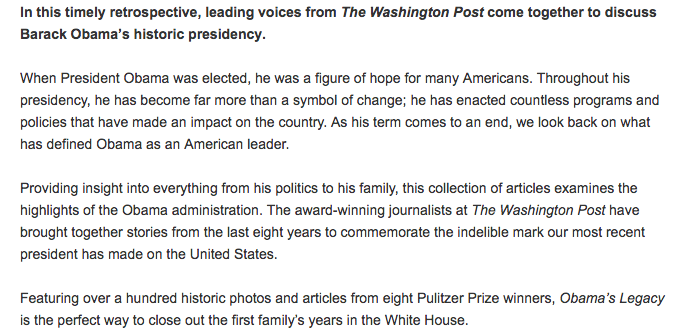
In my research I found that The Washington Post did publish a book about Obama. It may not have had the time to extensively research Barack Obama's background in 2008 but it did have time to write a puff piece on "Obama's Legacy" shortly before Trump was inaugurated.


This is how the book is described in the promotional material by the publisher.


Notice how Obama is portrayed by these Washington Post writers?

"Figure of hope."  "Symbol of change". "Countless programs and policies that have made an impact"
"the indelible mark".

Compare that to how the Trump book was described by the authors. (This is from the updated and revised book from after Trump was elected President that is now on sale),


Notice the words to describe Trump by these Washington Post reporters?

"A man certain of his views", "hugely confident in his abilities", "not terribly well informed", "quick to take offense".

Do we have fake news? I am not sure that fake news is as big a problem as is biased and slanted coverage of reporters with an agenda.

Do we have a double standard? Look at these two books from The Washington Post and you can decide.

Thursday, August 9, 2018

The SAT Meets PC

After World War II aptitude tests gained increased favor with both business and education due to their wide use in processing hundreds of thousands of military recruits into the right roles in the War effort. For example, my father was only a high school graduate at the beginning of World War II but he was assessed with high intelligence and trained as a cryptographer. He told me that he was one of the cryptographers who passed the top secret message to drop the atomic bomb.

Business used the tests after the War for hiring for management positions based on whether someone had the aptitude to succeed rather than simply focusing on a college degree. It was the same reason that the Armed Forces used aptitude tests. Quite simply, in those days only 1 in 10 went to college. If someone did not attend college it most likely had nothing to do with their ambition or intelligence. They simply did not have the financial resources to continue their education.

The use of standardized tests leveled the playing field. It did not matter if your father wasn't a bank president or you did not go to a boarding school. It only mattered if you had the smarts to succeed.

Interestingly, a Supreme Court case in 1971 (Griggs v. Duke Power Co.)  ruled that jobs-based aptitude tests were potentially discriminatory as they could cause "disparate impact" when used by employers to assess and predict the performance of workers for promotion and advancement. As a result, a college education became the "default" for determining who would get on the management track and college became the only ticket for future advancement. High school graduates were left out in the cold no matter what their abilities might be.

The use of the SAT and ACT tests began being used extensively in college admissions decisions for similar reasons after the War and their importance grew after the Griggs decision. Admissions into the Ivy's and other top schools that were historically based on family connections and the East Coast boarding school they attended became democratized through the use of standardized tests.

Using a standardized test that measured one's aptitude for college work leveled the playing field. It allowed schools to find overlooked talent who may not have had all the advantages of the prepsters on the East Coast. It did not matter if you hailed from Michigan, Montana or Mississippi and did have had the same access to a quality high school education that the affluent had. The SAT showed whether you had the ability to do the work. The SAT also allowed admissions officers to objectively compare a student from the Choate School with students from Chillicothe, Ohio and South Central LA.


You can therefore argue that standardized testing has been one of the biggest factors allowing deserving, overlooked people to be recognized and receive opportunities to get ahead in the military, business and education over the years. This led to millions being elevated in their class status in the United States.

In fact, it would be difficult to point to anything else that has had a bigger impact on improving class mobility and opportunity for deserving people over the last 75 years.

Therefore, I find it interesting that more and more colleges are dropping the SAT and/or ACT as part of their admissions process.

The University of Chicago announced last month that it was dropping the requirement. Chicago joins over 1,000 other colleges and universities that have eliminated the standardized test in their admission decisions.

What is interesting is that the argument for doing so is to "enhance diversity".

That seems particularly ironic in that standardized tests were introduced in order to "enhance diversity" in the first place. They were introduced to identify talent and aptitude without regard to anything else--family background, wealth, race, religion or gender.

We now have to get rid of these tests to do the same thing they were introduced to do?

Standardized tests are not just a big topic at the university level. They are also under attack in New York City where they are used for admission decisions for the city's top high schools.

The reason?

Too many Asians are scoring well and too many Blacks and Hispanics are scoring poorly.

52% of admission offers to New York City's elite high schools for 2018 went to Asians.

4% to Blacks.

6% to Latinos.

27% to Whites.


This is not fair according to New York City Mayor Bill DeBlasio because Blacks and Hispanics make up about 70% of the city's school population but they are only getting 10% of the spots in the elite high schools due to their standardized test scores.

On the other hand, Asians make up 13% of the school population but got 52% of the spots.

Accordingly, DeBlasio has won approval to get rid of the standardized test and allocate spots in the elite high schools so that Blacks and Hispanics get somewhere close to 50% of the admission offers.

All in the name of diversity.

Of course, if the NFL determined who made their rosters with similar thinking they would no longer consider 40-yard dash times or how much an athlete could bench press. They would also allocate a set number of roster positions to those that played in the Ivy, Patriot and Mountain West conferences and cut back those who played at Alabama, Ohio State or USC.

All in the name of diversity.

Of course, there remains the question as to whether putting individuals in positions where they are in over their heads is really in their best interest.

Well-regarded African American economist Dr. Thomas Sowell argues that affirmative action programs aimed at promoting diversity actually do more harm than good for minorities. After all, it easy to see that putting someone in an NFL game that is ill-equipped could hurt them. It is harder to see that in college or high school admission decisions.

Minority students admitted to institutions whose academic standards they do not meet are all too often needlessly turned into failures, even when they have the prerequisites for success in some other institution whose normal standards they do meet.
When black students who scored at the 90th percentile in math were admitted to M.I.T., where the other students scored at the 99th percentile, a significant number of black students failed to graduate there, even though they could have graduated with honors at most other academic institutions.
We do not have so many students with that kind of ability that we can afford to sacrifice them on the altar to political correctness.
Such negative consequences of mismatching minority students with institutions, for the sake of racial body count, have been documented in a number of studies, most notably "Mismatch," a book by Richard Sander and Stuart Taylor, Jr., whose sub-title is: "How Affirmative Action Hurts Students It's Intended to Help, and Why Universities Won't Admit It."

A law professor at the University of Pennsylvania named Amy Wax was recently placed on probation and prohibited from teaching required first year courses because she questioned the wisdom of the school's affirmative action program. In doing so she stated that she had never seen a black student rank in the top quarter of the class and only rarely in the top half. She claimed that almost all black law students gained admittance due to diversity mandates.

Penn's law school dean refuted Wax's claims. However, he produced no data to support his claim that "black students have graduated in the top of the class" at Penn Law.

Wouldn't that be relatively easy to do considering the amount of data that a law school typically compiles for accreditation purposes and for the annual law rankings that are done by US News and others?

The Dean's defenders state that he cannot release that data due to privacy concerns. That is nonsense. We are talking about aggregate data. I would like to see the class rank distribution and graduation rates for all admitted minority students at Penn for the last 10 years.

Is Professor Wax right or wrong in her assertion? If wrong, the discipline is warranted. However, if she is right doesn't Penn owe everybody an explanation and shouldn't more research and thought go into whether its affirmative action programs are helping (or hindering) minority students?

In the meantime, the SAT has met PC (political correctness) and ability seems to be losing in the name of diversity.

Monday, August 6, 2018

Your Life's Ride

There is nothing more difficult to do than save for retirement.

As human beings, we are hard-wired to live for today. For most of our existence, that is what we did. We set out in the morning to hunt and gather what we needed to survive for that day. We did not worry about tomorrow until tomorrow came.

Our natural state is not to delay ourselves gratification.

This mindset was also reinforced by the limits of technology. Many things could not be easily stored. You used it as you acquired it. It was not until refrigeration was developed that it was possible to store many items for future use.

All of these limitations also made the older members of the tribe a potential liability to the group. If someone could not produce what they required to be sustained on a daily basis, it placed additional pressures on everyone else.

You worked until you dropped. Retirement was not an option. Therefore, it was not given a thought.

This was the reality of human existence for thousands and thousands of years. It is hard to break brain patterns that evolved over that length of time.

The abundance we have today, and the choices that are available to us, make it even more difficult to save. The ease of seeing what others have (through tv, movies, social media) and the fact that marketers are constantly trying to influence us to buy their products just adds to the pressure.

Ben Carlson, who writes an investment blog "A Wealth of Common Sense", asked an interesting question recently, "Are SUV's Ruining Retirement Savings?"

SUV's are all the rage these days. If you think you see a lot of them on the road, you are right.

In 2013, SUV's and trucks made up 50% of all vehicle sales. By 2016, that number was up to 63%. Today they compose an astounding 67% of all sales.

That must be a big reason why the Ford Motor Company recently announced that it will not longer manufacture any passenger vehicles other than the Mustang. It will only make SUV's, trucks and crossover utility vehicles.

However, as Carlson points out, SUV's generally cost more than sedans and compacts. They also guzzle a lot more gasoline. Yes, it is hard to be driving a sensible sedan or a Sienna when everybody else is driving a Suburban or Sequoia . However, every dollar spent today on that SUV is one less dollar saved and invested for retirement.

The prices of many of these SUV's are now surpassing what I paid for my first house 40 years ago.


That is why so many vehicles are leased today. Most just want to get the lowest monthly payment even though it is much more sensible financially for most to buy a vehicle and drive it as long as they can.

On that note, I thought this was also an interesting list that Carlson referred to in his blog post that shows the top 15 vehicles that people hold onto for 15 years of longer.


Note that there is not one American nameplate on that list. You also have to admire the obvious reliability of those Toyota vehicles that keeps those original owners behind the wheel for 15+ years.

Carlson sums it all up with some excellent personal finance advice.
Personal finance experts love to discuss how much money you can save by avoiding that daily Starbucks habit or packing a brown bag lunch every day at the office. While I guess you could add to your bottom line somewhat by cutting back on the little things (a) this stuff doesn’t move the needle all that much, (b) it’s the little things in life that can give you small joys on a daily basis and (c) the large purchases will have a much greater impact on your bottom line.
If you can right-size your housing and transportation costs on a monthly basis, everything else becomes easier from a saving and budgeting perspective (income is the third leg of this stool but that’s a topic for another day).
Behavioral mistakes are potentially even more harmful to your bottom line in the personal finance realm than the markets. At least when you make mistakes with your investments you’ve already put that money aside. When it comes to personal finance mistakes, you’re often hurting your chances of saving enough money in the first place.
Buying an expensive car or SUV can be an enormous savings killer for those who aren’t putting enough money aside for the future.
If you’re maxing out your retirement accounts, saving for your children’s college fund, and have a nice emergency savings backstop, by all means, enjoy your expensive gas guzzler if you have some money left over. There’s nothing wrong with guilt-free spending when all of your other bases are covered.
But if you’re one of the many people who are woefully unprepared for retirement or any of your other saving goals, a good place to start would be cutting back on any unnecessary spending on transportation.

I would put it this way.

Enjoy the ride (your life) but recognize that the distance you will ultimately travel (your longevity) is a long way off. Make sure you have the fuel (savings) to make it to your final destination.

Wednesday, August 1, 2018

The Rich and Risk

There continues to be a lot of talk about income inequality in the United States.

The gap between the "haves" and the "have-nots" has increased over the last 35 years and some argue that having too much income inequality is not healthy from a public policy perspective. The argument is that the greater the inequality the greater the odds become for political and economic risk in a capitalistic representative government like the United States.


The 2016 election is evidence of that. Whether you agree with Donald Trump or not, I think everyone has to agree that he was not elected to continue the status quo. He was also elected because many working class Democrats, who had seen their wages stagnate for many years due to illegal immigration and unfair trade practices, voted for Trump

Trump's policies are intended to affect change. Immigration. Foreign Trade. NATO. These are all areas where Trump is pursuing policies differently than we have seen from either Republican or Democrat administrations in the last 50 years.

Any change also carries inherent risk. We are in the midst of some of that political and economic risk right now. We will have to see where that path leads.

We are also seeing the rise of the Socialist movement in the U.S. as a reaction to income inequality. Of course, their prescription is to do away with capitalism altogether. Abolish profits. Enact more government control and regulation of business. Impose confiscatory taxation on the rich. Start handing out guaranteed income to everyone. If you want to talk about political and economic risk, consider that potential path.

There is a lot of talk about income equality but there is not much talk about why the gap has widened.

I have written about some of the underlying issues before.

Education is a big factor. Those with higher educations have prospered in the new economy. Those with limited education and skills have suffered.

Immigration has also hurt Americans with lower education and skills. The influx of immigrants (especially illegal immigrants) has depressed wages at lower income levels.

Technology and trade has also contributed to the problem. Ten people sitting around a computer can produce a billion dollar company today. That used to require a manufacturing plant that would employ thousands of workers making a good wage. Our economy has favored the technologists and we let our manufacturing base (along with the good paying jobs) go to China, Mexico and other places.

A factor that is not discussed often, but I think has had an enormous impact on income inequality, is the era of ever lower interest rates that began in the early 1980's. Interest rates reached levels of absolute insanity in the aftermath of the Great Recession of 2008 when central banks poured liquidity into the financial markets.

For example, here is a graph of the federal funds rate from 1955 to the present.


Income inequality started to accelerate as interest rates declined beginning in the early 1980's.

Declining interest rates increase the value of financial assets (stocks and bonds).

Who owns most of the financial assets? The wealthy. Low interest rates have simply allowed the rich to get much richer.

If you don't think this is a major factor consider this chart that compares the value of financial assets with those of real assets that I came across recently. It shows that real assets (commodities, real estate, collectibles, precious metals, etc) are at all-time lows compared to financial assets.

When did that trend begin? In the early 1980's when interest rates started their downward slide.


Credit: MacroMusingsFrom10000Feetwordpress.com


The other side of coin is that the rich also bear most all of the wealth risk in the economy. They certainly bear most of the risk in the values of those financial assets. Those at the bottom of the wealth scale have little to lose in wealth but invariably a loss of wealth to the rich translates into loss of work for everyone else.

What happened in the aftermath of the stock market crash of 1929? What happened when the financial markets tanked in 2008? The rich lost lots of wealth. The rest lost lots of jobs.

This is why I don't understand why more people don't comprehend how our fortunes are inextricably linked together in our economy. Everyone is interdependent on each other.

The rich supply the risk capital that fund the businesses that create the jobs. The rich need laborers and workers. They also need people with money in their pockets to consume the products and services of those businesses. The poor need people with generous hearts and they need taxpayers to fund welfare programs. The government needs taxpayers to fund government spending.

Yes, there is risk if we lose balance between all of these factors. However, the biggest risk is when those who supply the risk capital do not have the ability, or simply refuse, to fuel the economy. We have seen the effects of this before in our economy in the early 1930's and in 2008-2009. It is even clearer in a socialist economy when the rewards are taken away from the risk takers. Look no further than Venezuela on that score.


This is how Calvin Coolidge put it almost a hundred years ago.

"Don't expect to build up the weak by pulling down the strong."

I also like what Warren Buffett said about the subject of risk.

“It is insane to risk what you have and need in order to obtain what you do not need.” 

The fact is that if you are rich your first priority is to remain rich. Yes, if you are rich, it is nice to think about becoming richer. However, when the risk is too great you simply fold your cards and hunker down. You don't spend your money. You don't risk your capital. You don't expand. You don't fund new businesses. You don't hire help.

For those in the top .1% or 1%, if they lose half of what they have, they will still be rich.

If you are are not rich, you simply cannot afford to lose anything---most particularly your job. Most have no savings, no assets, no cushion. If their wages stop, their life stops.

Keep all of this in mind when you hear that we have to do something about income inequality by trying to penalize the rich.

In addition, keep the Buffett quote in mind when you also think about all of the media and other abuse that Donald J.Trump has taken since he decided to run for President. Did he really need to be President?

Think about it

Barack Obama did not have anything to lose when he became President. However, he had much to gain. He is now part of the 1%.

Donald Trump had little to gain and much to lose when he became President.

Trump's critics say he is insane. They might be right. What did he need? Why take the risk at this state of his life? If you are one that questions Trump, think about those questions.

Monday, July 30, 2018

Baseball by the Numbers

There is no sport that has been driven by statistics longer than baseball.

When I grew up I poured over the batting averages and ERA's of every major leaguer when they were published in the Sunday paper.

Of course, the basic statistics used in the 1960's like batting average, RBI's, ERA and strikeouts have been supplemented with a range of more sophisticated stats. OBP, OPS, WAR, RF, dWAR, WHIP, SV, BLSV.

If you know what these are, you are a real baseball fan. You also probably read Moneyball by Michael Lewis where Lewis paid homage to the new era of statistics and the baseball men who were managing their team with them.

Despite all of the statistic scrutiny today, baseball still simply remains as it has been since professional baseball first began in 1869 in Cincinnati. The batter has to hit the ball where it cannot be caught. The pitcher has to throw the ball over the plate so it can't be hit. The team with the most runs after nine innings wins.

That is why I found the following seven baseball charts that date back to 1871 to be quite interesting in documenting the evolution of the game.

Let's look at offense first. The blue line represents the overall average of all players. The black dots represent each individual player. Stand out performances are shown with the player's name.

The overall batting average in MLB has not fluctuated much in 150 years.


However, a lot more home runs are hit.


Stolen bases were much more prevalent in the late 1800's than they are today.


A few charts on pitching.

ERA's have been heading down since 2000 but are still higher than in most of MLB history.


Strike outs are way up.


Complete games are way down. In fact, they are almost non-existent anymore.


The one thing that is really up is the size of the players. You don't often see major league players that are not at least 6 feet tall anymore. Average weight is about 210 pounds. Look at how pronounced the upward trend in weight has been just since 1980. This has to be to due to increased use of strength and weight training programs for athletes.


I will conclude with one more baseball statistic that I did not know is being tracked. It is the number of pop-outs that a batter has. A pop-out is considered a pop fly that is caught by the other team within 140 feet of home plate.

I recently came across the fact that Joey Votto of the Cincinnati Reds had popped out just 7 times since 2010. To put that in context, the average major league batter would have popped out 127 times over that period.


Credit: @MLBRandomStats
Stats as of July 19, 2018

To put that in additional perspective, Votto's pop-out percentage is one-sixth that of the next closest MLB batter over the last three years!

It is a remarkable baseball stat. It is also helps to explain why Votto has the highest OBP (on-base percentage) of any active major leaguer today. In fact, Votto's career OBP is the 10th best in the history of baseball. Better than Mantle, Musial, Mize, Ott, Greenberg, DiMaggio and almost every other Hall of Famer (save 10) that you can think of.

If you want to see a rare baseball moment, here is Votto popping out for the only time he did during 2017.

https://www.youtube.com/watch?v=IkVZ2bjQjLU (if your browser does not bring up the video)


If we could only track that statistic back to 1871. I would like to see where Votto stacks up.


Wednesday, July 25, 2018

Trump and Trade

Franklin D. Roosevelt had to deal with a two front war in World War II---Europe and Asia.

Donald J. Trump is faced with a three front trade war right now. China, the EU and our North American neighbors, Mexico and Canada, have all been waging a unilateral trade attack on American business and jobs for years.

More power to these countries for taking advantage of our foolishness. Our elected representatives literally gave away substantial portions of our domestic economy by thinking short-term rather than long-term. They had the leverage of having the most attractive market in the world and yet they gave it away to China, Mexico and other countries for nothing.

No one called it a war when it was one-sided and the United States took it all lying down. Now that Trump is fighting back everyone wants to call it a war.

Let's review how badly we have been losing the war before Trump starting fighting back.

China---$375 billion trade deficit

European Union---$151 billion trade deficit ($65 billion with Germany alone)

Mexico and Canada---$89 billion trade deficit

In total, our trade deficit on goods was -$807 billion offset by a trade surplus in services of $255 billion for a net trade deficit of -$552 billion in 2017.

Fighting multi-front wars are never easy.

It is even more difficult in trade wars where there are multiple internal parties involved.

For example, much is being made right now of the negative effects to farmers as China, Mexico and the EU threaten retaliation on our agricultural exports in response to Trump's tariffs on steel, aluminum, autos and other products. Those effects are seen and felt. However, what of the hundreds of thousands of unseen businesses and jobs that have already been lost in the one-sided war? What about the hundreds of thousands of unseen jobs that might be created if we truly had an even playing field with our "trading partners?" They are not as easily seen and felt but they are much, much bigger in size and scope.

Trump understands the big picture. He also understands the long game. Trump understands that to win you also have to take calculated risks. Of course, it is easier to do that if you have less to lose than the other guy.

Trump has been derided in the past for stating that "trade wars are good, and easy to win."

I don't know that is always true but it is a lot easier to win a trade war when your country is importing a lot more than it is exporting. And that is the case with the United States today---by a wide margin.

Beyond thinking about the long term, rather than the short term, Trump also understands that in order to do deals and reach agreements you need to understand your strengths and weaknesses, as well as those of your adversaries. You also have to be able to apply leverage when you have it. Most everyone on the planet is driven by enlightened self-interest. There are not many who have something that they are going to give up willingly.

Do you think any of our trading "partners" wants to give up the great advantage they have today? No way.

The media and the establishment want you to believe that Trump does not know what he is doing. They want you to believe that he is isolating the United States and we are alone in a three front trade war.

I have to believe that Trump is thinking much bigger than anyone can imagine. I have no doubt he is also thinking two steps ahead.

Notice his comment on Twitter that was directed at the EU yesterday.


Word then came out later that some type of understanding had been made with the EU moving towards no tariffs, barriers and subsidies.


What if Trump's pitch to the EU had sounded something like this?

"Look, we have to get together to create a free trade zone between ourselves. We need to position ourselves to compete with China. Think about it. China trade is similar to what Amazon is in the e-commerce space. We are like WalMart and Macy's going up against them. We need to collaborate to help each other and also put some pressure on China to open their markets. We each can't do it alone. However, if we commit to do this together, China probably doesn't have any choice but to join us. How YUGE would it be to have free and fair trade between the three biggest global trading partners?" 

If you are wondering about the Amazon analogy, consider the market share of Amazon in e-commerce compared to its competitors.


Source: eMarketer, July, 2018 vis Tech Crunch


By the way, the EU had a $175 billion trade deficit with China last year. They also have the same problem as the United States in trade discussions with China. Most of the Chinese market is just not open to EU businesses.

Don't think that the Chinese are not worried about a USA-EU trade alliance. Consider this headline from Reuters earlier in July where it appears that China was trying to preempt such a plan. China wanted to do their own deal with the EU and cut out the United States.


Consider as well the extent that China has leveraged itself and you might begin to understand what Donald Trump already understands. When you are this leveraged you desperately need revenue to service the debt. Trust me, Trump has been there and knows something about it.


Credit: https://www.themaven.net/mishtalk/economics/surge-in-global-credit-driven-by-china-deflationary-bust-coming-Gf5zvrzR0ES3wot8gS5FyA/


Trump has more leverage in the trade war than is being reported. A deal with the EU gives him even more leverage in dealing with China. And with NAFTA as well.

Three front wars are difficult to manage and win. However, if an adversary becomes a true ally, it is a game changer. Don't think that Donald J. Trump does not understand it all.