Sunday, June 2, 2013

Animal Spirits

Have you noticed that your burger or steak is costing you more this year?

According to USA Today, steak averages $4.81 a pound at the store and ground beef is $3.51.  These are the highest on record.

The culprit? The basic economics of supply and demand.

High feed costs have led to the smallest number of cattle being raised in the United States since 1952-89.3 million. At the same time, we are just entering the summer grilling season when demand typically picks up.

Here is a chart of U.S. cattle production since 1945.


Bear in mind that in 1952  the population of the U.S. was about 158 million compared to an estimated 315 million today.  Therefore, the ratio of cattle to population is about half of what it was 60 years ago. 

This chart from The Atlantic shows the changes in meat consumption by Americans since 1955.  It is only updated through December, 2012 but it gives you a good idea of the trends.  Beef consumption per capita is only about half of what it was in the mid-1970's.  On the other hand, chicken consumption per capita has doubled.  Is it any wonder that Chick-fil-A has been so successful?

Source: The Atlantic Wire

This leads to some interesting chicken trivia that I found during my research of this subject.

  • There are an estimated 19 billion chickens alive at any one time in the world according to the United Nations.  This compares to an estimated 7 billion human beings.
  • 50 billion eggs are produced in the United States every year according to Purdue University.
  • 9 billion chickens are born and about the same number are consumed in the United States each year according to Human Diets and Animal Welfare.  By comparison, there are only about 274 million turkeys, 100 million hogs and 45 million cows born in a typical year.  There were slightly fewer than 4 million babies born in the U.S. last year.
It can't end here can it?

What about ants?
  • It is estimated that there are 1 million ants for every human being on earth according to info.com.
What about fish?

I could not even find any source willing to estimate the number of fish in the world.  There are over 25,000 species of fish that have been identified and it should be remembered that over 95% of the oceans have never been explored.  There undoubtedly are lots and lots of fish swimming the seas.

Last but not least, what about bees?  We couldn't ignore the bees in BeeLine.  Again, I could not find any source willing to guess at the number of bees in the world.  There are about 20,000 different species of bees so undoubtedly bees also outnumber humans by a substantial margin.

A few facts about bees.
  • About 50,000 honeybees typically are in a hive
  • A honeybee makes about 1/10 of a teaspoon of honey in her lifetime.  That lifetime is typically only about a month.
  • A hive of bees must fly about 55,000 miles and tap 2 million flowers to make one pound of honey.
  • A bee can fly about 15 miles per hour.
Of course, when that bee returns to the hive she does it on a straight beeline.

Wednesday, May 29, 2013

Facts That May Matter

I spend a good deal of time each week consuming news.  I read a lot and I am constantly looking for interesting information, facts or charts that provide context for what is going on in the world.

Here are a couple of facts that may matter at some point.  On the other hand, they may mean nothing in the fullness of time.  In any event, they each tell me there may be trouble ahead for someone.  These are the kind of facts that make me sit up and take notice when I see them.

First, let's take a look at Japan.

Japan has an enormous debt problem.  It has also been dealing with deflation and a lagging economy for over 20 years.


You have probably read that Japan is undertaking a massive quantitative easing program to try to solve their problems.  Japan's Central Bank has stated it is committed to purchasing up to 50 trillion yen ($520 billion) of government bonds this year.  That is the equivalent of almost 10% of Japan's annual GDP.

All of this QE has sent Japan's stock market soaring since last Fall while the yen has fallen by about 30% compared to the dollar.  The big question is what does all this QE do to bond yields in Japan.  Interest rates in Japan have been extraordinarily low for a long time in Japan.  However, the recent moves by Japan's Central Bank may be finally making the bondholders in Japan nervous. Rates have started to rise and the bond prices have fallen.  In fact, 10-year sovereign bonds have trebled in yield since early April.  Of course, that still means they are only yielding 1% which shows just how low rates have been in Japan.  That is less than half of the current U.S. 10-year yield.

Against this background is the fact that got my attention.

Grant Williams who writes Things That Make You Go Hmmmm notes the following.

The real problem, of course, is the enormous amount of debt overhanging (Japan). Currently, debt-service costs take up 24% of GDP — and should Esenapaj yields rise to just 2.2%, a staggering 80% of government revenue will be needed to pay the interest cost on the country's debt. However, the bond market will not wait to react until the numbers no longer work. (emphasis mine)
Did you catch that?

A rise in Japanese government bond yields to just 2.2% (about what U.S. yields are right now) would require that 80% of all government revenue would need to go just to pay interest on the country's debt.

Game over!

Keep your eye on Japan.  It may become a cautionary tale to the rest of the world of the dangers of massive debt and the attempt by a Central Bank and politicians to ignore the reality of mathematics.

Kyle Bass is a well-repected investor who has been warning that Japan is a train wreck for some time.  He paints a bleak picture for what happens next in Japan.


We believe that Japan is teetering on the precipice of financial collapse, and any number of data points or events in the coming weeks and months could be the proverbial tipping point. It could be as significant as a negative structural current account, a revocation of BoJ policy independence, or even political and economic conflict with regional neighbors or perhaps something as innocuous as ratings actions or Basel III regulations that force financial institutions to reduce their hugely concentrated exposure to JGBs. 
What we do know is that when it does break loose, 20 years of suppressed, spring-loaded interest rate volatility on the back of the largest peacetime accumulation of sovereign debt will afford no time to readjust portfolios to get out of the way.
The second little fact I came across was in an article in the Washington Examiner and involves the IRS Scandal.

The Obama Administration stated from the beginning that the entire targeting of conservative groups was nothing but a mistake by some low level employees in the Cincinnati office of the IRS.

Of course, this has been shown to be a complete untruth as the facts have come out.

Photo Credit:AP


The path then led to Lois Lerner, the IRS head of Exempt Organizations who pled the Fifth Amendment before Congress last week.  Ms. Lerner is now on "paid administrative leave".

The fact that I found interesting in the Washington Examiner reporting on the scandal was that IRS Commissioner Doug Shulman visited the Obama White House 118 times in 2010 and 2011.  Of course, this also happened to be the same time period that the Tea Party and other conservative groups were being harassed by the IRS.  Coincidence?  By comparison, would you like to know how many visits the IRS Commissioner made to the Bush White House between 2003 and 2007? ONE!

Asked by the Congressional Committee investigating the IRS Scandal why he visited The White House, Shulman's initial answer was he went there for the Annual Easter Egg Roll with his kids.  He later mentioned he visited to talk about Obamacare.

Something smells and I don't think it is the leftover eggs from the Easter Egg Roll.  There clearly is a path leading from the White House to the IRS Scandal that eventually will come to light.  There is just too much going on here to mark this up to a bunch of bureaucrats running wild.

The big question is how close did that path run to the Oval Office?  That answer could very well define the final legacy of Barack Obama's Presidency.

Update:  The Daily Caller reports on 5/30/13 that IRS Commissioner Shulman visited The White House more than any other Obama cabinet member.  Over twice as many as Attorney General Holder, three times as many as Secretary of State Clinton and nine times as many as Defense Secretary Robert Gates. What's up with that?

Monday, May 27, 2013

Remembering Memorial Day

I have featured Angela Pan's photography in BeeLine previously. Angela is based in Washington, D.C. and some of her best work features the the monuments and memorials in our capital city.

 These images truly honor the men and women who have given the ultimate sacrifice to preserve our freedom through the years.  May they never be forgotten.

World War II Memorial


Vietnam Memorial


Iwo Jima Memorial


Manassas Battlefield
Manassas was the site of two major Civil War Battles.  The First Battle of Bull Run (July 21, 1861) and a Second Battle of Bull Run (August 28-30, 1862). Over 20,000 Americans were killed or wounded in the two battles.

Memorial Day began as a day of remembrance for those who perished in the Civil War.  Originally it was called "Decoration Day", a term I still remember my grandparents using to refer to the day.  It originally was celebrated on May 30 of each year which I also remember. The holiday was established as the last Monday in May by an Act of Congress in 1971.

Lest we ever think about forgetting these are the numbers of Americans who have laid their lives down for us per Wikipedia.

Civil War625,000
WWII405,399
WWI116,516
Vietnam War58,209
Korean War36,516
Revolutionary War25,000
War of 181220,000
Mexican-American War13,283
War on Terror   6,518
Phillipine-American War  4,196


Thursday, May 23, 2013

Debt, Deleveraging and Default

"Compound interest is the most powerful force in the universe."
This statement has been attributed to Albert Einstein.  Snopes.com can find no evidence Einstein actually said it.  However, there is little doubt in my mind that whoever first said it knew what they were talking about.

I have written before about the power of compound returns in my blog post, "Confounding Compounding Chronicles".   This is one of my favorite compound interest stories from that blog post.

Brutus and Caesar
Caesar was a great politician but like all politicians he had his share of enemies.  In order to insure that his children were taken care of if he met an early demise, he instructed Brutus to set up a trust for his children with $1,000 Roman dollars.  Of course, Brutus was not the most trustworthy guy.  He skimmed off a penny and set up a trust for his own heirs invested in safe government bonds yielding 3%.  Caesar's children got $999.99.  Brutus left  instructions that no one was to touch the money for 2,000 years.

How would that work out?  One cent compounded for 2,000 years at 3% would grow to $473,000,000,000,000,000,000,000 ( that is 473 billion billion).  The current GDP of the United States is about $15 trillion.  In other words, one single penny compounded for 2,000 years would be able to buy everything in the U.S. economy for the next 30 billion years.

If one penny could grow to that sum over the last 2,000 years why isn't there more wealth?  The biggest reason is that people rarely can keep their hands off the money.  Compounding only works if interest compounds on interest.  Most people can't do that.  They spend the income as soon as they earn it.

Another big reason is that the original investment capital is lost and the compounding stops with it.  Brutus thought he was being smart by investing in the safest investment around-government bonds.  Unfortunately, those bonds were Roman Empire bonds.  The empire fell apart and the government bonds became worthless.  Not only was the compound effect lost but so was the original penny.
 
***************************************************************

The Brutus and Caesar story really drives home how powerful compound interest is.  In fact, it is fair to say that compound interest over time is an impossibility based on the insidious way it works.  It is simply so powerful that any borrower who is subject to its terms cannot keep up and will end up being buried beneath it.  Anyone paying compound interest eventually cannot run fast enough, or make enough, to pay what is owed.

Those that are successful in fending off the forces of compound interest over the long-term usually do so only because they are able to issue new notes by enticing new lenders to loan them money.  They pay off the old notes and interest with promises built on tomorrow and the faith of that lender that the money will be paid off.  It often is not.

The end result of this process is default and bankruptcy.  This is how the system equalizes.  Over time, a lot of borrowed money simply does not get paid back.  That is why 1 penny invested 2,000 years ago didn't change the world.  The returns on the investment are gone along with the original investment.  This is the harsh rule of investing in bonds, stocks or anything else.  Money is made and money is lost.  There are winners and losers over time.

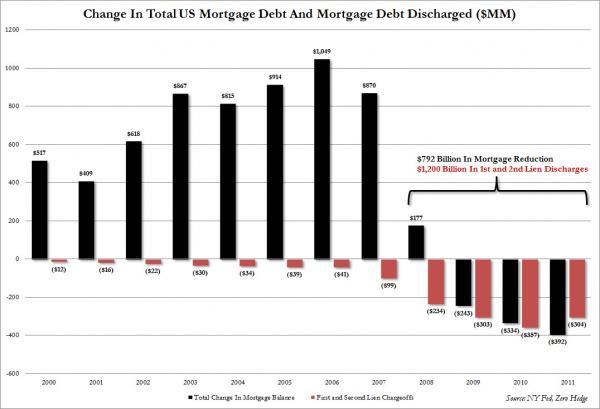
All of this was driven home to me when I saw this post and chart in Zero Hedge on the so-called deleveraging of debt that is supposedly going on among American households.  Tyler Durden sets the record straight with the facts which show that it is not deleveraging that is bringing debt levels down but defaults.

Lately there has been an amusing and very spurious, not to mention wrong, argument among both the "serious media" and the various tabloids, that US households have delevered to the tune of $1 trillion, primarily as a result of mortgage debt reductions (not to be confused with total consumer debt which month after month hits new record highs, primarily due to soaring student and GM auto loans). The implication here is that unlike in year past, US households are finally doing the responsible thing and are actively deleveraging of their own free will. This couldn't be further from the truth...

This chart tells the story.  Notice that there has been a reduction of almost $800 billion in mortgage debt since 2007 but there has been $1.2 trillion in 1st and 2nd mortgage lien discharges due to defaults.  In other words, debt discharges from defaulted mortgages are totally responsible for the reduction in mortgage debt in the United States.


Durden puts it this way.

Instead of actual responsible behavior of paying down debt, the primary if not only reason there has been any "deleveraging" at all at the US household level, is because of excess debt which became insurmountable, not because it was being paid down, the result of which is that more and more Americans are simply handing their keys in to the bank and walking away, and also explains why the US banking system is now practicing Foreclosure Stuffing, as defined first here, as the banks know too well, if all the housing inventory which is currently in the default pipeline were unleashed, it would rip off any floor below the US housing "recovery" which is not a recovery at all, but merely a subsidized bounce, as millions of units are held on the banks' books in hopes that what limited inventory there is gets bid up so high the second housing bubble can be inflated before the first one has even fully burst.
All of this brings me back to my original point.  Compound interest is deadly when you are on the borrower's side of that equation.  And if you are the lender to that borrower you take it in the shorts when default occurs.  That $1 trillion in discharges came out of the hide of Fannie, Freddie, your local First National Bank and many more financial institutions who loaned money to home buyers who could not keep up with the original payment terms of the loan.

This is a good lesson to keep in mind when you loan anyone money, whether it is your brother-in-law, a Fortune 500 company or the federal government.  History, economics and the power of compound interest tells us that all of the money that is borrowed is not going to be paid back.  Proceed cautiously with your money and think very carefully about buying any junk bonds (or Japanese government bonds   for that matter) right now.  You don't want to be the one holding the bag with nothing in it.

Here is a chart showing junk bond yields.  Yields on these high risk loans have dropped to the lowest amount in history.  Therefore, those buying these instruments today are receiving smaller compensation for taking this higher risk than ever before.  Are we to believe that these loans are that much safer than ever before as the low yields would suggest?  Hardly.  This is another distortion caused by the Fed's QE policy. Buyer beware!


Tuesday, May 21, 2013

Trouble in Obamaland

For the first time in over five years I am beginning to discern real trouble in Obamaland.

Until recently, living in Obamaland was akin to living in Fantasyland.  It did not matter what happened on a given day in Obamaland. You were pretty much assured that the sun would be shining and the birds would be singing when the morning paper came the next day no matter what happened.  The mainstream media made sure of that.  Obama and his minions could do no wrong. Life would be perfect if not for the obstructionist, obstreperous, obnoxious Republicans.

Over the last month I have begun to see the earth starting to move under Obamaland. The White House press corps is starting to press Press Secretary Jay Carney harder in his briefings.  Democrats in Congress are starting to put some distance between themselves and The White House.  More people appear to be willing to discuss intimidating tactics that would seem more likely to occur in Moscow than in Washington.

The Benghazi whistleblowers were the first to make the earth move a little under Obamaland.  I  believe that there is much more to this story but it still seems to be an issue that is unlikely to gain any traction with the press or the public.

The largest unanswered question in my mind is what Obama was doing that night that was more important than monitoring what was going in Libya?  Was he packing for his fundraiser in Las Vegas the next day? Did he have a scheduled golf lesson?  Was he watching a movie in the White House theatre with a couple of his Hollywood cronies? I don't understand why this question has not been pursued more aggressively by the press considering four Americans lost their lives in a terrorist attack that night.  The press doesn't seem to want to pursue the issue and the public seems to think it is more about politics than anything else.

The two issues that could really rock Obamaland are the IRS scandal and the AP/James Rosen scandal which have the common theme of using government powers to intimidate and silence critics, whistleblowers and freedom of the press.  I believe these issues seem to show calculated efforts to silence dissent and disclosure.  It should give everyone in our republic some pause.

The big question is whether the mainstream media will respond and assume the role that our Founding Fathers envisioned for them.

Like it or not, the media provides the oxygen that allows a scandal to burn into the public eye.  Fires don't burn without oxygen.  Stories don't become scandals without the media giving it airtime.

Are we going to see some air on these issues?

Political interference of any kind with the workings of the Internal Revenue Service should bring fear to almost any American.  Interference and intimidation with the workings of a free press should as well. The IRS and freedom of the press are hot button issues.  This is not Benghazi.  These are issues that any American can understand. How can the press sit by and stay silent?

Noah Rothman of Mediaite.com thinks that the media will respond much to the White House's chagrin.


The White House has greatly underestimated the press and their reverence for the sacred function they perform in a healthy democracy. The political media’s admiration for the president, someone who largely shares their philosophy and pedigree, is a pale shadow in comparison to the esteem with which they hold their own institution.
A storm is coming for the Obama administration. There is no stronger animosity than the one born of spurned affection. Now legitimately mistreated and aggrieved, the press is coming for this White House.


I am not going to make any predictions.  Obamaland long ago proved too confusing for me to understand. One thing I do know is that there are no scandals without that media oxygen.  Another thing I know is that there is no scarcity of material for the press if they want to start exercising the role they are supposed to play in a democratic republic.

If you have any doubts, click here to see a full-sized Obama Scandal Bracket that was created by Jon Gabriel at Ricochet.com.


Monday, May 13, 2013

Fracking, Fuel and Fools

I come across some interesting charts every week.  This is a good one.  It tracks natural gas prices since 2005 in the United States, Europe and Japan.

In 2005, the prices for this commodity were the essentially the same wherever you were in the world.  Prices tracked pretty closely through 2008.  However, since that time, prices have diverged substantially.

Prices in the United States recently were $3.32 per million BTU.  It was $11.77 in Europe and $16.66 in Japan.

What has happened?

This is the shale gas revolution in action that has been made possible by new applications of hydraulic fracturing technology, horizontal drilling and the discovery and development of new sources of shale gas in the United States.


This second chart shows the massive growth in shale gas production in the United States over the last few years.


Have you ever heard anything about the laws of supply and demand in economics?  The supply of natural gas has exploded in the United States since 2008.  The result-a dramatic decrease in its price.  Conversely, in the rest of world, demand is vastly outstripping the available supply with resulting higher prices.

Please keep in mind that it is the extreme environmentalists who don't want the development of any of these natural resources.  Our country and the world does not work without energy.  It does not prosper without affordable energy.

President Obama and the Democrats have been beating the drum for five years that renewable energy is the key to our economic renaissance.  Perhaps that will be true some day.  However, today the best prospects for our economy rest on this shale gas revolution.  It is telling that all of this new development has occurred with almost no federal government support over the last five years.  While the Obama administration was giving billions of dollars to "green" energy companies (many of which have gone bankrupt) the oil and gas industry was actually producing affordable, efficient energy to fuel our future economy.

Shale gas and oil is the best option that our country has right now to remain the predominant economic power in the world.  We have been blessed with this resource and with the technology and talent to take advantage of this fuel.  We would be fools to not do so.  Only fools would keep us from doing so.


Hat tip to PowerLine for the chart on natural gas prices.

Wednesday, May 8, 2013

The 29-Hour Work Week

The Bureau of Labor Statistics released its April employment numbers last Friday.  Most of the media played the story as "good news" noting that the unemployment rate dropped a notch to 7.5%.  However, beneath the surface, the numbers tell a more troubling story.  This is especially true in looking at the data within the Household Survey which provides a more comprehensive look at the employment situation.

  • The labor participation rate remains at 63.3%.  This is the lowest percentage of Americans working since 1979.
  • The headline in the BLS Establishment Survey data was that 165,000 jobs had been created.  However, in looking at the Household Survey, which takes a deeper look at the jobs situation across the economy, total employment rose by 293,000. This was composed of the addition of 441,000 part-time jobs offset by the loss of 148,000 full time jobs.  In effect, part-timers are replacing full-time positions.  That might make the unemployment rate lower but it is making the workforce poorer.
  • The FTE ratio (the number of full time equivalent workers per 100 working age Americans) declined for the fifth month in a row to 53.09.  FTE is calculated by taking full time jobs + .50 x part-time jobs.  This also indicates that full time workers are being replaced by part-timers.

What does this tell us?  I think you can draw several conclusions from the data.

First, there is still a lot of uncertainty about the economy. Part-time workers allow employers to hedge their bets.  If things are softening, an employer may reduce the work hours of an employee before letting her go. They also will be cautious about bringing on full-time help.  It is better to hire someone for 30 hours a week than a full 40 hour week.  This also provides a cushion against having to pay overtime pay at time and a half if business picks up.

It also makes the unemployment rate look better than it really is.  After all, if two people work part-time jobs at 20 hours each that is twice as many workers as one working a full-time job at 40 hours.  The most recent BLS data shows that there are 7.9 million men and women working part-time jobs involuntarily because their hours have been cut back or they had to take a part-time job because they could not get a full-time position.

Second, Obamacare appears to be starting to affect the behavior of employers. Part-time workers (those working less than 30 hours per week) don't have to be offered insurance under Obamacare and employers are not subject to the $2,000 penalty per employee they are for full-time employees.  The Wall Street Journal explains the incentives to employers to hire part-time workers with Obamacare.

The savings from restricting hours worked can be enormous. If a company with 50 employees hires a new worker for $12 an hour for 29 hours a week, there is no health insurance requirement. But suppose that worker moves to 30 hours a week. This triggers the $2,000 federal penalty. So to get 50 more hours of work a year from that employee, the extra cost to the employer rises to about $52 an hour—the $12 salary and the ObamaCare tax of what works out to be $40 an hour.
Moving to 33 hours a week costs the employer about $10 an hour more in ObamaCare tax. Look for fewer 30-35 hour-a-week jobs. The law that was sold as a way to help business and workers is thus yanking a few more rungs from the ladder of economic upward mobility.
Many franchisees of Burger King, McDonalds, Red Lobster, KFC, Dunkin' Donuts and Taco Bell have started to cut back on full-time employment, though many are terrified to talk on the record. Activist groups have organized boycotts against Darden Restaurants,  which owns Olive Garden and Red Lobster, for daring to publicly criticize ObamaCare. It's safer to quietly dodge the new costs and avoid becoming a political target.
But the damage won't be limited to franchisees or restaurants. A 2012 survey of employers by the Mercer consulting firm found that 67% of retail and wholesale firms that don't offer insurance coverage today "are more inclined to change their workforce strategy so that fewer employees meet that [30 hour a week] threshold." This week Nigel Travis, the CEO of Dunkin' Donuts, asked Congress to change the health law's definition of full-time to 40 hours a week from 30 hours so worker hours won't have to be cut.
Louis Woodhill of Real Clear Markets sees more ominous signs for the economy in the job report numbers. A sustained drop in the FTE ratio has historically been an early warning signal for a coming recession.


During April, the FTE jobs ratio fell for the fifth month in a row, to 53.09. The earliest warning signal for every recession since 1955 (the first year for which the data is available) has been a significant, sustained decline in this ratio.
As of April, the fall in the FTE jobs ratio from its local peak was only 0.11. This is not yet a strong indicator of an impending recession. Only one of the recessions since 1955 (that of 1970) was presaged by this mild a decline, and there were eight instances during the past 50 years where the FTE jobs ratio declined by this much over five months, and the economy did not fall into recession.
This having been said, there also has never been a case where the FTE jobs ratio fell for five months in a row and a recession did not follow. So the recent decline is definitely something to be concerned about.
Based upon the historical record, if the current decline in the FTE jobs ratio were to continue, and to reach a cumulative 0.60, renewed recession would become a virtual certainty.
In the case of the most recent recession, the decline in the FTE jobs ratio exceeded 0.60 five months before the recession officially started, and a full 15 months before the National Bureau of Economic Research (NBER) formally declared that a recession had begun in January 2008.
But wait! How can we fall into another employment recession when we haven't even gotten out of the last one yet?
It is simple.  We haven't had a President like Obama before.  We also have never had anything like Obamacare.  Anything is possible these days.  Even a 29-Hour Work Week.

Monday, May 6, 2013

Meddling Misalignment

My view of government is that it should be like the referee in a tennis match.  It should sit above the action and observe the play on the court to make sure the rules are evenly applied and it is a fair match for both sides.  Government should be there to call it if a ball is hit out of bounds or if someone steps over the line. It should not be taking sides on who wins and loses.  It certainly should not be on the court trying to play the game.


Another view that I hold strongly is that everything in the world is about incentives.  Human beings will behave according to their self-interest. Therefore, incentives drive the world. If the incentives for people are properly aligned, you will get the result you want.  If the incentives are not properly aligned, you will get poor results.  Whenever you get a poor result it is likely that you will find that the underlying incentives were not aligned properly.

If you are looking for a perfect example where our system in not properly aligned and our government has left the referee chair look no further than the recent story that Apple Computer is borrowing $17 billion in order to pay dividends to its shareholders.  By the way, that is the largest issuance of corporate bonds in the history of the United States.  That is not chump change.


What is interesting is that Apple has almost $150 billion in cash sitting on its balance sheet.  So why are they borrowing money to pay a dividend when they are already awash in cash?  Something is not right.  Clearly the incentives are misaligned.  What is the story?

First, Apple's cash hoard is almost all sitting overseas in foreign bank accounts.  Why would they do that?  It has to do with U.S. tax policy.  Even though almost every other country in the world now observes a "territorial" system of taxation, the United States continues to observe a "worldwide" system.

What does that mean?

Under a territorial system the rule is that you pay taxes only in the country where the income is earned.  For example, if a Japanese company makes money in Germany, it is taxed in Germany.  Japan does not tax the income earned in Germany when the money is transferred back to Japan.

The United States follows a worldwide philosophy of taxation.  It taxes all income earned by U.S. corporations and individuals no matter where that income is derived.  Of course, the foreign country where the income is earned also wants their share.  Therefore, a U.S. corporation doing business in Germany first must pay taxes in Germany and then it also must pay taxes in the United States when it repatriates those earnings to the United States.

To prevent double taxation the United States provides a credit for any foreign taxes paid on the income overseas. Thus, for example, if the corporation pays a 30% tax in Germany on its profits and repatriates the income to the United States, the income is taxed again at the U.S rate of 35%.  A credit for the German tax of 30% is allowed so that the U.S. company ends up paying the full 35% rate-effectively 30% to Germany and 5% to the U.S.

Corporations are not bringing cash back to the United States because of this system.  The United States now has the highest corporate tax rate in the industrialized world.  Therefore, the current tax system has created an incentive for U.S companies to keep cash they have earned overseas rather than bringing it back to this country where it could be invested for the good of our economy.  By leaving the money overseas it will not bear the higher U.S. tax until it is brought home.  However, few large companies are bringing the cash home because of the high U.S. corporate tax rate.

A report last year by JP Morgan Chase & Co. estimates that U.S.-based companies had $1.7 trillion in accumulated offshore profits.

The U.S. tax system is clearly outdated, uncompetitive and its incentives are not aligned with the modern global economy.  Liberals suggest that U.S companies should pay current U.S tax on foreign profits rather than when these profits are repatriated.  However, such thinking simply ignores the realities of the world today.  All that would do is make U.S. companies even less competitive in world commerce.  The only logical answer is to have the U.S tax system more closely aligned with the rest of the world by lowering corporate tax rates and moving towards a territorial system.  This would remove the disincentives to bringing this cash back to the United States.  More cash in the United States means more capital, investment and jobs over the long term for our citizens.

The incentive should be to bring money back to this country, not keep it sitting outside the country.  The current law of our federal government is doing exactly the opposite and it should be no surprise we are getting a bad result.  This is why Apple is not bringing billions of dollars back to the U.S. to pay dividends ( a large portion of which would be paid to U.S. shareholders who pay U.S taxes).

Instead of bringing that cash back home they are borrowing the money to pay the dividends.  Why? Because of the inordinately low interest rates which are a direct result of the Federal Reserve's monetary policy.  Let's look at the math.  If Apple brings the cash back they have to first pay tax at 35% before they can pay dividends to their shareholders.  Alternatively, they can borrow money at 3% or less (which is also tax deductible) and leave the money overseas with no tax.  That is a difference of around 33% (after considering the tax deductibility of the interest expense.  On $17 billion, that is almost a $6 billion advantage. What would you do?  It does not take a Wharton MBA to figure that one out.

All of this is caused by government directed distortions to what should be the natural order of the affairs of commerce.  Government is both meddling and muddling to cause this result.  It is meddling by keeping interest rates artificially low to bail out banks and borrowers (the biggest being the federal government itself). It is also muddling along by keeping an outdated tax system in place that might have made sense in the mid-20th century but is totally out of sync for the 21st century global economy.  The rest of the world has moved to much lower corporate tax rates and we have stubbornly kept ours high.

Government long ago left the referee's chair.  They are trying to pick the winners and losers and the outcome of the game instead of making sure the game is fair.  In addition, the incentives in the system are totally misaligned and government doesn't seem to have a clue of what this is doing to harm us over the longer term.

Stop the meddling.  Cease the misalignment.  Get in the referee's chair and let the system work as our Founders intended it to.

Saturday, May 4, 2013

Striking Out On The Weather

In my last post I wrote about how April, 2013 saw more strikeouts than in any April in the 138 year history of major league baseball.

Perhaps it had something to do with the weather.  After all, that bat can really sting your hands on a cold day if you don't make solid contact.

Through the end of April, the United States is on track for the second coldest spring on record-only slightly warmer than 1975.  The data below is from Index of /pub/data/ghcn/daily/hcn/.  It includes all US HCN stations taking the average of all daily temperatures.

Here is a graph of the data compliments of Real Science.


There is a good chance that, unless things start to warm up considerably, 2013 may turn out to be the coldest Spring on record.  1975 had an above average May at 17C (see below) so the record is within reach.


You now are beginning to see why we no longer hear about global warming and we are supposed to be worrying about climate change.  After all, If you look at the graphs above it is clear that the climate is changing from year to year.  Do you see any clear trend toward warmer temperatures? In fact, the trend line for May is actually slightly downward.

Real Science points out that "crack government scientists with supercomputers, predicted in January that this spring was going to be super hot!"


The "A" in the deep orange in the map above is centered on the Texas Panhandle near Amarillo, Texas.

Amarillo had the following low temperatures the last three days (May 1- May 3), 36F, 32F, 30F.

Remember two years ago when we were having a spike in tornado activity and we heard from "climate change" alarmists that all of that extreme weather was caused by man-made global warming and we would see more of it?

2013 has seen the lowest number of tornado activity in recorded history according to tornado expert Harold Brooks at the NOAA.   In 2011, when there was an historic high in tornado activity, there were those saying that "it's irresponsible not to mention climate change" as a potential cause.  What are they saying now?


I think I am smart enough to realize that climate change is always occurring.  Look at the charts above for evidence.  I am also attuned enough to realize that what used to be called "global warming" is now called climate change.  Why is that?  It seems that the models that some scientists put together several years back predicting increasing temperatures have not proven out.  Therefore, the so-called dangers of global warming have been replaced with fears about climate change.  That is a convenient term because you will never be wrong.


I guess major league batters are not the only ones striking out a lot these days!

Thursday, May 2, 2013

Strike Three! You're Out!

I heard an interesting bit of baseball trivia today.

There were 5,992 strikeouts in April.  That is the highest strikeout total in any April in baseball history.

That works out to an average of 15.29 strikeouts per major league game or almost 8 per team.  That is the second-highest average for a full month in baseball history.

However, these strikeouts do not seem to be an isolated event but a major change in the way the game is played.  According to the Elias Sport Bureau...


The April average of 15.29 strikeouts per major-league game was the second-highest average in a full month in major-league history... The record was set just last September, when there was an average of 15.47 strikeouts per game. And that brings us to the larger point: Over the 138-year history of Major League Baseball, the top eight months on that list - that is, the list of months with the highest average of strikeouts per game - are the last eight months.

You read that correctly. Not eight-of-the-last-12, or eight-of-the-last-10, but eight-of-the-last-eight. There were 14.91 strikeouts in September 2011, 14.63 in April 2012, followed by 14.93 last May, 15.01 last June, 15.07 in July, 14.68 in August, the record 15.47 in September and now 15.29 in April 2013. Those are the eight highest monthly strikeout averages in baseball history.


Photo Credit: John Grieshop, SB Nation

All of these strikeouts have cost a local pizza chain in my hometown of Cincinnati over $100,000 in free pizzas so far this season.  This story from Fox19 in Cincinnati provides the background.


Anytime Reds pitchers combine for 11 or more strikeouts in a game during the 2013 season, win or lose, every ticket holder at Great American Ball Park wins a free LaRosa's pizza as part of a special promotion.

Officials say 11 batters have been struck out by Reds pitchers 7 times so far this year at Great American Ball Park. It's great for the stat lines and even better for hungry fans.

"We felt comfortable last year deciding at more than 11, we'd create the free pizza giveaway. It just so happens this year the Reds are blowing away all their previous records," said Mike LaRosa, Chief Executive Officer.

Starting the day after the game, fans have a week to redeem their ticket for free pizza.Reds officials say all of the free pizza this season has cost the restaurant around $100,000. We asked, why the number 11?

"11 was the number that was possibly going to be achieved 10 to 11 times throughout the whole season in the home games," explained LaRosa.

What gives?  Why so many strikeouts?  Are the pitchers that much better or are the hitters that much worse?

It will be interesting to keep an eye on this stat during the season.  And if you like pizza, it might be worth a trip to Great American Ball Park sometime during the year.

Tuesday, April 30, 2013

Hoisted On Their Own Petard

Early in my career as a tax attorney I worked on the sale of a large portfolio of commerical jet aircraft that my company owned.  It was a complex transaction that involved the sale and leaseback of about 25 jet aircraft that would be financed by one of the big money center banks to an experienced charter operator.

The President of the air charter operator was a great guy but there were a lot of issues that had to be negotiated to the satisfaction of both parties.  We were in New York City for weeks on end ironing out the deal.  One night our negotiations spilled over to a late dinner in one of Manhattan's eateries.  We were going back and forth when I realized that Bob had left himself open on one of the negotiating items.  He had pushed hard on a smaller point not realizing that he was undoing himself on an even bigger issue with the logic of his argument.

I jumped in and agreed with him on the small point he was making and then I immediately went to the bigger issue and pointed out that he must also agree with me on that one.  It took him a moment but he soon realized that he had been undone by his own words.  He looked up at me with a smile and said,

"You just hoisted me on my own petard!"


I had never heard that phrase before but I knew he was saying that he had just been skewered by the device he was intending to use on me.  Hearing the reference I wrongly thought that a "petard" was a small sword.  I thought being hoisted meant that you got lifted into the air on the point of your own sword.  I later found out that a petard is actually a firework or small explosive used to break into doors in Shakespeare's time.  Hoisted by your own petard means getting blown up by your own explosive or caught in your own trick. Shakespeare used the line in Hamlet.  You do learn something every time you read BeeLine!

I couldn't help but think of this story as I read the news from Washington last week that our legislators are in full panic mode as it has dawned on them that they and their staff members must use the Obamacare healthcare exchanges to access their healthcare coverage in 2014.  There was talk last week that a bipartisan effort was quietly underway to repeal this part of Obamacare until howls on both the right and left caused both John Boehner and Harry Reid to distance themselves from the idea.

Being required to get their health care in the exchanges presents two problems for Congress.  First, it puts individuals who have been getting their coverage on a group basis into what is essentially an individual marketplace.  It takes what have been group community rates for that coverage and makes it individually-rated coverage based on age.

The bigger problem is that the legislation as passed does not appear to allow the healthcare exchanges to accept any employer subsidy money to purchase healthcare coverage.  Government employees generally pay only 25% of the cost of their health care coverage currently. The remaining 75% is paid (tax-free) by the federal government as employer-provided health coverage.  Therefore, the concern is that Congress and their staffers may have to pay for the entire cost of their health care coverage with their own after-tax dollars.  Ouch!

Avik Roy of Forbes magazine provides the background on this story.
As Obamacare was winding its way through the Senate in 2009, Sen. Chuck Grassley (R., Iowa) slipped in an amendment requiring that members of Congress, and their staff, enroll in Obamacare’s health insurance exchanges. The idea was simple: that if Congress was going to impose Obamacare upon the country, it should have to experience what it is imposing firsthand. But now, word comes that Congress is quietly seeking to rescind that provision of the law, because members fear that staffers who face higher insurance costs will leave the Hill.

Sen. Grassley’s original idea was to require all federal employees to enroll in the exchanges, instead of in the Federal Employee Health Benefits Program, where most gain coverage today. Indeed, a previous Senate Finance Committee amendment proposed putting members and staffers on Medicaid. But “fierce opposition from federal employee unions” sank Grassley’s effort, and he had to water his amendment down to only apply to Congress and congressional staff.

Of course, the Democrats were totally in control so they could have banded together and just ignored Grassley's amendment.  However, being the great politicians that they are, they decided they better embrace the amendment since they were arguing that Obamacare would be so wonderful for everyone.

This is where their problem begins as it appears that someone did not read the entire bill before they passed the law.  This is how the law reads:

The only health plans that the Federal Government may make available to Members of Congress and congressional staff with respect to their service as a Member of Congress or congressional staff shall be health plans that are — (I) created under this Act (or an amendment made by this Act); or (II) offered through an Exchange established under this Act (or an amendment made by this Act).

That is pretty clear and simple.  The problem arises because the exchanges do not have any procedures for handling premium contributions from large employers.  Therefore, the implication is that those in the exchanges must pay the full cost of their health care cost coverage individually.  Oops!

There is no doubt in my mind that this is a drafting error.  I think it is clear that Senator Grassley merely intended that the employer contribution would follow the employee to the exchange.  However, there is a very real practical problem here as well.

Employer-provided group coverage is what is called community-rated.  Everyone in the group plan pays an average blended rate.  The 64-year old employee and the 24-year old employee pay the same rate for simplicity's sake.  In the individual market, coverage is age-rated.  Those older pay a higher rate than those younger because the actuaries will tell you that, on average, those older will have higher health care costs than those younger.  In fact, someone in their 60's will generally cost about 5-6 times someone in their 20's, according to the actuaries.

For example, let's assume a small employer has five employees in a group plan with the ages of 24, 34, 44, 54 and 64.  The actual projected monthly health care cost for each is $100 (age 24), $200 (age 34), $300 (age 44), $400 (age 54) and $500 (age 64) for a total of $1,500.  This would be the age-rated cost in the individual market. The community rate is $300 per employee.   If the employer pays 75% of the cost of coverage, each employee pays $75 per month.

The individual health care market today is generally age-rated.  Those older pay more than those younger. However, Obamacare turns this on its head a bit with a community rating provision that limits the rate differential from young to old at no more than 3X. This means that the young will pay more and the old will pay less than today.  Using the example above, the 64 year old might only be charged $450 but the 24 year-old would have to pay $150 with the other age cohorts being adjusted accordingly to reach the $1,500 per month total required for the entire group.

Why is this a problem for Congress?  Most Congressional staffers are in their 20's and 30's.  They potentially are going to get a real rate shock in the exchanges compared to what they could get in the individual market today.   Of course, this problem could be mitigated by the employer subsidy if it is allowed.  However, to insure no chaos, the subsidy will have to be customized to each age cohort.  That is no small task administratively to set up and manage.

The bigger problem is the potential loss of the tax-free employer contribution to the staffer's (or Congressman's) health care coverage.  There is a big difference between paying 25% of something and 100% of something.

Of course, all of this is caused by the disparate tax treatment between health care coverage provided to an employer (tax-free) compared to coverage purchased by an individual (taxable).  This potential problem would go away if Congress made all health care coverage tax deductible or, alternatively, did away with the tax preference for employer-paid health care coverage.  Neither solution seems to be in the cards.  As a result, Congress is in a real bind.

However, I am not going to feel the least bit sorry for Congress and their staffers.  Any way you look at it, they are responsible for their problem.  They passed Obamacare and they also wrote the tax law that discriminates against the individual who purchases health care coverage on their own.  They made their bed, it is time to sleep in it.

Said another way, they have been hoisted on their own petard!  That should bring a smile to many people across America.

Sunday, April 28, 2013

Going Global

Are you familiar with this brand?


How about this one?


You are probably thinking they must be a couple of start-ups.  You would be wrong.

These are the logos of the top two companies on the recently released Forbes Global 2000 list of the world's top 2000 companies.  They are both banks in China.  They topped Exxon Mobil, JP Morgan Chase, General Electric and Berkshire Hathaway, among others, on the Top 10 list.

Forbes arrives at its ranking of the world's top companies by equally weighting sales, profits, assets and market value.

#1 on the list is ICBC.  That is the Industrial & Commerical Bank of China (ICBC).  It has almost $3 trillion in assets and over 400,000 employees.  It was founded in 1984!

#2 on the global list is China Construction Bank.  It is a relative old-timer in China having been founded in 1954.  It has $2.2 trillion in assets and over 350,000 employees.

China now has 5 of the top 11 companies in the world according to Forbes.  The Agricultural Bank of China is #8, PetroChina is #9 and the Bank of China is #11.

If you need evidence that the balance of power in the world economy is changing, look no further than this year's Forbes Global 2000 list.

If you need evidence that it is changing quickly, consider that in the Forbes Global 2000 list for 2007 China had only one company in the top 50 (PetroChina at #41).

How did China come so far, so fast?

I wrote about the changes in China two years ago in "The China Numbers Game".  Most of what we are seeing today has only occurred as China moved away from its socialist economic system to one more focused on capitalist principles.


China had a planned socialist economy from its founding in 1949 to 1978.  In that year they first introduced the ability for farmers to grow what they wanted and sell much of it at market prices.  They opened up most of the rest of the economy to what they refer to as a "socialist market economic system" in 1984.  Since that time China's GDP per capita has increased some 13 fold in dollar terms. 
The Chinese are now focusing intently on new innovation and patents.  This from "China Business". 
In an extensive campaign significant for the global economy, China is targeting an astounding 2 million domestic patent applications annually by 2015, and wants to be one of the top two patent owning countries by 2020.  
How are they intending to get where they want to go?
To boost domestic patents, China will offer incentives of cash rewards, houses and tax breaks to scientists and innovators. The patent master plan promises infrastructure for quicker filing, examining and granting of patents, funding patent holders, and integrating new patents into the economy.  
It is truly amazing what can happen when people are given incentives to innovate and produce.  That is why socialist, collectivist and communism systems never work.  That is why China is the economic miracle of the world the last 20 years and why North Korea, Cuba and Venezuela continue to struggle.  


My only advice is that if you have children steer them away from French and Spanish as their choices for foreign languages.  They need to learn Chinese.

Photo Credit: BocaParent.com

Thursday, April 25, 2013

Tornado Tale Times Two

BeeLine was inaugarated a little over two years ago with a email to a dozen friends who I thought my enjoy my blog.

It has slowly grown in readership due solely to the word-of-mouth of loyal readers like you.  Although daily readership is not in the thousands, a good day now numbers well over a hundred readers.  Readership also spans the globe which shows the power of the world wide web.  Just this week visitors from Romania, Russia, China, UK, France, Brazil, Germany, Ukraine, Ireland and Turkey have read BeeLine.

The growth in readership this year has been particulary gratifying.  In fact, nine of the ten most read BeeLine blog posts were published in 2013. 

However, events on this day exactly 52 years ago could have prevented BeeLine from ever being born.  I wrote about that tale two years ago on this day and that post is the only one that was written prior to this year that is still in the top 10 most popular BeeLine posts. 

Since BeeLine has so many new readers, I thought I would reprise that post today.  Here is my Tornado Tale Times Two.  No, that is not me in a red dress.  I just thought it was a very compelling image that I found on the internet.  My tale was before photoshop and touch-tone phones.  Let me take you back to 1961.


Photo Credit: Brian Oldham


A Tornado Tale
(Originally published 4/25/11)


50 years ago today I came close to death.  I was in a house that took a direct hit from an EF4 Tornado in Eaton, Ohio.  It was shortly before 400pm on a late April afternoon and I was in my bedroom organizing my baseball cards with my best friend.  My mother was visiting a neighbor with my younger brother.  I looked out the back window and looming straight ahead about a half mile away was the tornado dancing back and forth right in front of my eyes.  It appeared to be on a direct path to our home.

I remember seeing details that you normally don't pick up in photographs.  I clearly could see lumber, shingles and other debris swirling around near the top of the twister.  We made a quick call to my friend's home to warn them of the approaching tornado and headed for the basement.  We bounded down the stairs.  We heard the sound of a car's horn racing down the main road that was parallel to the tornado's path.  We later learned it was the family who operated the farm behind us who had decided to run for it rather than go to their basement.

A few seconds later the tornado hit.  It was a deafening roar.  It was as if you were standing right by the railroad tracks and a train was going by at enormous speed.  I remember covering my ears with my hands because of the roar.  I remember my friend and I shouting at each other at the top of our lungs but you could not hear a word over the sound.  Suddenly it got even louder and it sounded as if the entire house was caving in.  I remember looking up at the floor and joists above me and thinking that this was it.  I fully expected to be soon buried alive.  Time did slow down.  I remember thinking I had just turned eleven years old and this was the end of the road.  It then became deathly quiet.  The floor had held and my friend and I checked each other to be sure we were all right.

We cautiously started up the basement stairs.  The door would not open but we both put our shoulder to it and pushed hard. We got it about half way open and slithered out.  Staring at us through the adjoining door to the garage was a steel beam that had been thrown around like a tooth pick. It had penetrated almost a foot through the door into the house.  The windows on the back side of the house that faced the tornado were all broken.  The draperies hung in tatters and were now blowing in the wind.  The windows on the front of the house were intact but were caked with dirt and grass that looked like it had been sprayed on. The dirt was so thick you could not see through the windows at all.  All through the house lay debris. Drywall from the ceiling was laying all over. You could look up and see the sky.

I tried to make my way back to my bedroom but I couldn't navigate the debris that littered the hallway.  My friend and I went out the front door and we could see the tornado continuing on its way to more destruction down the road.  The tornado looked much better from the backside.

I did not have shoes on but I began running toward the house where my mother was.  It had been spared but for some minor damage.  It was a debris field of 2x4's, downed electric wires and protruding nails to get to her. I saw some hay straw blown straight in to some siding as if it was a nail.  I reached my mother and looked back at our house for the first time.  I almost could not believe the sight.  It looked as if our house had been bombed.  I had a hard time choking back tears as I saw our house.  I kept saying to my mother, "Look at our house".  She just kept repeating, "It is ok.  You are alive".  Even after 50 years, you do not forget a day like that.

Photographs and other background on the tornado of April 25, 1961


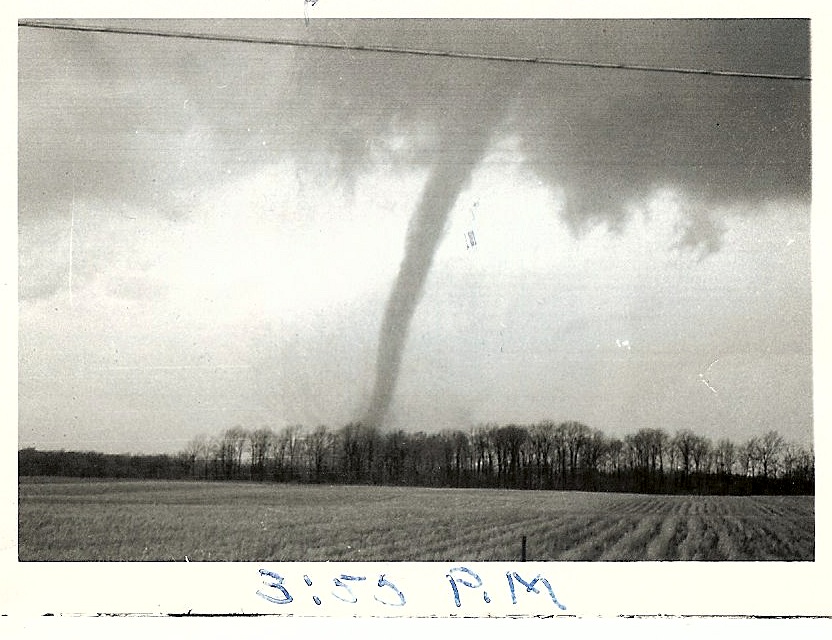
Photo taken of the tornado by a local photographer at close to the time it destroyed our house.


Photo of what was left of the Turner farmhouse that was directly behind our house.  Witnesses said that when the tornado hit the 2-story frame house it lifted it straight up and the house exploded and deposited almost all of the debris in the basement.  Fortunately, the Turner family did not go to the basement for shelter.  Mr. and Mrs. Turner started for the basement but their 20-year son did not feel the house could withstand the tornado.  They jumped in their car and made a run for it.  That decision undoubtedly saved their lives. It was their car horn I heard in the basement right before the tornado struck.


Our house was totally constructed out of stone.  I was in the basement on the left side of the house as you look at this picture.  The people are on top of debris that used to be the garage and a back porch that were on a slab.  It was the sound of the collapse of this part of the house that had me thinking the entire house was coming down on me.


The house as it looked shortly after construction in 1957 (4 years before the tornado).  I was in the bedroom looking out the window on the far right side of the house when I first saw the tornado approaching.


The house from the right front showing the collapsed garage.  I was in the basement near this corner of the house when the tornado struck.


Through April 24, according to the National Weather Service, there have been 438 confirmed tornadoes in the United States. Only one has been an EF4 similar to the Eaton tornado of 1961.  We have already seen 306 tornadoes in April, 2011. This is the highest April total ever.  The previous record was 267 in 1974. The average number of April tornadoes is 163.  Keep your eyes on the sky and take shelter immediately if one of these terrible twisters heads your way.