Tuesday, May 7, 2019

Can You Believe Anything They Say?

Do you remember the doom and gloom predictions the Democrats made right before the Trump tax bill was voted on in December, 2017?

Chuck Schumer of New York, the Democrat leader, said this according to the New York Times.

 As the final vote approached in the Senate, Chuck Schumer of New York, the Democratic leader, gave his closing argument against the bill and scolded his Republican colleagues for talking during his remarks on the floor.
“This is serious stuff,” Mr. Schumer said. “We believe you’re messing up America. You could pay attention for a couple of minutes.”

That was relatively tame compared to what Democrat Nancy Pelosi had to say about the bill.

Pelosi called it "the worst bill in the history of the United States."

Of course, Bernie Sanders also weighed in at the time.

"..today is the day of one of the great robberies, criminal activities if you like, in the modern history of this country, because the federal treasury is being looted tonight."

I wrote at the time (right before Christmas, 2017) that we ought to refer to them as "The Democrat Grinches".

Not one Democrat in the House or Senate voted for the tax reform package.

So how has this all worked out almost a year and a half later?

Is the country messed up?

Was it the worst bill in the history of the United States?

Was it a criminal robbery unlike we have ever seen in the modern history of the country?

Here are a few recent economic indicators.

The unemployment rate is 3.6%. That is the lowest in 50 years. Further, the unemployment for women is 3.1% (the lowest since 1953), for Hispanics 4.2% (the lowest since this was first tracked in 1973), and for those with only a high school degree 3.5% (lowest since 2000). The unemployment rate for Blacks is 6.7%.  It was 8.0% in November, 2016 when Trump was elected. The all-time low (5.9%) was also set in the Trump administration in May, 2018. That is almost a full two percentage points lower than it ever was in the Obama administration.

5.8 million jobs have been added to the U.S. economy since President Trump was elected.

Wage growth over the last year has been 3.2%. Year over year wage growth has exceeded 3.0% for 9 straight months. Before 2018 (when the Trump tax bill took effect) there had not been wage growth in excess of 3.0% in any rolling 12-month period since March, 2009.

Inflation (measured by CPI) is at 1.9% over the last 12 months meaning that we are seeing real wage growth.

Can you believe anything they say?

In addition, despite what Bernie Sanders called the criminal theft of the federal treasury, taxpayers (especially middle income taxpayers) are keeping more of what they make rather than being forced to turn it over to the federal treasury. Why do they always think it is their money, not ours?

A recent report by H&R Block, which included an analysis of all the tax returns it filed for its clients (most of which are middle or lower income filers),  found that overall income tax liability was down 24.9% compared to last year.

Refunds were up 1.4% compared to the prior year.

By the way, H&R Block prepared 20 million tax returns in its most recent reported fiscal year. That is a pretty good sample size of working class taxpayers.

I found this data particularly interesting in that we saw so many stories in the mainstream media during tax filing season that middle income taxpayers were not seeing any benefit from the Trump tax bill. Of course, a lot of that narrative was fed by Democrats who continue to repeat the falsehood that only the "rich" benefited from the tax bill.

Why did so many middle income Americans believe this falsehood?

H&R Block explains that most people ignored the increase they got in their take home pay once the W-4 withholding tables were adjusted in March. They only considered their tax refund when they filed their return. The average reduction in tax liability for H&R Block clients was $1,200 but the average refund was up by just $43.

In effect, the money was in their pockets the entire year rather than being held in the Treasury. That money in the hands of the American worker and consumer has had a big impact on the economic numbers we are seeing right now.

I thought this was a particularly interesting chart in the H&R Block report in that it shows the average tax liability decrease by state.


Why do I find it interesting?

Look at which states showed the largest tax decreases.

New Jersey (-29.1%), Massachusetts (-27.6%), California (-27.1%).

These are all very liberal states where you heard a lot of noise about the limitation of the state and local (SALT) tax deduction for those who itemized.

As I wrote when the tax bill was being discussed, this provision hit higher income earners and those with high property taxes disproportionately. It was the best way to skew the greatest tax benefit to the middle class.

Limiting the SALT deduction clearly had very little effect on middle income and lower earners. Taxpayers in these deep blue states with high state and local taxes actually benefited more from the Trump tax bill than any other states. This is the exact opposite of the narrative we keep hearing in the media.

Of course, none of these facts are stopping the Democrats from continuing to rail about the Trump tax cuts.

Joe Biden was on the stump this week and said this.

"First thing I'd do is repeal those Trump tax cuts."

Really?

I guess Joe is not aware of the facts.

Is he really going to repeal the 25% cut the average H&R Block client got this past year and take an average of $1,200 out of everyone's paycheck?

I thought he was middle class Joe. I have to think if he does that the average taxpayer might figure out rather quickly that Trump really was on their side.

My advice for the Democrats is this. If they truly believe what they say, what are they waiting for ?

Nancy Pelosi and the Democrats control the House of Representatives.

Article 1, Section 7, Clause 1 of the U.S. Constitution states that all bills for raising revenue must start in the House of Representatives.

All Bills for raising Revenue shall originate in the House of Representatives; but the Senate may propose or concur with Amendments as on other Bills.

If it is the worst bill in the history of the United States, why wait? Why not vote on a bill to repeal the Trump tax law right now? There is nothing to stop them. After all, not one Democrat voted for it in the first place. It should not be a difficult vote for them.

Have had it.

What could go wrong?

Could it be that the Democrats might really experience the doom and gloom they were talking about in December, 2017 if they actually have their way?

Can you really believe anything they say?

Sunday, May 5, 2019

Logic Rules Our Brains

How often do we hear it said today?

He is a racist. An Islamophobe. An anti-Semite.

She discriminated against me. She is prejudiced.

They are biased. They pre-judged me.

We are told this is flawed humanity in full view. Humans letting their emotions control rather than objectively assessing others.

If only humans were robots and logic ruled their decisions.

Then along comes this headline to burst our bubble.


This is from the story that accompanied that headline.
Embracing stereotypes or even forming a simple opinion about others may seem like a trait exclusive to humans, but a recent study shows that robots can develop prejudice and even discriminate in similar ways to people, too.
You might think that’s because they’re programmed that way, but the research by computer science and psychology experts at Cardiff University shows that robots and machines using artificial intelligence are capable of generating prejudice on their own.

How can this be? Aren't robots always supposed to be logical?

Robots are logical. The same goes for our brains. Due to that fact, bias is built into our brains.

Bias exists all around us. We stereotype. We profile. We discriminate. What troubles me is that we seem to be incapable of accepting this fact of life. We can't change the bias in the brain. You can only affect the experience that creates the bias that gets built into your brain.

What they are finding with robots should show us how true that is.

The fact is that we all stereotype because all of our brains use shortcuts to make decisions. It is the way the brain is wired. These shortcut pathways make decision making easier. It is the logical way to do things.

Our brain is a wondrous thing. A good portion of the calories we burn in a day goes to fuel this enormous power plant. Therefore, the brain always tries to make decisions that use the least amount of effort and energy it can. These shortcuts are called heuristics.

It does not mean that the decisions based on these shortcuts are always right. But they have generally served the human species well for the most part because it helped us to adapt and survive. We could make quicker and more efficient decisions even if we weren't right all the time.

For example, we learned early on that it was dangerous to go outside the cave at night because a higher percentage did not return as compared to when others left in daylight. We learned to avoid the plant with the funny looking berries. Uncle Abner made that mistake, may he rest in peace. Once we found a "safe" place we tended to stay there despite the fact that had we ventured over the hill we very well may have discovered an even better place.

If you are human you use heuristics, bias and stereotypes every day. If you don't know better you are going to start with a default position as you assess things. For example, if you are looking at a product you are not familiar with and you have two items to choose from, you are going to assume the expensive option is better. Experience has taught you it usually is. If you move to a new city and need to open a bank account, you are going to assume that the bank with 50 branches and the skyscraper downtown is better than the bank with one office. After all, if they got that big they must have done something right.


Credit: ABC


In both cases, a closer and detailed look may show you are totally wrong, but you will undoubtedly have an initial bias based on prior experience. Your brain is not going to start from ground zero when there are previous neural paths in your brain to rely on. There is bias built into your brain based on your experiences since you were a baby. That bias is not based on emotion. It is based on prior experience. It is logical to use it in making your next decision.

That is the reason my brain led me astray when I saw the recent story on a high school athlete running a sub-10 second 100 meters dash in Houston. I quickly assumed the athlete was African-American because times like that almost never come from anyone else. It was logical. However, I was wrong. That was the subject of my last blog post.

Prior to the 1970's, Asians who lived in the United States were stereotyped as cheap, poor, uneducated laborers. Products from Asia were derided as nothing more than cheap junk. That stereotype no longer exists. It literally has been turned on its head. Our actual experience has shown the prior generalization was wrong. It has been replaced with another stereotype that is also an overly broad generalization.

Today, students in high school and college cringe when they see Asian-Americans entering their classrooms on the first day of class. American businesses have also learned some hard lessons from their Asian counterparts. The old stereotype is gone. That change did not occur because people just started to think differently one day.  It changed because people were forced to change their thinking because of what they experienced and the behaviors and results they saw from greater and greater numbers of Asians they came in contact with.

Any bias that the police may have in dealing with young, black men is rooted in their brains. It is based on their experiences in their field of duty. Look no further than the crime statistics if you have any doubts why a police officer might be quicker to draw a gun against a young black man compared to a White or Asian man.

The incidence of arrests for Blacks is over twice what it is for Whites on a per capita basis.

Blacks commit almost 5 times as many violent crimes (murder, manslaughter, rape, robbery and aggravated assault) per 1,000 population as Whites according to FBI data based on arrests for violent crimes.

Blacks commit eight times more crimes against Whites than Whites do on Blacks.

Consider what President Obama said about the very grandmother who supported and raised him.

"...my white grandmother – a woman who helped raise me, a woman who sacrificed again and again for me, a woman who loves me as much as she loves anything in this world, but a woman who once confessed her fear of black men who passed by her on the street, and who on more than one occasion has uttered racial or ethnic stereotypes that made me cringe."

Was Madelyn Dunham a racist?  Of course not.  She loved for and cared for Barack Obama when his own mother could not or would not as she pursued her own life. His race did not matter to her, she loved his soul.

Her bias was not rooted in racism that lived within her brain. It was based on the life experiences she had in her brain. It was not right. However, that is where her brain led her based on her prior experience despite the facts she was raising Barack Obama in her own household.

It seems it is no different with robots.

Take a futuristic robot which is charged with monitoring shoplifting in a retail store. If the experience of that robot is that almost all of the thefts are being perpetrated by teen age males would you not expect the robot to start looking closer at every teen age boy who walked in the store?

If a robot is programmed to replace TSA agents in the future, and it consistently finds guns and knives in the carry-ons of Middle Eastern men in their 20's, would it be logical for the robot to be pulling over elderly African American women for additional searches? For example, would a robot have patted down 75-year old Diana Ross at the New Orleans Airport to point she was brought to tears. Is that the brain at work or something else?


If a robot takes over at Starbucks and sees a person with long hair, lipstick and eye shadow, would you not expect the machine to address that person as m'aam? It would not be wondering whether that person actually is self-identifying as a male.

Logic rules our brains.

We would do better if we all recognized that fact.

Bias can be overcome. However, it can't be done by changing the heart or appealing to emotions. It has to be done through the brain. Bias gets turned on its head when opposing reinforcing experiences get burned into the brain every day and in every way until the logic of the brain accepts a new stereotype. That is the way the human brain works. We now come to find it is not much different in how a robot works in assessing similar decisions.

Thursday, May 2, 2019

White Lightning

When I heard that an 18-year old sprinter in Houston had recorded a new national high school record in the 100 meter dash this week I was expecting to hear that it was accomplished by a young man named Darius, DeShawn, DeAndre, Trevon or Terrell.

These were among the most popular names for African American baby boys born in the early 2000's.

Why would I assume that the 100 meter record high school record would be broken by a black athlete?

These are the 23 fastest men ever timed in the 100 meter dash. They are all black athletes. They also all trace their heredity to West Africa. There have only been a handful of white runners worldwide who have ever run a sub 10.00 meter dash.


Source: Wikipedia


That 18-year old in Houston ran a 9.98 last week. That time that would have qualified for the finals in the 2016 Olympics. Although it was aided by a 4.2 m/s wind, and therefore will not be considered the "official" high school record that sets 2.0 m/s as the maximum the wind can aid a run, it still would convert to a 10.07 non-wind aided time.

Here are the top 40 yard times at the recent NFL Combine. Every one of these athletes is black except for Andy Isabella.


We are accustomed to see black athletes dominate the positions in football where speed is most critical (running back, defensive back and wide receiver).

Knowing all of the above is why I assumed that the record had been set by a young, talented black athlete in Houston.

My brain could not have led me further astray.

The high school record was actually established by a young man named Matthew Boling. I can assure you that it does not appear that he traces his lineage to West Africa based on this picture of him.

It might be worthwhile remembering that name. You likely will hear more about him.


Credit: AP via The Daily Mail

Boling is not just a one-event standout. He also has the second fastest high school time in the 200 meters this year and also has the best long jump---26' 3.5". He high jumped 6'7'' as a sophomore and feels that the 400 meters could potentially be his best potential event. My guess is that the decathalon might also be in his future.

What is also interesting is that Matthew attends what I know to be an elite private Jesuit high school in suburban Houston---Strake Jesuit.

That is not the hardscrabble environment you would think that might be the incubator for the drive and desire that is required to attain this level of performance.

Is all of this talent inherited?

His father says he has no idea where Matthew's speed comes from.

“I would love to be able to claim that it’s genetic – but he just has a work ethic that I’ve never seen from anybody,” father Mark Boling told CBS News.


Matthew Boling with family the day he committed to a track and field
scholarship with University of Georgia
Credit: Heavy.com

There undoubtedly is a good deal of genetic component at work here even if his own father does not know where it comes from. There is also no doubt that any type of innate running talent that Boling does possess is not solely responsible for this type of performance. I wrote about this previously in "Nature of Nurture?"

You do not get elite athletes and performances without 100 percent nature and 100 percent nurture. Without both great genes and great work effort you simply do not get elite performance.

What makes Matthew Boling tick? That is a question that I would really like to know more about. From the fast twitch muscles that he must have in his body to the strong-willed mind that directs everything he does with it. He appears to be what Malcolm Gladwell would call an "outlier."

As I wrote in "Nature or Nurture" which draws heavily on David Epstein's book, The Sports Gene.

The reality of the gene pool is that most of us have talents and potential that are little different than almost everyone else on the planet. What differentiates those that succeed versus those that do not is purpose, passion, perseverance...and practice.
As one scientist remarked in the book, when it comes to the gene pool the biggest gift that you can receive is the will to want do something.

All the best to this young man as he moves forward in life. May he move ever faster and teach us even more in the process on that path.

Our brains do lead us astray at times. However, they can also propel us to unimaginable places. Look no further than this video of Matthew's 9.98 race. (click here if your browser does not play the video below).


You should also know that Boling has already picked up a nickname---"White Lightning".

That nickname might have some legs if Matthew keeps running like this.

Wednesday, May 1, 2019

Not Born in the USA

There are 44.5 million people living in the United States today that were born outside the country.

That is 13.7% of the population. That is the highest it has been in over a century.

Over a quarter of the total number of immigrants living in the country were born in Mexico. An amount of people equal to almost 10% of the population of Mexico was born there but is now living in the United States.

The foreign-born population in the United States is not distributed equally. For example, almost 40% of the population of New York City is foreign born. There are 3.3 million foreign born immigrants living in New York City alone. That number by itself would make it the third largest city in the United States.

500,000 of the immigrants in New York City were born in just one country---the Dominican Republic. There are 140,000 people who were born in Guyana living in New York City. Guyana only has a population of 700,000 in total. Is there anyone in Guyana who does not have a relative living in New York City?

This map shows the percentage of foreign-born immigrants living in each state according to the U.S Census Bureau's most recent Community Survey.

It ranges from 27% of the population being foreign-born in California to 1.6% in West Virginia.


Other states with high percentages of foreign-born immigrants are New York (22.9%), New Jersey (22.8%), Florida (20.9%), Nevada (19.9%), Hawaii (18.6%) Texas (17.1%), Massachusetts (16.9%) and Maryland 15.3%.

If you want to know why Democrats do not want to do anything to reform our immigration laws you do not have to look any further than this map.

If you look at the 2016 Presidential election results, 194 out of Hillary Clinton's 232 electoral votes came from states where foreign-born immigrants make up more than 10% of the population.

On the other hand, Trump won only four states where immigrants make up more than 10% of the population---Texas, Florida, Arizona and Georgia.

It is probably not a surprise that Mexicans make up the largest immigrant group in 32 of the 50 states according to the Census data.

A few of the states where Mexicans are not the largest immigrant group--New York (Dominican Republic), New Jersey (India). Florida (Cuba),  Hawaii (Philippines), Massachusetts (China), Maryland (El Salvador), Virginia (El Salvador).

However, where is the largest foreign-born population from in each state if you exclude those from Mexico?

These might surprise you.

Indians are the second largest immigrant group in the USA.  They are the largest in New Jersey, Connecticut, Ohio and Pennsylvania. They are second in 17 other states. Ironically, many of these states are where there were large American Indian populations 300 years ago.

Ethiopians in South Dakota? Guatemalans in Alabama and Nebraska? Germans in New Mexico? El Salvadorans in Arkansas? Filipinos in Wyoming? Immigration patterns are much different than they used to be.


All of this information raises the question again. Yes, we are a nation of immigrants.  However, at what point can we no longer intelligently assimilate these masses of people into our country and our unique culutre without damaging what prior immigrants created?

Sunday, April 28, 2019

Crowded and Crazy

Joe Biden recently became the 20th Democrat to officially announce that they are running for President in 2020.

It is the most crowded field to ever vie for a political party's nomination.

Why are so many running?

I think a big reason is that running for President in the media-driven world we live in today is an easy way to build a political brand while at the same time providing the candidates a way to line their own pockets. The visibility they get in running increases their name recognition and opens opportunities for speaking fees, book deals and the like.

Look no further than how Bernie Sanders leveraged a failed Presidential campaign to become a millionaire after losing to Hillary Clinton in 2016.

Here is a pictorial of the Democrats that are now in the race shown in the order in which they announced their candidacy.

Don't feel bad if there are names you don't recognize. I am a political junkie and I had to look up the bios of a couple of these candidates myself.


Credit: ReutersGraphics

One interesting factoid is that three of the candidates (Gabbard (38), Buttigieg (37), Swalwell (38)) are literally half the age of Bernie Sanders (77) and Joe Biden (76).

Biden and Sanders lead the current polls of the Democrat party who increasingly seems to love nothing better than to blame old, privileged, white men for every problem the country has. It will be interesting to see how this plays out as we move forward.

Here is the most recent polling data done by Monmouth which shows the polling strength of the announced candidates above as well as other candidates that may yet declare (DeBlasio, Bennet) and others who were rumored to be considering a run but have taken themselves out of the race (Brown, Holder, McAuliffe).


As you can see, the two old white guys right now are preferred by nearly half of the Democrat voters who were polled.

The Mayor of South Bend, Indiana Pete Buttigieg has had the fastest rising star among candidates over the last few months. Mayor Pete has gone from 0% to 8% in polling over the past three months. He seems to have primarily siphoned support from Harris (-3%), Warren (-2%) and O'Rourke (-3%).

Looking at this you have to ask whether we are really ready to elevate a 37-year gay Mayor from a city of 100,000 population to the highest office in the land?  However, being the "fresh face" has generally been more important than experience and competence with Democrat Presidential primary voters in the past. Look no further than the Obama vs. Hillary race in 2008. Or Democrat candidates like McGovern, Carter, Dukakis and Clinton. It even applied to JFK who bested old hand Hubert Humphrey in 1960.

It is way too early for me to start handicapping this race. There are a lot of televised town hall forums and debates to come to assess the candidates. The candidates are also each going to need to raise a lot of money to be able to stay in the race. The crowded field will make fundraising very important as there are only so many dollars to go around.

Most of these candidates have also never had to undergo the scrutiny of a national race. Who knows what that scrutiny turns up?

At this point I would think Bernie Sanders has the best chance for the nomination. He has been through this before. He starts the race with the biggest fundraising operation. There are also a lot of supporters who believe he was cheated out of the nomination in 2016 by the DNC. However, in the end, will Democrat voters nominate a 78-year old unabashed Socialist (he is not officially a Democrat in the Senate) as their nominee?

I have similar doubts about Biden. He will turn 78 shortly after the 2020 election. He also has the reputation as a gaffe machine. He had to drop out of the 1988 Presidential race because of evidence he plagiarized political speeches as well as in classwork he did in law school. He has also been found to have a penchant for exaggerations, embellishments and distortions about his background.

The sheer number of candidates assures us of a crazy campaign.

It will be even crazier due to the policy proposals that this group of Democrats has already set forth.

These are just a few of the crazy ideas that have been put forth by these candidates.

Support  for The Green New Deal and its trillions of spending and the proposed elimination of all fossil fuels, airplanes and cows

Cancellation of up to $1.6 trillion in student debt

Taxpayer funding of free public college tuition to anyone who wants it

Reparations to descendants of slaves of over $100 billion

Establishment of "Medicare for All" and elimination of all private health insurance

Abortions legalized up to and through the birth of the child

Taking down any border wall between the United States and Mexico and refusing to extradite any illegal immigrants that get into our country

Banning guns by executive order in direct defiance of the 2nd Amendment

Provide the right to vote for all felons currently in prison (including such model citizens as the Boston Marathon bomber).

It will be crazy.

I actually think the best line I have heard from any of the Democrat candidates is from Seth Moulton.
When asked what he thought he brought to the race and what differentiated him from the other candidates, he said,

"I'm not a Socialist. I'm a Democrat."  

I guess we will eventually find out if the Democrat party is really still controlled by Democrats or whether it has been completely taken over by the Socialists.

The Democrats may even make this a crazier year than when 17 Republicans set their sights on the GOP nomination in 2016.

If I need to remind you of why it is not wise to make predictions about possible Presidential nominees right now, consider this Quinnipiac polling data from the last week of April, 2015---exactly 4 years ago.

Source: Quinnipiac University Poll, April 23, 2015

Where is Donald Trump in that poll? Nowhere. He was not even mentioned in the polling question because his candidacy was considered such a long shot. Trump did not formally announce his candidacy until June 16, 2015.

This ought to tell all of us we are long way from knowing where we will be a year from now.

However, you can be assured it will be a crowded and crazy path ahead.

Thursday, April 25, 2019

A Tornado Tally and A Tale

Those that argue that man-made climate change is a scientific reality that requires a massive government response usually also state that our weather is already getting more violent and unpredictable.

In his 2006 film, "An Inconvenient Truth", Al Gore predicted that we had ten years to get things right on earth or face catastrophe. He stated that our weather would get increasingly warmer. As a result, our climate would become more severe with more hurricanes and tornadoes. And that by the summer of 2015 the Arctic sea would be ice-free.

13 years later, none of these predictions have proven true.

Alexandria Ocasio-Cortez is now saying that we have 12 years before the world is going to end because of climate change.

Now that we are at the height of tornado season I thought it might be useful to show a chart that USA Today published recently that shows the number of violent tornados (over 166 mph) in the United States since 1950. 

Interestingly, contrary to what Al Gore and AOC would like you to believe, there was not one violent tornado in the United States in 2018. That has not happened since 1950.


Credit: USA Today


You can also see from the data in the chart that the number of violent tornados have actually decreased compared to the 1950's, 1960's and 1970's.

Since 1950 there have been increasing levels of carbon emissions released into the global atmosphere.

Based on the thesis of the climate alarmists this should have resulted in increasing levels of warming temperatures and violent weather. That is what they claim is the "science". However, look at the graph above and show me what the facts show.


I know something about violent tornados. I survived one exactly 58 years ago today when I was 11 years old.

I wrote about that experience 8 years ago in these pages.

Stay safe and don't believe the hype. The climate change alarmists like to talk about science. However, their "science" really involves nothing more than models and predictions. The past predictions and models have not proven out. They then ignore facts like those above that directly contradict the predictions they claim as "science".

Note that when I wrote the blog post below in 2011 we were experiencing a spike in tornado activity. Climate alarmists jumped on this at the time but the tornado activity quickly settled down.

Could it be that man has nothing to do with the weather?

Am I crazy in believing that it is in God's hands?

I needed to believe that 58 years ago today. 


A Tornado Tale
(Originally published 4/25/11)


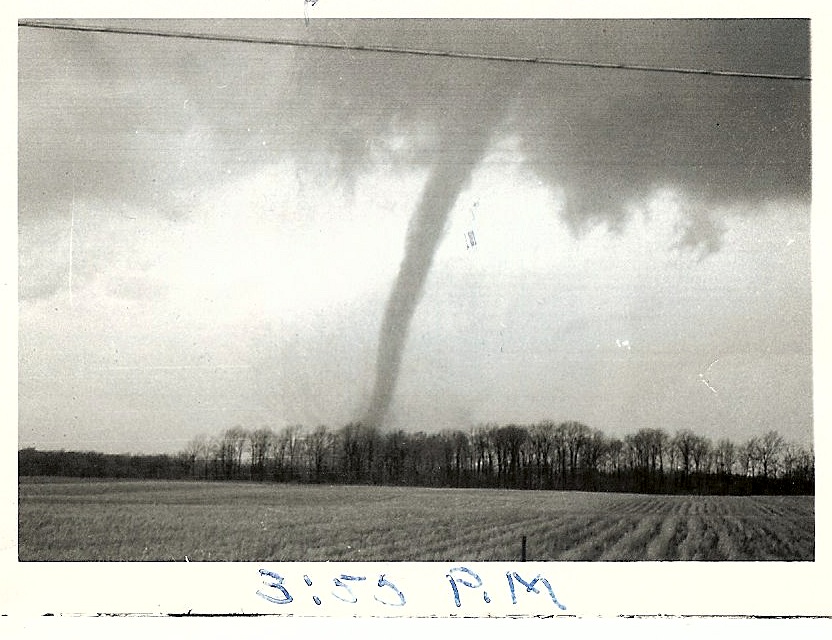
50 years ago today I came close to death.  I was in a house that took a direct hit from an EF4 Tornado (winds of 207-260 mph) in Eaton, Ohio.  It was shortly before 4:00pm on a late April afternoon and I was in my bedroom organizing baseball cards with my best friend.  My mother was visiting a neighbor with my younger brother.  I looked out the back window and looming straight ahead about a half mile away was a tornado dancing back and forth right in front of my eyes.  It appeared to be on a direct path to our home.

I remember seeing details that you normally don't pick up in photographs.  I clearly could see lumber, shingles and other debris swirling around near the top of the twister.  We made a quick call to my friend's home to warn them of the approaching tornado and headed for the basement.  We bounded down the stairs. We heard the sound of a car's horn racing down the main road that was parallel to the tornado's path.  We later learned it was the family who operated the farm behind us who had decided to run for it rather than go to their basement.

A few seconds later the tornado hit. It was a deafening roar.  It was as if you were standing right by the railroad tracks and a train was going by at enormous speed. I coveried my ears with my hands because of the roar.  I remember my friend and I shouting at each other at the top of our lungs but you could not hear a word over the sound.  Suddenly it got even louder and it sounded as if the entire house was caving in. I remember looking up at the floor and joists above me and thinking that this was it.  I fully expected to be soon buried alive.  Time did slow down.  I remember thinking I had just turned eleven years old and this was the end of the road for me.  It then became deathly quiet.  The floor had held and my friend and I checked each other to be sure we were all right.

We cautiously started up the basement stairs.  The door would not open but we both put our shoulder to it and pushed hard. We got it about half way open and slithered out the basement door.  Staring at us through the adjoining door to the garage was a steel beam that had been thrown around like a tooth pick. It had penetrated almost a foot through the door into the house.  The windows on the back side of the house that faced the tornado were all broken.  The draperies hung in tatters and were now blowing in the wind.  The windows on the front of the house were intact but were caked with dirt and grass that looked like it had been sprayed on. The dirt was so thick you could not see through the windows at all.  All through the house lay debris. Drywall from the ceiling was laying all over. You could look up and see the sky through the open roof.

I tried to make my way back to my bedroom but I couldn't navigate the debris that littered the hallway.  My friend and I went out the front door and we could see the tornado continuing on its way to more destruction down the road.  The tornado looked much better from the backside.

I did not have shoes on but I began running toward the house where my mother was.  It had been spared but for some minor damage.  It was a debris field of 2x4's, downed electric wires and protruding nails to get to her. I saw some hay straw blown straight in to some siding as if it was a nail. I reached my mother and looked back at our house for the first time.  I almost could not believe the sight.  It looked as if our house had been bombed.  I had a hard time choking back tears as I saw our house.  I kept saying to my mother, "Look at our house".  She just kept repeating, "It is ok.  You are alive". Even after 50 years, you do not forget a day like that.

Photographs and other background on the tornado of April 25, 1961


Photo taken of the tornado by a local photographer at close to the time it destroyed our house.


Photo of what was left of the Turner farmhouse that was directly behind our house.  Witnesses said that when the tornado hit the 2-story frame house it lifted it straight up and the house exploded. The entire remains of the house was deposited in the basement as debris.  Fortunately, the Turner family did not go to the basement for shelter.  Mr. and Mrs. Turner started for the basement but their 20-year son did not feel the house could withstand the tornado.  They jumped in their car and made a run for it.  That decision undoubtedly saved their lives. It was their car horn I heard in the basement right before the tornado struck.


Our house was totally constructed out of stone.  I was in the basement on the left side of the house as you look at this picture.  The people are on top of debris that used to be the garage and a back porch that were on a slab.  It was the sound of the collapse of this part of the house that had me thinking the entire house was coming down on me. You can also see that the entire roof on the side of the basement in was in was destroyed.


The house as it looked shortly after construction in 1957 (4 years before the tornado). I was in the bedroom looking out the window on the far right side of the house when I first saw the tornado approaching.


The house from the right front showing the collapsed garage.  I was in the basement near this corner of the house when the tornado struck.


Through April 24, 2011 according to the National Weather Service, there have been 438 confirmed tornadoes in the United States. Only one has been an EF4 similar to the Eaton tornado of 1961.  We have already seen 306 tornadoes in April, 2011. This is the highest April total ever.  The previous record was 267 in 1974. The average number of April tornadoes is 163.  Keep your eyes on the sky and take shelter immediately if one of these terrible twisters heads your way.

Tuesday, April 23, 2019

Move On

MoveOn.org is known for its far-left advocacy of progressive politics.

This is how MoveOn describes itself on its website.

Whether it’s supporting a candidate, passing legislation, or changing our culture, MoveOn members are committed to an inclusive and progressive future. We envision a world marked by equality, sustainability, justice, and love. And we mobilize together to achieve it.

It is probably not surprising that MoveOn also has this graphic prominently displayed on its web home page.


It wants Congress to begin impeachment proceedings against Donald Trump immediately for his abuse of power and violation of public trust.

I guess they don't love President Donald Trump. Would they love Mike Pence any more?

What I find ironic in all of this is that MoveOn was created in 1998 following the release of the report of Independent Counsel Kenneth Starr on President Bill Clinton's activities in The White House.


The founders of what became MoveOn.org launched a petition drive initially called "Censure and Move On" in which it asked people to demand that "Congress must Immediately Censure President Clinton and Move On to pressing issues facing the country."

Why were MoveOn founders Joan Blades and Wes Boyd motivated to start the petition drive and the organization?

They were concerned about "the partisan warfare in Washington" following revelations of the affair that President Clinton had with White House intern Monica Lewinsky.

Let's recap all of this.

MoveOn.org wanted the country to move on after the Starr report because of partisan warfare in Washington and the pressing issues facing the country.

However, MoveOn.org now does not want to move on when Donald Trump is President despite the pressing issues facing the country today.

And MoveOn.org was founded because of concerns about "partisan warfare" in Washington?

It is impossible to make this stuff up.

The Mueller report found no collusion with Russia by any person in America regarding the 2016 election. Mueller could also not make any credible case for obstruction of justice by President Trump who was then cleared of any charges by the Department of Justice. Consider further that you might also be be a little upset at a 2-year investigation into collusion with Russia when you did nothing of the sort.

My suggestion to MoveOn.org is simple---Move On. There are pressing issues facing the country.

MoveOn.org recognized that at one time.

Why not now?

It must have something to do with "partisan warfare in Washington". MoveOn.org  was very concerned about it in 1998. However, they are now responsible for contributing to it in 2019.

Move On!

Sunday, April 21, 2019

Student Debt Distress

I spoke to 140 students at the University of Cincinnati on "Making Their Money Count After College" a few weeks ago.

During my talk I asked the students how many of them would graduate with student loan debt. Almost all of them raised their hands.

I told the students they were not alone. They join 45 million other Americans who owe money on student loan debt.

Total student loan debt is now $1.67 trillion.

Let's put that number in context.

That number is now higher than credit card and auto loans, combined, according to collegedebt.com

That number is greater than the entire GDP of Russia.

That number is also greater than the combined assets of financial giants Goldman Sachs ($957 billion) and Morgan Stanley ($866 billion).

Consider these numbers and then also consider political candidates telling young people that they are going to provide free college tuition or forgive student loans. If you think of it in practical terms, you cannot do one without the other. How can you forgive current student loans and not make college free going forward? How can you provide free college tuition prospectively but not wipe out student loans retroactively? In any form it would be a fiscal disaster that would spin out of control.

Beyond that, what about those people who scrimped and saved the money for their child's college education? What about those students who worked and saved the money to put themselves through college so they would not have to borrow? Shouldn't they be entitled to reparations if loans are forgiven or free college is given to others prospectively?

Underlying all of this is the fact that no segment of the economy has seen costs grow at a faster pace than tuition and fees for higher education over the last 30 years. College costs have increased at about twice the rate of health care over that period. Overall, college costs have grown at about four times the rate of inflation.


College costs could not go up without a supply of money to pay for it. Just as is the case with health care costs, college costs have become heavily dependent on the flow of federal money into the system.

Ironically, a program that was designed to assist students to afford college seems to be making it more unaffordable with each passing year. That is what occurs over and over when a well-intentioned "liberal" idea meets the real world. A desire to do good by government ends up being the undoing of the very people it was intended to help.

Fiscal watchdog OpentheBooks.com has recently completed a budget analysis of the U.S. Department of Education with a specific focus on the $120 billion in annual subsidies paid for higher education in the form of grants and student loans. Student loans make up 79% ($95 billion) of that annual amount.

One of the findings is how much the Ivy League is receiving in Department of Education funding despite the massive endowments these schools have.

For example, Harvard College got $154.1 million in federal subsidies for student education despite the fact that it has a $34 billion endowment.  Columbia received $263.2 million despite having a $9 billion endowment.

Why is the federal government funding grants and student loans for colleges with such large endowments? Why aren't schools with large endowments required to fund college loans for their own students? Why wouldn't loans to their own students not be considered a good investment for their endowment funds?

I wrote about the size of the Ivy endowments two years ago when in the aggregate they totaled $119 billion for the eight schools. At that time, those funds were sufficient to pay the tuition of every student at these colleges for the next 51 years without any further growth in the endowment!

When you consider that the universities also received the benefit of the charitable contribution tax subsidy as they received the donations that make up that endowment, the case is even stronger that reforms need to be made regarding federal student loans at schools with large endowments.

Subsidies to the Ivy Leagues pale in comparison to what is flowing to other schools, particularly large public university systems with lots of students.

Here is a list of the top 10 colleges by the amount they received in grants, direct payments and student loan monies for the most recent fiscal year.

The City University of New York received over $1.1 billion in federal education subsidies last year?


Source: OpentheBooks.com


Notice two of the schools on the list are for-profit colleges (University of Phoenix and Grand Canyon University). Combined, they got about $1.2 billion in federal funds.

What are the graduation rates at these two schools?

Phoenix  17%

Grand Canyon  31%

With graduation rates like that what chances do these students have to pay-off the loans they took to attend these schools? They have the debt but they don't have a degree.

Why should the taxpayers have to bear the cost of future defaults from these loans?

Why aren't these schools required to at least share some the default risk? They gained the dollar benefit upfront. Why should they not bear the financial risk if the loan goes unpaid?

A lot of people argue that more students should be going to junior colleges or community colleges for a couple years to keep college costs lower and to limit student loan debt. That generally sounds like a good idea.

However, look at the student subsidies paid to these schools and the graduation rates.


Source: OpentheBooks.com


As bad as all of this is, it actually gets worse when you consider the education money flowing to hair and beauty schools.

The largest school, Empire Beauty School, received $534 million in federal education subsidies between 2014 and 2017.

Empire charges students $14,000 in tuition per year to learn how to cut and style hair, apply makeup and give massages over a one to two year period required for graduation. Most students pay with federal student loans.

What is the average pay of their graduates? The New York Times did a study of regarding the economic outcomes of students from these types of schools. At age 34 the median income of Empire Beauty School graduates was $18,800 per year.

Does that sound like a good investment? Take on $14,000 in student debt to get a job that pays $19,000 per year?

None of this could occur but for the massive amount of federal government money made available to facilitate it.

That money is the root cause of why a college education (and beauty and barber schools) have become unaffordable.

The answer is not to throw even more money at it as liberal politicians so often want to do.

It is time to put more accountability on the educational institutions who reap the benefits by making them put more skin in the game.

That should be the first step to putting an end to the student debt crisis that is causing so much distress to so many.

Thursday, April 18, 2019

Journeying Out

What is the safest mode of transportation?

That is a question we often hear and it seems to be asked more when there is a high profile accident like the recent Boeing 737 Max airliner crash in Ethiopia.

We often hear that airline travel is the safest way to travel.

However, a lot depends on how the calculation is done.

Do we consider miles (or kilometers) traveled per fatality?

Do we consider the amount of time that was traveled per fatality?

Or do we consider fatalities per journey?

Most calculations you see measure fatalities per mile traveled.

However, it could be argued that what people are really asking when they pose this question is what are the chances they will embark on a trip and end the journey safely.

Here is a chart that shows the safety of various modes of transportation measured per one billion journeys.


I doubt many are surprised that embarking on a skydiving adventure or getting on a motorcycle are pretty risky.

You probably also knew that getting on a bike was riskier than getting in a car but did you realize it is four times riskier?

Walking is also as risky as getting in a car. After all, those cars are usually in close proximity to where you are walking. However, did you know that getting on a bus is almost 10 times safer than getting in a car?

Based on this measure, air travel is also not nearly as safe as it is normally portrayed. Each time you get on a plane you are actually taking on about three times the risk compared to each time you get in a car.

Air travel involves long distances and few overall passengers so its statistics look much better when calculated on a per mile basis.

Auto travel involves a lot of small trips over short distances with a few passengers each time but spread over trillions of trips.

Bus travel generally involves slightly longer trips than cars but many more passengers on each journey.

To show you how the statistics vary based on the measurement used, here is the same data (excepting skydiving) viewed by journeys, hours and miles.


Credit: Wikipedia


Air travel looks much better when measured by time and it looks fantastic based on miles. There is nothing even close.

Bus and rail look safe no matter how you measure it. Likewise, riding a motorcycle is risky on all counts.

What is the big takeaway from all of us.

I say it a lot in the pages of BeeLine.

"Context is everything when assessing anything."

It applies even when assessing transportation safety.

Tuesday, April 16, 2019

Bernie's Returns Reveal A Lot

Socialist Presidential candidate Bernie Sanders likes to rail against the rich. However, his tax returns reveal that is just what he is.

Sanders reported over $1 million in adjusted gross income ("AGI") on his 2016 and 2017 tax returns and over $500,000 in 2018.

How does a public servant get that rich? The easiest path today is to run for President and write a book.

I guess that explains why we have nearly 20 Democrats now running for President and that number is likely to climb. There is no better way to gain fame and fortune in this media era we live in than declaring a run for the Presidency. I still find it ironic that the one guy who did not need to do that to get fame and fortune is the one who is criticized the most for using the office for financial gain. Forbes magazine actually reported that Trump has lost wealth as President. Every other person gains wealth. Look no further than Barack Obama and Bill and Hillary Clinton for ample evidence of that.

Sanders said last night on a town hall meeting on Fox News Channel that he was not going to apologize for writing a great book (did he really write it or was it a ghostwriter?) that people wanted to read and he made a lot of money on.


Bernie Sanders at Fox News Channel Town Hall, April 15, 2019
Credit: nbcnews.com


I agree. More power to Bernie for cashing in. However, let's be real. Sanders would not have had two people interested in what he had to say if he was not a Senator from Vermont and ran for President. Everything he has "accomplished" was done on the public dole. Everything he might accomplish in the future will be done the same way.

That is why it is easy for Bernie to say that he wants to tax the rich, redistribute the wealth and pay more taxes individually. The economics are simple. Bernie the politician gains power and money that are many multiples of what he might ever pay in taxes individually. That power comes from the money in other people's pockets that he wants to trade for votes.

Sanders earns his reputation as a Socialist honestly. Until he was age 40 he never had a steady job or paycheck. Of course, when he got a steady job it was a government job---Mayor of Burlington, Vermont.

Investor's Business Daily provided some useful background on "Bernie Sanders, The Bum Who Wants Your Money" in an editorial in 2016.

Sanders spent most of his life as an angry radical and agitator who never accomplished much of anything. 

One of his first jobs was registering people for food stamps, and it was all downhill from there.
Sanders took his first bride to live in a maple sugar shack with a dirt floor, and she soon left him. Penniless, he went on unemployment. Then he had a child out of wedlock. Desperate, he tried carpentry but could barely sink a nail. “He was a shi**y carpenter,” a friend told Politico Magazine. “His carpentry was not going to support him, and didn’t.”

Then he tried his hand freelancing for leftist rags, writing about “masturbation and rape” and other crudities for $50 a story. He drove around in a rusted-out, Bondo-covered VW bug with no working windshield wipers. Friends said he was “always poor” and his “electricity was turned off a lot.” 

They described him as a slob who kept a messy apartment — and this is what his friends had to say about him

Of course, reviewing his tax returns reveal how wrong Sanders is when he decries our tax system. They also raise questions as to how he manages his own money.

A popular theme of Sanders is that the rich don't pay enough. We need to make our tax system more progressive so the rich pay "their fair share."

Let's take a look at that argument by looking at Bernie's tax returns.

In 2015, before the book royalties started coming in, Bernie had AGI of around $250,000. His federal and state income tax payments were $43,000---an effective tax rate of 17%.

In 2017, after the book money flowed in, Bernie had AGI of $1,132,00. His federal and state tax income payments were $488,486 ---an effective tax rate of 43%.

To put in more simply, Bernie's income increased a little over 4 times. His income tax bill increased over 10-fold. That is the result when you have a very progressive tax system. How much more progressive does Bernie want it to be?

What is also revealing to me about Bernie's tax returns is, that despite the millions he earned the last few years, there is little evidence of where it went (other than in income taxes) by reviewing his returns.

You would think that when someone comes into that type of windfall you would expect that some part of money would go into interest-bearing bank accounts, money market funds, bonds or stocks. This would be reflected on the returns in increased interest income and dividends.

Bernie reported $96 in interest income and no dividend income in 2015. He reported $381 and $1 in dividend income in 2018. Bernie does not seem very focused on saving for a rainy day. My children had more interest and dividends than this from savings from their summer jobs when they were teenagers.

What did he do with his new found wealth?

He didn't spend it on medical expenses. He reported just $2,250 in medical expenses for 2018. It was about the same in 2016 and 2017.

He didn't give it to charity. He gave 3.4% away in 2015 and the same percentage in 2018.

I have read that Bernie has purchased another house or two with his new found wealth but that is not apparent in looking at his returns. He took a deduction for $11,953 in property taxes in 2015 and $11,604 in 2018. That does not suggest he owned more real estate in 2018 than in 2015.

He may have paid down part of his home mortgage. He paid $21,658 in mortgage interest in 2015 but that amount was down to $11,804 in 2018.

It is a mystery to me how you can earn millions over the course of several years and there is no evidence of where it went by looking at that man's tax returns.

I will give this much to Bernie. He is a socialist through and through. He has not invested anything in the American system of capitalism. He apparently has not even purchased U.S. Treasury securities or U.S. savings bonds. He does not personally support many charitable activities. There is little to suggest that he is invested in anything but himself.

Of course, the Democrats are hell-bent in trying to get a hold of Donald Trump's tax returns. Would they also be revealing? I have no doubt that there would also be interesting information in those returns as well.

However, it surely would not show any evidence of "collusion" with the Russians which is the reason the Democrats claim they need to see the returns. It more likely shows that Trump may not be quite as wealthy as he claims to be. He might have paid less in taxes than you might think because of large (legal) depreciation expenses on his properties. It might also show that Trump is no more generous with his money than Bernie is.

However, those returns also undoubtedly show the expansive and complex real estate empire that Trump built and the thousands of jobs that were created in the process for other Americans.

Say what you will, but Donald Trump has a long history of investing and putting money to work in the United States of America. He is what is called a "maker".

Bernie Sanders, from all appearances, is nothing but a "taker."

Is he going to "take" the Democrats and the country for a ride as well?

Sunday, April 14, 2019

No Gain Without A Lot Of Pain

"Medicare for All" has become a popular theme for many Democrats and that party's Presidential candidates.

Bernie Sanders introduced his proposal last week. Predictably, it is short on details and makes no mention of how it would be paid for.

It is claimed that going to a government-run single payer program will massively reduce administrative expenses and lower health care costs for the American public. In so doing, private insurance companies, and their "obscene profits", will be eliminated from the system.

I have written before how the facts about healthcare costs are often much different than it is portrayed by politicians and understood by most of the public at large.

For example, one fact that is often overlooked is that the average cost per day for a hospital stay is actually higher in a non-profit hospital than in a for-profit hospital. The costs are also higher in a state/local government run hospital than a for-profit one. I wrote about this in 2013 but it is still true today.

This is exactly the opposite of what Democrats would have you believe when they argue that healthcare should be a not-for-profit government function. They argue government or non-profits are able to deliver healthcare better and cheaper as there is no profit motive adding to costs.

Here are the latest average costs per inpatient day for hospitals based on ownership according to the Kaiser Family Foundation. All of the other charts below are also from the KFF with the exception of the out-of-pocket expenditures by country comparison chart which is based on WHO data.


When you consider that hospital costs are the biggest component of national health expenditures, it would seem to be a pretty significant fact that for-profit hospitals are over 20% less costly than non-profits.

Why is this? I explained in my previous post.

A big reason for the higher costs with non-profit hospitals is the lack of accountability. They are not accountable to tax collectors, shareholders, and most particularly, patients (due to our third party payment system where it is rare that the bill is paid by the person receiving the treatment).

How about another fact that most people are not aware of? Many complain about high deductible plans today, which has meant more out-of-pocket spending by patients. However, the reality is that out of pocket costs still make up only 11% of total U.S. health care expenditures in the United States. In 1970, it was 33%.


Americans are also paying less of the total share of national health expenditures in out-of-pocket expenses than other countries.

How much better can it get on this score? Would "Medicare for All" lower these "out of pocket" costs? Our out of pocket costs are already lower than in the "socialist" systems.


Let's also look at the components of U.S. national health care expenditures to determine how big the effect would be if we could reduce administrative costs (including all private insurance profits) from the system.

Here is where the $3.5 trillion in healthcare expenditures went in 2017 that represented about 18% of the entire GDP of the country.

Hospitals account for 33% of all costs. Physicians and clinics are 20%. Drugs are relatively small at 10%.


Total expenditures per capita have increased 30-fold since 1970. Adjusted for inflation, costs have increased 6-fold!


Administrative costs (included in other health costs above) make up just 7.4% of total costs. This includes all private and public plan administrative expenses and all the profits of the private insurance companies. 92.6% of healthcare costs would remain even if you removed all private insurance companies and administrators in the system.

In other words, you could eliminate all the administrative costs that are being paid for by all the private insurance plans, Medicare and Medicaid and you would only save about one year of health care inflation.

Granted, there are internal administrative costs in the costs of each hospital and medical provider but it strains credulity to believe that this alone is going to significantly lower healthcare costs in the United States.

What can be done? There is no easy answer despite what glib politicians might tell you. In fact, as I have written before in my post "Why Is Health Care So Expensive", everything suggests that the problem will get even worse no matter what the policymakers do. Every factor is trending against controlling health care costs.

More and more medical technology becomes available everyday. Americans have rebelled against every attempt to limit choice in selecting doctors, hospitals, etc. Americans are getting older. Americans are not getting any healthier and the United States still has more money to spend on healthcare than any other country. Attempts to control costs are akin to trying to change course heading into a Category 5 hurricane.

How could health care costs take a smaller bite of our economy and household budgets?

There are only three options.

1. Hospitals, doctors and other providers have to make less money.

2. Patients need to see their care rationed or limited in some way.

3. We all need to get a lot healthier.


"Medicare for All" sounds great as a theory. 56% in a recent poll stated they favored the idea. They liked the idea of guaranteed health insurance (71% favor) and eliminating health insurance premiums and reduced out of pocket expenses (67%),

However, support collapses when people hear exactly how the plan would have to work--eliminate private health insurance (37%), require most people to pay taxes (37%), threaten current Medicare (32%) and delays in getting medical tests and treatments (26%).


The bottom line is this.

There will be no gains in controlling healthcare costs without a lot of pain on someone...and most likely, everyone.

Don't let any politician convince you otherwise.

If you want to actually consider a system of healthcare that might work at controlling costs, while serving the American people better, read my previous blog post "Revolutionary Replacement".