Tuesday, May 8, 2018

Stine or Steen?

Rod Rosenstein. Harvey Weinstein. Diane Feinstein.

These names are in the news a lot but what is the correct pronunciation?

Is it STINE or STEEN?

I hear both.

Rod RosenSTEEN and Rod RosenSTINE.

Harvey WeinSTEEN and Harvey WeinSTINE.

Diane FeinSTEEN and Diane FeinSTINE.

However, there never seems to be any confusion with these famous names.

Frankenstein.

Einstein.

They never are mispronounced. We know they end with STINE.

Those of us who lived through the Watergate years also know that Carl Bernstein (STEEN), along with Bob Woodward, broke many of the big stories of that era writing for The Washington Post.

If you really want to get confused, consider legendary New York Philharmonic conductor Leonard Bernstein.


Leonard Bernstein
Credit: MilkenArchive.org


Bernstein grew up as Lennie Bernstein (STEEN) in a small town near Boston.

Lennie was not a good name for a symphony conductor so he became Leonard Bernstein (STEEN).

Later on in his career, Bernstein (STEEN) thought he needed to become  more classically identified, so he changed the pronunciation of his last name to BernSTINE.

I knew him first as BernSTEEN and had to later come to know him as BernSTINE.

Are you as confused as I am?

However, we both have not had to endure the life confusion that Michael Silverstein (STEEN) has had due to all of this STINE and STEEN business.

Silverstein wrote a humorous blog post on "How To Pronounce My Name" a few years ago. He blames any confusion on how to pronounce his name on Leonard Bernstein.

People used to have no trouble pronouncing my last name, Silverstein, with the last syllable pronounced steen. They also had no trouble with Goldstein, Bernstein, Weinstein, and all the other -steins, which were all pronounced with the same steen ending. The only time anyone used to address me or the other -steins with a stine ending was when they wanted to be offensive; such a pronunciation amounted to a backhanded ethnic slur.
And then Leonard Bernstein came along. 

Silverstein then tells the story that I have summarized above.

So, which is it? STINE or STEEN? What is really right? Is there a real rule?

My research indicates that it all depends on an individual's preference.

After all, it is their name and they can choose to be called anything they want to be.

If you want more it seems that the German pronunciation would definitely indicate that -stein would be STINE.

The name Stein by itself also always seems to be pronounced STINE. Never STEEN.

Names ending in -stein in Germany are also always pronounced STINE.

It is in the United States the STEEN has appeared.

Some argue that it was a way to separate themselves from their German heritage.

Some argue that it has something to do with German-Yiddish translation.

Some argue that the STEEN has been used when the name has a hard-sounding first syllable. STEEN is softer sounding than STINE. That may be why WeinSTEEN is preferred over WeinSTINE by Harvey.

Some argue that it is due to confusion at Ellis Island in recording the names of immigrants.

I am not sure what the real reason is.

However, I suggest we raise a stein to anyone that has to deal with the STINE or STEEN question.

Life is hard enough without people mispronouncing your name every other day.

Rod RosenSTINE, Harvey WeinSTEEN and Diane FeinSTINE should all agree.


Credit: LonelyPlanet.com, Thomas Sauzedde

Postscript:

By the way, if you read my last blog post on the reluctance of politicians to retire and leave their name identification behind, there is no better example than Diane Feinstein.

Feinstein is running for re-election to her Senate seat from California. She will be 85 years old next month. She was first elected to political office in 1969. Ted Cruz and Marco Rubio were not even born when Feinstein held her first elected position!

Sunday, May 6, 2018

It's All In The Name

My father used to tell me that the most important asset you had was your name. It was important to always protect it.

In politics, it is also about the name. A politician's name identification. It is their most important asset. However, instead of protecting their name, most politicians are intent on using and promoting their name. It is the primary currency for any politician.

Name ID is huge for any politician. The reality is that, beyond presidential general elections, a great number of voters do not have a deep understanding of who is running and what the candidates stand for.

Therefore, it is a huge advantage when a voter goes into the voting booth and sees a name that they are familiar with. This is why incumbents are so hard to beat in Congressional races.

Here are the incumbent re-election percentages between 1964-2016 in the U.S. House of Representatives. 98% of incumbents won re-election in the general election in 2016.


The substantial "asset value" that a politician has in his or her name is also the reason why so many politicians have a hard time stepping away. They know they have an "asset" and they want to use it. It really becomes a question of "use it or lose it."

This is very apparent in the Ohio gubernatorial primaries for Governor that will be decided on Tuesday.

Mike DeWine is running for the Republican nomination for Governor. DeWine is 71 years of age and was elected to his first political office (Ohio State Senate) in 1980. He subsequently was a U.S. Congressman, Ohio Lt. Governor and a U.S. Senator for Ohio for 12 years. He was defeated in 2006 by Democrat Sherrod Brown in his bid for a third U.S. Senate term but then ran for Attorney
General of Ohio which he won in 2010. After serving two terms, he now wants to be Governor when most people would be selecting their retirement home.

His name ID seems to be burning a hole in his pocket.

DeWine is running against the current Lt. Governor, Mary Taylor, who is 52 years of age. She also wants to take advantage of her name ID. She was first elected to the Ohio House in 2003 where she served two terms and then on to Ohio State Auditor for one term before her two terms as John Kasich's running mate as Lt. Governor.


Similarly, Dennis Kucinich is running for the Democrat nomination to Governor. That name should be familiar to a lot of you even if you are not from Ohio from his two Presidential runs.

Kucinich will be 72 years of age by election day in November. Kucinich was first elected to the Cleveland City Council at the age of 23 (almost 50 years ago!). He became Mayor of Cleveland at the age of 31 in what turned out to be a tumultuous two year term. He subsequently was elected to the Ohio State Senate and then the U.S. Congress where he served for 16 years. He ran for the Democrat nomination for President in both 2004 and 2008.

His name ID is also burning a hole in his pocket.

Kucinich is running against Richard Cordray (age 59) who was first elected to political office in 1991. He served in the Ohio House and later was Ohio's State Treasurer and Attorney General. He was defeated for re-election in 2010 by DeWine and subsequently was appointed by President Obama to be the first Director of the Consumer Financial Protection Bureau.

When I first got involved in political consulting in the early 1980's a wise politico told me this is the way the game works. Very few politicians walk away without trying to spend all of their name ID. Most will keep trying to climb the ladder using their name ID currency as far as it will take them. For many of them, they don't have much going for them except for that name ID. It is bigger than any amount of money they have in the bank or any ability they have to govern or lead.

As a result, the deck is largely stacked against younger politicians who want to get in the game. This is particularly true for statewide races. Money and old-fashioned door to door campaigning can overcome name ID in a district, city or county race but it is hard to overcome name ID in a statewide election. Door to door is of limited utility and the money required to overcome a statewide name ID disadvantage is astronomical.

The same is true in Presidential elections.

Who are the names we hear the most right now for the Democrats in 2020?

Hillary Clinton (age 70) seems to be trying very hard to keep her name in circulation.

Bernie Sanders (age 76) built a lot of name ID in 2016. Do you think he wants to leave that on the table in 2020?

The same holds true for Joe Biden ( age 75) and Elizabeth Warren (age 69).

They all know they have name ID and they are not eager to let it go unspent even if they should be more concerned about their retirement house rather than The White House.

It is the way of politics.

It's all in the name.

And not many politicians are willing to forsake the opportunity to spend it all while they can, no matter what their age.


Thursday, May 3, 2018

Backwards In Seattle

20 North American cities (19 in the U.S. and Toronto) are currently vying to be chosen as the second headquarters site for Amazon, Inc.

Amazon says it expects to spend $5 billion to build a headquarters building and fill it with 50,000 well-paid high tech workers. Of course, that will lead to a cascading effect as additional doctors, teachers, waiters, carpenters and store clerks will be needed to serve that worker population. Those 50,000 jobs may each come to support three or four additional jobs in the local economy of the chosen city.

New York City, Chicago and Los Angeles are all in competition for the Amazon jobs. So are Dallas, Atlanta, Philadelphia, Miami and Boston. Washington, DC is on the list as are Northern Virginia and Montgomery County, MD.

Austin, Denver, Pittsburgh, Columbus, OH, Indianapolis, Nashville and Raleigh are also in the hunt.

Amazon, founded in 1994 in a garage in Seattle, now employs 585,000 people.

45,000 of them work in the city of Seattle.

The politicians who run Seattle are apparently not content with the good fortune that brought Jeff Bezos to Seattle to establish Amazon. They seem intent on "killing the goose that laid the golden egg."

The Seattle City Council is in the process of considering an employee head count tax that would levy a $540 "head tax" on each employee of employers in the city. It is expected to generate $75 million per year. Based on Amazon's 45,000 employees, that head tax would amount to over $22 million in additional costs for the company each year.

Amazon has responded by announcing that it is suspending construction of a new office building for employees in downtown Seattle and is considering subletting another building it recently completed due to the proposed head tax.

Is it any wonder that Amazon is looking for a "second headquarters site"?

The head tax proposal is scheduled for a vote on May 14.

Last July I wrote about "The Socialist State of Seattle" and the far left agenda that its city council is pursuing. You would think that these people would take a look at what is happening in Venezuela and realize that the socialist ideal never seems to be fulfilled no matter how many times it is tried.

It should probably not come as a surprise that the Seattle City Council is comprised of this group of men and women.


Credit: Wikipedia


Other recent laws and ordinances passed by the Seattle City Council include other prized progressive policies---a $15 minimum wage, a soda tax and a "secure scheduling ordinance" which mandates that employers set their employees' schedules weeks in advance and penalizes companies for changing them.

These were small potatoes compared to the income tax that the City Council passed last year targeting only those with incomes over $250,000 to be effective in 2019. This was done in violation of the State Constitution which I wrote about in detail in my earlier post. The State of Washington remains one of the few remaining states to not levy an income tax. The City of Seattle is not happy about it but only for "the rich".

The stated purpose of the "head tax" is to generate funds towards fighting the city's "homeless crisis".

However, the Seattle Times recently reported that the city has already doubled spending on such programs since 2013 (to $63 million) and has spent almost $1 billion on the problem over the last 20 years to no avail.

Local residents are increasingly angry about the city allowing unsanctioned homeless tent cities to expand into their neighborhoods with the city council doing little to police the violations. At last count there were more than 400 such tent cities in Seattle.


Homeless Tent City in Seattle
Credit: Seattle Times


Seattle's answer seems to be to make Amazon and other employers pay for this "injustice" but do little to enforce simple justice with zoning and vagrancy laws. I guess enforcing these laws is about as popular with liberals as enforcing immigration laws.

The logic of the supporters of the head tax is quite interesting. They are effectively arguing that Amazon and other employers are at fault by being successful and hiring many people at high wages that has had the effect of hurting other people.

“While Amazon didn’t single-handedly cause this problem, they have contributed to the growing income inequality, displacement and housing affordability issues facing our City.   It seems only fair that as so many struggle to make their way through a tax system that’s rigged in favor of large corporations, that we ask those same corporations to financially contribute to the public health and housing solutions designed to address those consequences said members Mike O’Brien, Lisa Herbold, Lorena Gonzalez and Teresa Mosqueda.
“It’s about large companies that are really benefiting from the economic growth in this region in a way that is leaving other people in Seattle behind,” "It's time for companies like Amazon to share the wealth they have experienced in Seattle" said City Council member Lisa Herbold.

Progressives always like to think they are the forward thinkers. On the contrary, the Progressives on the Seattle City Council seem to have it all backwards.

They seem to think that Amazon somehow benefited more from being in Seattle than Seattle did by having the good fortune to have Amazon based there.

They also seem to think that Amazon and other successful businesses are the problem because they have made so many people much better off.

They like to talk of inequality and injustice. True injustice occurs when there is no one left to pay the bills.

I guess they will only be happy when everyone is poor.

How happy is anyone these days in Venezuela?

Thursday, April 26, 2018

What's Your "Social Credit" Score?

People in the United States know that your credit score is important. It determines your ability to access credit but your score may also affect your ability to get insurance, and its cost, and even your ability to get a job.

People in China have much greater concerns. The Chinese government is in the process of instituting a "social credit" score on every person in its enormous 1.4 billion population in order to monitor their behavior.


Credit: luminous-landscape.com


This is how Business Insider describes the ranking system which is due to being fully operational by 2020. It is already being piloted for millions of people in China right now.

The "social credit system," first announced in 2014, aims to reinforce the idea that "keeping trust is glorious and breaking trust is disgraceful," according to a government document.
Like private credit scores, a person's social score can move up and down depending on their behaviour. The exact methodology is a secret — but examples of infractions include bad driving, smoking in non-smoking zones, buying too many video games and posting fake news online.

China is using 176 million surveillance cameras it has installed to support the "social credit" system with plans to increase that to 660 million cameras by 2020.  Drivers who don't stop at crosswalks and jaywalkers risk losing points.

It is believed that saying positive things about the government, community service and purchasing Chinese-made products can boost your score.

What happens if you get a low score? Here are a few of the "penalties".

  1. Banning you from getting on an airplane or train to travel
  2. Throttling your internet speeds
  3. Banning you or your children from attending the best schools
  4. Preventing you from getting the best jobs
  5. Banning you from owning property
  6. Keeping you out of the best hotels
  7. Being publicly named as a "bad citizen"

According to CBS News, 11 million Chinese are already banned from flying and 4 million cannot travel by train due to low scores.

What are the benefits of a higher score? For starters, you can continue to travel, browse the internet, get your kids into the best schools and own property. You might also get your name on the "good citizen" list.

Those with higher point totals who are considered "trustworthy" may also get discounts on their energy bills, better interest rates or get their profile boosted on China's largest online dating site. You might laugh at that last one but when you are one of 37 million excess males in China under the age of 30 you will probably pay more attention to your "social credit" score with that in mind.

Those of us in the United States undoubtedly look at all of this with horror.

It should be a sober reminder of how fortunate we are to enjoy the freedoms that we do.

However, in some respects, we are not as far removed from where the Chinese are as you might think.

Look no further than what is going on in the United States of America today. Here are a few examples that have recently been in the news.

Shania Twain stated in a recent interview that she would have voted for Donald Trump if she was an American citizen (she is Canadian) and quickly became engulfed in an avalanche of criticism on social media. She subsequently apologized. Why?

Did anything similar occur if someone stated they voted for Barack Obama, Hillary Clinton or Bernie Sanders?

Kanye West said some nice things about a conservative black woman and Donald Trump. Another backlash ensues. Kanye did not back down and even doubled down with this tweet.


A New York City judge ruled that bars are allowed to refuse to serve Trump supporters. However, Christian bakers are not allowed to refuse to bake a cake for a gay wedding?

Conservative talk show hosts routinely have had their advertisers attacked in an attempt to keep them off the air. The latest was Laura Ingraham.

We also see conservative speakers on college campuses shouted down to such an extent that universities refuse to even allow them to speak on campus citing security concerns.

The Liberal Left and the Progressive Media believe that they know exactly how people should think and act. If you do not adhere to "their standards" you are a reprobate, a racist or a fascist.

Of course, the fundamental basis of a liberal, socialist or progressive ideology is that government does know best. Individual freedoms must be sacrificed for the greater good.

However, the United States of America was founded by men who were deeply suspicious of government power. They had experienced government oppression and overreach first-hand. The Constitution they wrote was intended to protect the governed, not the government. They even included a Bill of Rights to protect what they considered the most important individual rights and freedoms---speech, assembly, religion, the right to bear arms and the right to a trial of their peers.

Why do liberals complain about the constraints of the Constitution and argue that it should be interpreted as a "living document" that should interpreted based on the contemporary moral, political and cultural climate?

A big reason is that the Constitution favors individual freedoms over government power. Quite simply, the basic framework of the document is inimical to the interests of progressive, liberal ideology that seeks to increase government power and control.

We would all like to think that what is going on in China could never happen to us. However, you should never feel content or safe when talking about your freedom. What would happen with an extended period in which liberal Democrats control the Presidency and Congress? What does the Bill of Rights really mean to them? Is the Bill of Rights also subject to the contemporary political climate?

It is not a mystery as to what the Democrats believe on these issues. We see it every day in examples like those I cited above.

There is abundant  evidence of what their "social credit" scoring system might look like. I write the following somewhat "tongue in cheek" but, at the same time, we know that all of these are on the Liberal Left's list of what they see as deplorable behaviors.

Social Credit Scorecard (Points Subtracted)

-20 Voted for Trump

-10 Watch Fox News

-10 Believe that judges should interpret the law rather than legislate from the bench

-10 Own a gun

-10 Support traditional marriage

-10 Support voter id laws

-10 Believe that current immigration law should be enforced

-10 Believe in the words "In God We Trust"

-5  Believe you pay too much in taxes

-5  Eat at Chick-fil-A


On that scoring system, I would start out in the hole 100 points.

The Liberal Left likes to condemn, castigate, demean and delegitimize those that they disagree with. That is not consistent with the founding principles of the United States of America. It may be acceptable in Communist China. Let's hope it is never acceptable here.

God Bless our Founding Fathers.

God Bless our Constitution.

God Bless The United States of America.

Tuesday, April 24, 2018

Strikeout Spring

Baseball season is here. However, you can't tell it by the weather.


Credit; MLB.com


As of Sunday, April 22, there had been 26 major league baseball games postponed due to weather. That is the most postponements in April since records were first kept on cancellations beginning in 1986.

Since then, both Baltimore and Pittsburgh have postponed games bringing the total to 28.

The rainy and cold weather seems to be particularly challenging for hitters.

I can relate. Playing baseball in high school on a cold March day there was nothing worse that making poor contact with a bat in your hands. It felt like you were being electrocuted with the "stinger" that resulted.

Perhaps that is why, for the first time in almost 150 years of major league baseball, it appears there will be a full month where there are more strikeouts than hits.

Buster Olney reports that Elias Sports Bureau  has calculated that going into the games of April 23, there had been 5,562 strikeouts but only 5,174 hits this year.

This continues a trend because in each of the  last ten years major league baseball has set the record for most strikeouts in a season.

Last year the average team struck out 8 times per games.

To put that in context, the 1927 Yankees struck out an average of just 3 times per games.

The average for the major leagues did not get above 4 until 1952. It hit ( pun clearly intended)  5 in 1959, 6 in 1994 and 7 in 2010.

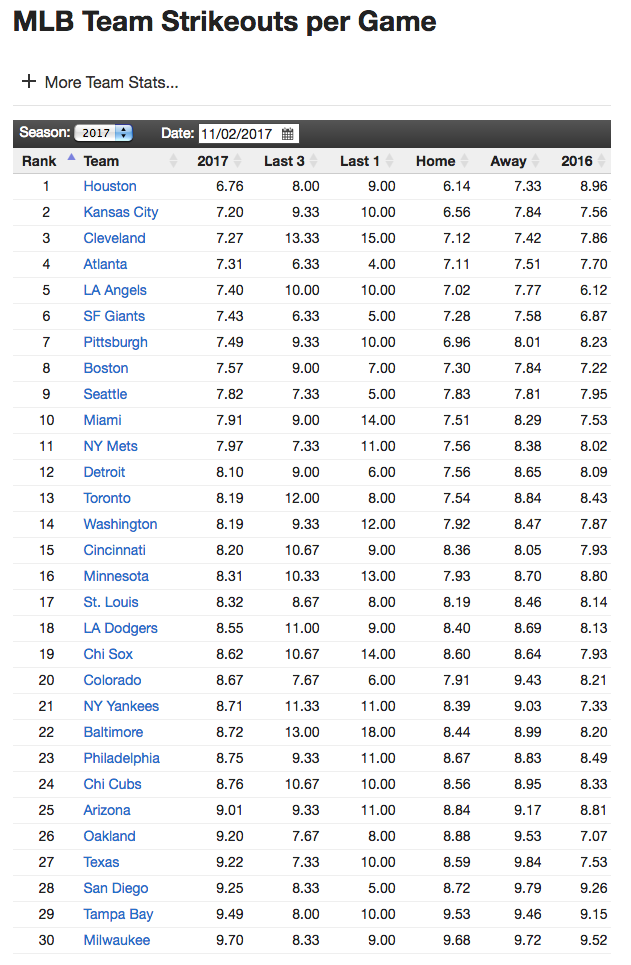
I guess it should not be surprising that the World Series Champion Houston Astros had the lowest team strikeout average per game last year---6.76.  Even more impressive was they dropped from 8.96 to 6.76 strikeouts per game between 2016 and 2017.


Credit: TeamRankings.com


At the same time, the Astros also led major league baseball in average hits per game.

Credit: TeamRankings.com


I guess it just goes to show you there is something to just getting your bat on the ball in order to play winning baseball. It is just as true today as it was when my highs school coach was telling me that over 50 years ago.

It is not easy to hit a baseball coming at you at 95 mph. However, it is a lot easier to do it when it is 85 degrees than when it is 45 degrees.

Bring on summer. The batters need it.

Sunday, April 22, 2018

Housing Presidential History

Do you know what this is?


When I first saw this architectural rendering I had several guesses of what it could be.


  • The proposed Mars space expedition vehicle assembly building
  • The new Indonesian National Bank in Jakarta
  • A new mosque proposed for Mecca in Saudi Arabia

I was wrong on all three counts.

This is the proposed Barack Obama Presidential Library in Chicago that is expected to cost $500 million to complete. That includes $175 million of estimated public funds for roadwork and infrastructure spending from the City of Chicago and state of Illinois.

In my last post I wrote about how profitable becoming President of the United States has become. It was not always this way. It might also not hold true for Donald Trump. Right now it looks like he will leave office poorer rather than richer.

In addition to the Presidency becoming a pathway to prosperity over the last 75 years, it also has become de rigueur to construct a library for the records and archives of each President. Most of the funding for these libraries are privately-funded by friendly donors of the President. There are no reporting requirements so there is no way of knowing what lies beneath the surface in this "generosity".

Up until this point, after construction is completed, the presidential library has been turned over to The National Archives and Records Administration which operates every facility for each President from Herbert Hoover through George W. Bush. The Obama Library will not do that. It will be owned and operated by the private Obama Foundation.

The Obama Library will also be different in that it will not actually contain any Presidential papers, records, archives or artifacts. All of the records will be digitized by the NARA and will be accessed remotely to where the records are stored in remote NARA facilities.

I think this means that if you want to view the Obama birth certificate, his school records when he went to a Muslim elementary school in Indonesia, or his college records, you are out of luck.

Of course, that is nothing out of the ordinary. These libraries are, by their very nature, attempting to tilt history in favor of their guy. For the same reason, I doubt we will also see Trump's tax returns on display in his future library.

Anthony Clark in Politico notes some of the shortcomings of what the presidential library has developed into.

Presidential libraries are perfect examples of just how far presidents will go to control their own legacies. Since the first one was created in 1941, what were intended to be serious research centers have grown into flashy, partisan temples touting huckster history. Built with undisclosed, unlimited donations, often to sitting presidents, libraries have traditionally been donated to the government after their construction. But even though they are taxpayer-funded and controlled by a federal agency, the private foundations established by former presidents to build the libraries retain outsize influence. The libraries’ whitewashed exhibits are created by presidential boosters; they host political events; their boards are stacked with loyalists; and many of their important historical records may never see the light of day.

At the same time, Clark believes that the Obama Library may establish a better presidential library model for the future in limiting governmental involvement in operating the facility while permitting the NARA to focus solely on the archiving of records and determining the proper time period for their release to the public.

It will be interesting to see how all of it plays out in the end.

Of course, if I am a betting man, I would wait until Donald Trump starts to plan his Presidential Library to see something that might me truly unique and trend setting.

Who knows what lurks in that real estate mind of his?

Then again, Trump many not even need to build an edifice to showcase his more important Presidential records.

It may turn out that one will simply go to Twitter and view the archives of his tweets.

These are Trump's tweets over the last 24 hours.


The only other thing needed would be a glossary of the nicknames in which Trump uses with his tweets. Trump has proven to have an uncanny ability to zero in on his enemies' biggest weakness or insecurity about themselves and immortalize it for all to forever remember.

Who can forget these nicknames even if we might want to?

"Little Rocket Man"

"Crooked Hillary"

"Low Energy Jeb"

"Pocahontas"

"Little Marco"

"Cryin' Chuck Schumer"


I cannot count the number of times I talk to someone who says that they voted for Trump, they like what he is doing, but they wished he would stop using Twitter.

Would Trump be as effective in fighting against Fake News and the Deep State without Twitter?

I doubt it.

More importantly, I am sure there is absolutely no doubt in Trump's mind that he needs to be doing this to get his message out.

It has been said that "nice guys finish last."

I don't know if that is true. However, of those that Trump has graced with a nickname on Twitter, not many have outlasted Trump.

Thursday, April 19, 2018

Nice Work If You Can Get It

Throughout most of our history, being elected President of the United States was not a path to riches and wealth.

In fact, a number of well-known Presidents were close to penniless in their later years.

Thomas Jefferson left no inheritance and was saddled with enormous debt when he died. Jefferson's debts were such a problem in his old age that Congress attempted to bail him out by buying his collection of library books at $4 per volume to replace the books in the Library of Congress which had been burned in the War of 1812.

Harry Truman had almost no assets when he left the Presidency and his only income was a small pension from World War I. He and his wife Bess moved into his mother-in-law's house in Independence, Missouri when he left Washington, D.C.  Truman's precarious financial condition was a prime reason that Congress first enacted a pension for former Presidents in 1958. However, this was not done until almost 200 years after the nation's founding.

Ulysses Grant was another President who was almost penniless when he died. Grant spent his last days writing his memoirs while battling throat cancer in order in the hope of providing some income to his wife Julia. His book, published posthumously, was a great success and went on to secure the financial future of his wife.

How times have changed today.

When Bill Clinton entered The White House in 1993 he has stated he had the lowest net worth of any President in the 20th century. His net worth is now estimated at $75 million by 24/7 WallStreet.com.

That puts Clinton in the Top Ten for richest ex-Presidents according to that same analysis (in constant 2016 dollars). Not bad for someone who came in with what was arguably zero net worth when he took office.

Until Donald Trump took office, George Washington was considered the richest President. Washington had a net worth estimated at $580 million (in 2016 dollars). His salary as President was also generous. At the time, it made up 2% of the entire federal budget.

If that percentage of pay based on the budget still held today, President Trump would be making $80 billion per year. Trump is effectively working without pay as he is donating his entire salary to charity.

You would think the Democrats and the Never Trumpers would give him some credit for that! Even George Washington did not turn down his salary.

Like Bill Clinton, Barack Obama had a very modest net worth when he became President. Four years before he became President of the United States he was an Illinois state senator making $85,000 per year.

Over the next 11 years, Barack and Michelle Obama made $20.5 million according to an analysis by Forbes magazine. And all of this while he was an elected government official!

How times have changed since the days of Harry S. Truman.


Credit: Forbes.com

Notice that about three-fourths of the income of the Obamas over that period was from book royalties.

Now that Barack Obama is a private citizen he can really take advantage of the private enterprise, capitalist economy that he often spoke critically of as a public official.

He is making $400,000 per speech.  He is in advanced discussions with Netflix to be paid to produce a series of high profile shows for the streaming service. Most significantly, the Obamas have received a $65 million advance for each of them to write a memoir about their White House years.

That $65 million number got my attention because I know a little about how the financial aspects of book deals typically work regarding royalties for authors. Let's put that number in context by looking at the general guidelines that most New York publishing houses follow for book royalties for authors.

This is from Alan Jacobson on "The Business of Publishing".

Typically, an author can expect to receive the following royalties:

Hardback edition: 10% of the retail price on the first 5,000 copies; 12.5% for the next 5,000 copies sold, then 15% for all further copies sold.

Paperback: 8% of retail price on the first 150,000 copies sold, then 10% thereafter.

Most people are shocked to see how little the typical author makes from writing a book. However, consider the fact that the publisher must pay the costs of printing, binding, warehousing, distributing, shipping, promoting and advertising the book and it makes more sense.

Let's look at the Obama deal more closely from the economic perspective of the publisher.

If you apply a 15% royalty on a $30 book that would equal $4.50 per book. Assuming normal financial terms for the publisher, it would need to sell 14.4 million books by Barack and Michelle in order to recoup the $65 million advance.

I have no doubt that the Obama books will sell a lot of copies. However, 14.4 million copies? At $30 per book that would put total gross sales for the two books at $432 million.

The best-selling book of 2017 sold 1.1 million copies. Here is the top 10 list in unit sales as compiled by Statista. Hillary Clinton's book, "What Happened" did not make the list. It sold 449,000 hardcover copies in 2017 according to Wikipedia

I may prefer non-fiction but most readers seem to favor fiction titles.


Best Selling Print Books in the USA by unit sales


For additional perspective, here is a list of the best-selling individual books of all time (the Bible excluded).

Notice that they are all fiction titles and only Harry Potter and The DaVinci Code were published in the last 20 years.


Credit: BookRiot.com


For additional context, consider that Barack Obama only received 69.5 million votes when he was first elected President in 2008. That means he needs about one out of every five people who voted for him to buy one of the books.

How does this make any economic sense?

It does not in the world that you and I live in. However, in the world of political elites, payoffs, and paybacks, it is par for the course.

It also seems to be more profound when liberals are in control and making the decisions.

For example, I am always frustrated when I go to the local library and find that all of the titles I am interested in are checked out or they don't even have the book. I don't know if the people who make the decisions on what books to buy are Liberals. However, I would guess that they are more liberal in their political outlook than the average American voter.

How do I know?

Here is a photo I recently took of the new book section at my local library branch as I was browsing the bookshelves.

What is on the shelf waiting to be checked out?

5 copies of Hillary Clinton's book, "What Happened".

7 copies of Al Franken's book, "Giant of the Senate".


New Non-Fiction Bookshelf
The Public Library of Cincinnati and Hamilton County
Symmes Township Branch


Mind you this is a small branch library.

My tax dollars at work.

Just as assuredly your tax dollars will also be put to work buying multiple copies of the Obama books for your local library.

What I find most ironic in all of this talk about Presidential net worths is that our current President is so often criticized for his wealth (and supposed conflicts of interests).  However, unlike most other recent Presidents, he is very likely to leave office with less net worth than when he went in.

Forbes reduced its estimate of Trump's net worth by $600 million during his first year office due to the personal costs he paid for his campaign and fallout to his businesses due to his "unpopularity".

Obama has always been portrayed as the "selfless public servant" and Trump as the "greedy opportunist" by the mainstream media.

Could it be that they have it reversed?

Tuesday, April 17, 2018

Really, Really Serious

One of the topics I keep returning to time and again in BeeLine involves the looming crisis in public sector pension funds.

I believe it is an important topic for several reasons. Establishing and maintaining a pension plan requires significant financial discipline. Funds have to be set aside today to be used in the future. If this is not done it results in substantial intergenerational inequity. Current needs then need to be sacrificed for what should have been prior expenses.

These factors are particularly acute when public employees are involved. Politicians are predisposed to appeal to voters today rather than worry about the costs of tomorrow. They are also especially susceptible to the pressure of special interest groups.  Over the past 50 years, public sector unions have been preeminent among those groups. As a result, pension benefits were often increased while the necessary funds were never set aside for those increased benefits. It was easy to give the benefits away. It was not easy to raise taxes to pay for them.

We are now reaching the point where those bills are coming due. The impact of that financial neglect and irresponsible fiscal discipline will touch many people. Those costs will be high and will undoubtedly result in higher taxes and cuts in current government services. It might also culminate in cuts in pension benefits to public sector retirees if and when the pain of higher taxes and reduced services on the rest of the voters causes the politicians to understand where most of the votes are.

Here are links to recent posts I wrote on the pension issues in Kentucky and Illinois, which are two of the states that are in the worst shape. New Jersey and Connecticut are two other states that are in serious shape.

Another state that faces significant challenges in funding its public sector pension plans is California. Its pension funds are better funded than the four states mentioned above, but the sheer size of the CALPERS (the California Public Employees Retirement Systems) and CALSTRS (California Teachers) pension plans puts California at risk of major financial problems.

CALPERS has approximately $350 billion in assets under management.  That is a lot of money but it only represents 69% of what is currently owed to current and future retirees in present value terms.
That means California is short at least $150 billion for is state employees.

CALSTRS is the pension fund for teachers in the state. It was 64% funded at the end of its last fiscal year. It is short almost $100 billion in funds for future pensions.

13D Research recently looked at the public pension issue and concluded that we are near "The End of the Road for America's Pension Crisis". The article suggests that we are so late in the game that only two options now exist for many public pension plans---Implosion or Reform. There is nothing in-between.

13D Research reaches that conclusion by looking at where we are today after a spectacular 9-year bull market in equities.

Consider the fact that the S&P 500 almost tripled in value in the nine years ending December 31, 2017. However, many of the large public sector funds have not made any significant progress in improving their funded status over that period of time.

For example, here is a chart from CALSTRS that shows that the pension fund is essentially at the same funding level as it was in 2009. This has resulted from increasing numbers of teachers retiring and taking their pensions such that the investment funds cannot be replaced fast enough even with fantastic investment returns.


CALSTRS now only has about 1.5 actives for every retiree. It was nearly 6:1 in 1971 and will soon approach 1:1 as the following chart demonstrates.


13D Research asks the question of what happens in California when the inevitable difficult bear market in the stock market occurs?

We had a taste of what is possible last month, when CalPERs lost $18.5 billion in value, or 5% of total assets over a 10-day trading period. The fund has since gained much of that back, but the potential liability remains. Demographic realities mean this liability is deep and intractable. If state pension funds were unable to meet their benefit obligations after a 9-year bull market, how can they if there is a sustained downturn?

However, even without a bear market, California is facing massive increased funding costs to close the current funding gap.

According to a new report from the League of California Cities released after reviewing data for 451 municipalities that use CalPERS to administer their pensions, from fiscal year 2019 to 2025, city payments for pensions will increase an estimated 50%. Pension costs, which consumed an average of 8% of cities’ general fund budgets in 2007, will drain an average 16% by 2025. The bottom line — without tax increases there will be even less money for public services.

However, the new limitation on the deduction of state and local taxes for federal tax purposes is going to make it even more difficult for legislators to solve their problem with tax increases.

Consider this chart prepared by The Brookings Institute that shows the alternatives facing state legislators in the four states highlighted above that would be necessary to fund their public pension problem.


20% tax increases across the board or 20% cuts in direct spending or 500% increases in worker contributions? There are no good choices left in these states.

This is also assuming that stock market returns don't turn negative at some point.

13D Research looks at all of this and comes to the conclusion that public sector employees are going to have to accept pension reform. It is that or implosion.

The public sector unions have had a lot of clout for the last 50 years. I wrote six years ago in  "The Bloom Is Off The Rose that the power of those unions had reached an inflection point. I predicted that in the future that public sector unions would no longer be playing offense but they would soon have to spend most of their time playing defense. Public sector pensions would soon come under attack by voters and politicians.

Private sector workers and taxpayers are not going to put up with the rich defined benefit pension plans, early retirement packages, extended sick leave programs, vacation days that get converted into deferred compensation packages at retirement and low cost medical plans that the public sector employee unions now enjoy.   Of course, this was all paid for by the private sector workers who, if they ever got any of these bennies, don't have them anymore. 
The voters are not willing to pay more in taxes for these outsized benefit programs and they are also not willing to see essential public services cut to pay for rich retirement and other benefit programs

How serious is it?

Consider that the political columnist for the liberal Los Angeles Times recently wrote a column titled, "Democrats running for California governor need to stop talking about Trump and start talking about public pensions."

A liberal saying to stop talking about Trump and start talking about a real problem?

That is really, really serious.

Sunday, April 15, 2018

Tax Day Salute

As we find ourselves at the tax return filing deadline this week in the United States, it seems appropriate to recognize those individuals who are carrying the largest income tax burden.

Despite all that you hear and read that the rich do not pay their "fair share" of taxes, the truth is that they pay quite a bit.

I guess it depends on what your definition of "fair" is.

The Tax Policy Center recently updated its analysis of the distribution of income taxes by income groups so you can assess "fairness" more objectively.

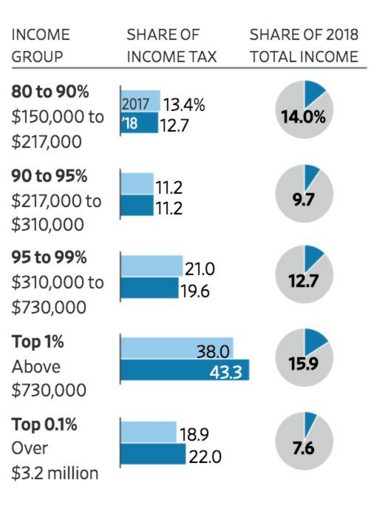
It shows that the top 20% of taxpayers by income will pay 84% of the income tax burden in 2017.

After the Trump tax cuts, the top 20% of taxpayers will pay 87% of the tax burden in 2018.

It kinds of makes you wonder what the Democrats were talking about when they unanimously opposed the tax cuts last year that they said were a giveaway to the rich. Everyone else supposedly got mere "crumbs" according to Nancy Pelosi.


Note: Top .1% group is also included in Top 1% numbers above
Credit: Tax Policy Center via Wall Street Journal


For context, the top 20% derives 52% of the income but are bearing 87% of the tax burden in 2018.

Many argue that the top 1% are getting a outsized portion of the nation's income and should be paying a higher tax burden.

It is true that the top 1% is deriving 16% of all income. However, this group will be paying 43% of all individual income taxes in 2018 (up from 38% in 2017).

What about the bottom 80%?

They generate almost half of all income but will pay just 13% of the income tax burden in 2018.

Where do the 1% reside who are bearing such a large portion of the individual tax burden?

Bloomberg recently did an analysis of 2015 IRS data by zip code in order to answer that question.

It turns out that Fisher Island, which is an island just off of Miami Beach, Florida, had the highest average annual adjusted gross income of any zip code in the United States---$2.5 million.

The underlying data on the income of those rich people on Fisher Island also supports a point that I have made in these pages before. The income of the rich, by and large, does not come from their labor. Outside of entertainers and professional athletes, it is difficult to generate large amounts of income from the sweat of your brow. It has to come from either getting your money to work for you or being able to mobilize others to work for you in a business enterprise.

Average salary income on Fisher Island was $668,000 of the $2,543,000 of AGI----only 26%. Dividends, interest, capital gains and income from a business brought in most of the bacon.

I published this chart last year that shows the components of gross income based on Congressional Budget Office data on the distribution of household income and taxes by households in 2013.


I don't know that I have ever seen a better graphic to show where the jobs come from that pay the labor income, or the taxes that pay for the government transfers that the bottom 80% rely on to live on, than what you see above.

How about the redistribution of income? Consider that 38% of before-tax income of the lowest quintile of income earners is in the form of government transfers (Social Security, Medicare, Welfare) that involves taxing the rich to pay for these benefits.

The so-called 1% could also get their name from the amount of their income they are getting in the form of similar government transfers---a mere 1%.

What is also interesting is the degree to which the middle class in the 3rd and 4th quintiles are reliant on income from labor to support themselves--about 2/3 of their household income comes from labor income. Only 2%-3% of their income is coming from capital income and gains.

On the other hand, the Top 1% derives only 35% of their income from labor. Almost 2/3 of their income comes from business income (23%) and capital income and gains 38%).

It is consistent with what the Bloomberg analysis shows regarding the richest zip codes. Of the top 5 zip codes that had the highest AGI, salaries made up only 34% of total gross income. That is right in line with the CBO data from 2013.

If you want to live in an ultimate zip code some day, my advice is to save and invest so you can get your money working for you or create a business where others work for you and they share their productivity with you. This is what the people in these zip codes have done.


A few other interesting bits of information I picked up from the Bloomberg data.


Highest median home price---Atherton, CA (94207) $6.7 million

Highest average tax deductions---Palo Alto, CA (94301) $491,600 (high mortgage interest, property taxes, state income taxes)

Largest 5-yr increase in avg. AGI---Palo Alto CA (94301) +220.7%

Worst 5-yr increase in avg. AGI---New York City (10005) -16.6%

For additional perspective, here are the top 10 zip codes by adjusted gross income for each of the four major regions of the United States.

Northeast


Midwest


South


West


How about a tax day salute to the taxpayers in these zip codes who carry so much of the burden of paying for our government services? These same people are also responsible for providing many of the jobs that sustain so many American families.

They richly deserve it, don't you think?

Of course, I understand it still depends on what your definition of  "fair" is.


Credit:Pinterest.com


Credit: Pinterest.com

For those who might actually be interested in assessing "fairness' factually , pass this blog post along.

Thursday, April 12, 2018

Russa To The Rescue

There are no regions of the United States that are more liberal than the Far West and the Northeast.


2016 Presidential Election Results
Red= Trump  Blue= Clinton 


It necessarily follows that there are not any two regions of the country that are more anti-Trump and undoubtedly convinced that evil Russians somehow colluded to make Trump President.

The liberals in these states are also decidedly anti-fossil fuels. Their view is that anything that comes out of the ground should stay in the ground---coal, oil, natural gas or uranium.

That is why the promise of battery-powered cars are so important to the left. California already has a commitment to see to it that there are 1.5 million "zero emissions" vehicles by 2025. (There are 300,000 on the road today. This is about half of the total electric or hybrid vehicles in the USA.).

A California legislator wants to take it a step further and fully ban the sale of new cars powered by internal combustion engines by 2040.

Of course, Liberal Democrats tend to focus only on that which is "seen" while ignoring those things that are "unseen". It makes things easier. Unfortunately, life is not that simple.

The "unseen" issue is that as you are banning fossil fuel powered cars you need to power them with electricity for which our electrical grid is still dependent, and will continue to be dependent, on these fossil fuels for many years to come.  I wrote about all of this last October in "Electric Cars-Seen and Unseen".

Similarly, New Englanders are on the verge of running out of the necessary power to light and heat their homes due to the Liberal Democrats who control the levers of political power in the region,

It got so bad this winter that this anti-Trump region, who is undoubtedly sure that Russian collusion put Trump in The White House, had to turn to Russia for the natural gas to heat and power their homes this winter.

Yes, Russia!


Russian LNG delivered in Everett, MA
Credit: Forbes.com


This is despite the fact that one of the largest natural gas fields in America (Marcellus) is only a few hundred miles away from the region and the United States is producing more natural gas than any other country in the world.

What makes all of this even more bizarre is that the natural gas that the Russians supplied is potentially subject to the sanctions that are supposed to be on Russia for interfering in the 2016 election and other matters.

How could this happen?

It is due to the fact that the radical left political power players in these states have blocked the construction of pipelines and other infrastructure to deliver natural gas to their region.

At the same time, many of the regions's aging coal and nuclear plants have been phased out.  This is beginning to put a real squeeze on New England's power resources as there is just not renewable and other "clean" energy options to fill the void.

The Washington Examiner recently outlined some of the problems facing New England in a story titled "New England faces "horror story" of expensive power".

New England is struggling to keep the lights on as it pursues aggressive clean energy goals, a dilemma that is so troublesome that the region’s power grid operator warns of blackouts if something doesn’t change.
"I am getting nervous in New England,” said Robert Powelson, a Republican commissioner of the Federal Energy Regulatory Commission, which oversees wholesale power markets, during a recent event hosted by the American Council on Renewable Energy. “It is almost like a horror story.”
The story is complicated, but its impact is not: Residents living in the six New England states face the highest electricity rates in the country, 56 percent above the national average.

The inability to get natural gas to the region during the extended cold period this winter resulted in not only the need to import Russian natural gas, but also required some dual-source power plants to switch back to carbon laden oil. Doing that not only meant more carbon emissions but much higher costs as well.

Of course, who does higher energy costs fall on most heavily? The poor. Those people that the liberal left always states is their first priority.

And what happens when business leaves the region due to high energy costs? Working men and women pay the price for that in lost jobs.

The environmental extremists who block the gas pipelines to protect the planet also don't seem to recognize that importing the natural gas from Russia on gigantic tankers comes at significant environmental cost.

Liberals really don't seem to be able to look beyond what is right in front of them to consider anything that is "unseen."

Even the very liberal Boston Globe does not understand the logic of its political policymakers in a recent editorial, "Our Russian 'pipeline' and its ugly toll."

To build the new $27 billion gas export plant on the Arctic Ocean that now keeps the lights on in Massachusetts, Russian firms bored wells into fragile permafrost; blasted a new international airport into a pristine landscape of reindeer, polar bears, and walrus; dredged the spawning grounds of the endangered Siberian sturgeon in the Gulf of Ob to accommodate large ships; and commissioned a fleet of 1,000-foot icebreaking tankers likely to kill seals and disrupt whale habitat as they shuttle cargoes of super-cooled gas bound for Asia, Europe, and Everett.
On the plus side, though, they didn’t offend Pittsfield or Winthrop, Danvers or Groton, with even an inch of pipeline.
The environmental movement needs a reset, and so does Massachusetts policy. The real-world result of pipeline absolutism in Massachusetts this winter has been to steer energy customers to dirtier fuels like coal and oil, increasing greenhouse gas emissions. And the state is now in the indefensible position of blocking infrastructure here, while its public policies create demand for overseas fossil fuel infrastructure like the Yamal LNG plant — a project likely to inflict far greater near and long-term harm to the planet.

How do you make sense of it all?

You can't.

I don't doubt that at some point the Leftists in the Northeast will be blaming Russia for destroying the permafrost and uprooting the polar bears.

All the while reading the latest issue of The New Republic in their warm home with their Sierra Club and "Feel the Bern" stickers on the bumper of their Prius tucked safely in their heated garage.


Credit: BigGreenRadicals.com

Tuesday, April 10, 2018

Deeply Disturbing

One of the core values that has always defined the United States of America is equal justice under the law.

The evidence we have seen over the last couple of years has raised substantial questions about that principle. What occurred in the last couple of days seems to have signaled that there are no questions about it anymore.

I thought that having the FBI exercise a search warrant on a high profile attorney was something we only saw when the Mafia was involved.

On Monday we saw it done on the personal attorney of the United States of America.

Perhaps Michael Cohen is rightfully suspected of some crime. However, are you telling me there is no other way of building a case against him than having the FBI raid his office, his home and his hotel room (he is staying there while his apartment is undergoing renovation)?

Does the attorney-client privilege mean anything any more?

What about the rights of President Trump?

Did the FBI raid the personal attorney of Hillary Clinton? No.

Did the FBI raid the personal attorney of Richard Nixon? No.

Can you imagine the outcry if the FBI had raided the office and home of Barack Obama's attorney?

Let's put this in further context.

It has already been established that Perkins Coie, the outside counsel for both the DNC and Clinton campaigns, paid for the Steele dossier that was used as the basis for the FISA warrants against Carter Page and the Trump campaign. This was almost clearly a violation of Federal Election Campaign financing laws in that it appears that the law firm was intentionally used to hide the involvement of the DNC and Clinton with Fusion GPS. By using the law firm to launder the payments, there was no evidence that the campaign or DNC was involved by looking at FEC filings.

Has the FBI conducted a morning raid on the offices of Perkins Coie?

Consider further that when the FBI interviewed Hillary Clinton about her secret email server and missing emails, it allowed her Chief of Staff Cheryl Mills to sit in on the interview even though Mills was a material witness in the case. More germane to the Cohen situation, even though Mills was serving as Hillary's Chief of Staff in the State Department, and not as an attorney, the FBI allowed all of her communications with Clinton to be protected by the attorney-client privilege.

Do you see a little discrepancy here?

Sharyl Attkisson is a former CBS news investigative correspondent who I have a lot of respect for as a journalist.


Sharyl Attkisson
Credit; Cspan


While she was at CBS her computer was hacked by an unauthorized, external, unknown party on multiple occasions. Attkisson believes that it was done by someone within the federal government during the Obama administration that was unhappy about her reporting.

This is what Attkisson said about the invasion of her privacy last September at TheHill.com.

I have spent more than two years litigating against the Department of Justice for the computer intrusions. Forensics have revealed dates, times and methods of some of the illegal activities. The software used was proprietary to a federal intel agency. The intruders deployed a keystroke monitoring program, accessed the CBS News corporate computer system, listened in on my conversations by activating the computer’s microphone and used Skype to exfiltrate files.
Evidence continues to build. I recently filed new information unearthed through forensic exams. As one expert told the court, it was “not a mistake; it is not a random event; and it is not technically possible for these IP addresses to simply appear on her computer systems without activity by someone using them as part of the cyber-attack.”

Attkisson seems to have a real experience and perspective on what the overreach of the federal government and unequal justice under the law looks like.

Before the raid on Cohen's office Attkisson tweeted out a thread on what ground rules should apply to assure that any Trump meeting with the Special Counsel would be equivalent to the treatment that Hillary got with the FBI.

Attkisson did all of it in good fun, but when you read through the thread you really see how slanted the scales of justice seem to be.

Of course, it got much, much worse on Monday with the raid on Trump's personal attorney.

And the odds of Trump ever sitting down with Mueller in this investigation should have also gotten much, much worse.

It appears that there is nothing that the Deep State will stop at in order to attempt to unseat Donald J. Trump as President of the United States.


It is all deeply disturbing for anyone who believes in equal justice under the law.