Wednesday, October 4, 2017

Hit Makers

What makes one song a hit and another a flop?

That is one of the questions at the heart of a book that I recently read by Derek Thompson titled, "Hit Makers: The Science of Popularity in an Age of Distraction."


Why do we like what we like?

There is a science to it. Nothing "goes viral" by accident.

For example, how would you know that a song nobody ever heard has the potential to be a hit?

How do you know if people will "like" it , hum the tune and tell their friends and neighbors about it?

There are actually online song testing companies that survey thousands of people to evaluate the catchiness of new songs to judge how they will be received by the general public.

For example, the aptly named company "Hit Predictor" has found that songs scoring 65 or over on its numeric scale (scores can go into the 100's) have the potential to be a breakout hit.

Here are a few Hit Predictor scores of the songs that did become hits. I have added the YouTube link of the official music video of the song to each. Each entered the top five on Billboard Hot 100 in fall, 2015.


"Hotline Bling", Drake: 70.25    1.275 billion views

"Stitches", Shawn Mendes: 71.55   837 million views

"Sorry", Justin Bieber: 77.14   2.707 billion views

"Hello", Adele: 105.00     2.031 billion views


There is a similar UK company called "SoundOut" that tests about 10,000 tracks online a month.

Adele songs also test well with SoundOut. The magic number for hit success on SoundOut's metric is 80. For example, SoundOut tested the songs on Adele's second album, "21" before it was released. Every song on that album scored over 80. SoundOut says it has never had that occur ever--before or after "21".

However, only three songs on that album ended up number one hits. Catchiness of the tune does not guarantee a hit once the key threshold is met. Hits only because hits because of exposure and repeated repetition.

I have written before that the one thing that drives favorability with human brains is familiarity. The most popular songs are the ones you have heard the most. We like those things we are exposed to the most.

Reading this in "Hit Makers" reminded of my blog post from 2014 on the popularity of various music genres over time. It is worth reading again with the benefit of Thompson's views on the science of popularity.


Music is much more diverse today than it has ever been. Jazz dominated in the 1940's. Why was that? Perhaps it was because there were just a few AM radio stations and they all played jazz. It is difficult for other music to be popular when nobody ever hears it.

Notice how music genres started to diversify with the advent of television and FM radio in the 1950's and 1960's. There were more outlets for people to hear different kinds of music.

Music started to diversify more in the 1970's and 1980's with even more distribution options like cable tv and shows such as MTV.

It has really opened up in the digital age. It is no accident that music tastes have become more diversified as the distribution of music has become more democratized.

Songs do not become hits or go viral by accident.

As Thompson explains in the book, "Content may be king, but distribution is the kingdom".

Tuesday, October 3, 2017

More Context On Guns

The horrific events in Las Vegas deserves a lot of outrage. Predictably the outrage by most on the left is primarily about the need to take guns away.  Since these mass murders were perpetrated with an assault rifle it only follows that the loudest calls are about these weapons. However, as I have written before, rifles account for very few homicides in the United States annually. And the number has actually declined over the last five years according to FBI crime statistics despite the high profile mass murders we have seen in recent years at Virginia Tech, Sandy Hook, Aurora, Sandy Hook and Orlando.

These are the homicides by rifles since 2011 per the FBI data.

2011-332
2012-298
2013-285
2014-258
2015-252

It might be worth taking another look at my post "Context on Guns" that I wrote in January, 2016.


Context on Guns

(originally published January 7, 2016)


President Obama has his "executive action" pen out again. Frustrated with his inability to negotiate anything with Congress (not that he even makes a reasonable effort) he wants to take matters into his own hands to control gun ownership in the United States.

This is how The New York Times reported on his executive action proposal from Tuesday of this week.

As tears streamed down his face, President Obama on Tuesday condemned the gun violence that has reached across the United States and vowed to curb the bloodshed with or without Congress.

First of all, I am not a gun nut. I have used firearms and at one time had obtained the NRA Sharpshooter classification.  I respect guns and what they can do.  More importantly, I respect the U.S. Constitution. I believe the 2nd Amendment is pretty clear.

A well regulated Militia, being necessary to the security of a free State, the right of the people to keep and bear Arms, shall not be infringed.

There is no doubt that the people have the right to keep and bear arms and that right is not to be infringed. At the same type, it seems understood that some type of regulation is permitted with regard to that right.  The difficult question is at what point is the right to keep and bear arms infringed by regulations?

For example, does an individual have the right to keep and bear arms such as a nuclear weapon, surface to air missile or bazooka?  I have not heard anyone with the NRA or anyone else make that argument.  Machine guns and other military types of automatic weapons are already illegal and have been since the 1930's.  In fact, the use of these weapons by gangsters such as Machine Gun Kelly, Baby Face Nelson and John Dillinger led to the passage of the National Firearms Act in 1934 that made them illegal in the U.S.

If anything is going to be done that might infringe on the right to bear arms in the Constitution it would seem that it should be clearly demonstrated to be a reasonable regulation. To meet that standard government should have to show that vast numbers of the public are being killed (or could be killed) to outweigh the individual constitutional right.  This is clear with an atomic weapon, machine gun or SAM.  In other words, the public's interest to safety outweighs the individual's right to keep and bear arms.

If it is done it should also clearly be done by the Congress in conjunction with the President. There is a reason the Constitution established both an Executive and Legislative branch. They are supposed to be co-equal partners in governing and in protecting the rights of the people.

I often say, "Context is everything in assessing anything", so let's put "gun violence" in the United States in context.

First, despite all that President Obama, Hillary Clinton and the media talk about gun violence, the reality is that murders by firearms have actually dropped across the United States since Obama became President in 2009.

Here is a graph showing murder victims by firearms. (Note: the most recent data for all the charts below from government sources is 2013).

Homicides in which a gun was used are down 8% since Obama took office. 


In addition, despite the fact we hear a lot about the need to control assault rifles, the reality is that rifles of any type are rarely used to kill anyone in the United States. There were only 285 murders committed with a rifle in 2013. That is down 19% since Obama took office. Handguns were used 5,782 times.


It is also true that firearms are much more likely to be used to commit suicide than to commit a homicide. In fact, almost 2/3 of deaths from firearms in the first five years of the Obama administration were from suicides.


How do gun deaths compare to other causes of death?

Homicides caused by guns is not even close to other causes of death including drugs, poisoning, motor vehicle accidents, falls and alcohol. For example, there are over 4 times as many deaths by drugs as there are homicides by guns.  

What sense is it then for many liberals to favor legalizing drugs but banning firearms?


And why is it that Barack Obama spends so much time on the subject of guns but spends so little time trying to change the culture of violence that exists within our community of young, black males?

In fact, in 2013, almost 50% of the deaths of young, black males between 15 and 24 years of age were the result of homicide. The comparable number for young white males of the same age---8%.


Finally, we see and hear a lot about police violence directed at African American males.

CDC statistics on causes of death indicate that the overall homicide death rate for all black males is 35.1 per 100,000 with 29.4 of those being through the discharge of a firearm.

What is the rate for homicide for black males due to legal intervention (police)? ---.7 per 100,000.


The comparable numbers for white males? 

3.3 per 100,000 deaths for homicides in total. 2.0 of those through the use of a firearm. 

.3 per 100,000 is the homicide rate due to legal intervention.

Therefore, the overall homicide rate for black males is 10 times that of white males.

More interesting, about 10% of total homicides involving white males come as a result of police action. For blacks, only 2% of homicides are the result of legal intervention. 

Therefore, if a black male is the victim of a homicide, there is a 98% chance it was by someone other than a police officer. If it is a white male, it is a 90% chance. 

Context is everything when assessing anything.

Even when it comes to the subject of guns.

Thursday, September 28, 2017

Trolley Folly

Streetcars used to be mainstays of transportation in every major American city beginning in the late 19th and early 20th century.

They were an efficient means of transportation when most people lived in cities and most did not have automobiles.

The advent of the automobile, and the development of city bus systems, led to the ultimate demise of streetcars. More people had cars for personal transportation and buses became the preferred method of transit in cities because of lower capital costs and increased flexibility to modify route systems.

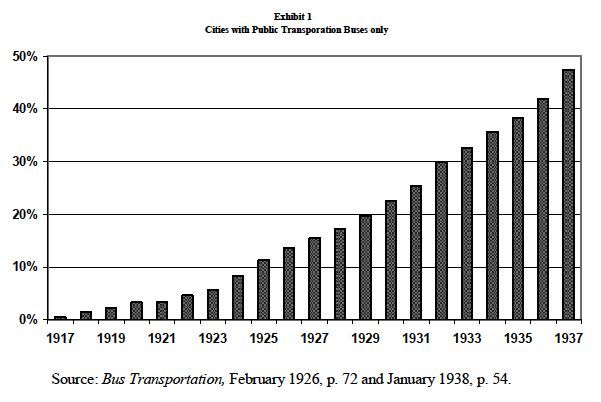
You can see how the popularity of public bus transportation exploded after World War I as more and more cities came to rely exclusively on buses. This graph is from an article in City Lab explaining the demise of streetcars as bus transportation took over.


You can also see the slow death of streetcars in this graph from the same article that compares streetcar and bus ridership up to the year 1970. By that time, almost all streetcars were in the scrap heap. The light gray is bus ridership. The dark gray is streetcar ridership.


An interesting sidenote in looking at the graph above is the spike in the use of all public transit during World War II. This was clearly the result of gas rationing during the war. However, the end of World War II led to the growth of personal auto usage, urban exodus and the decline in all public transit.

This led to almost all streetcars ending up like this by 1970.


Old Pacific Electric streetcars from Portland, Oregon
Credit: waterandpower.org

Despite all of this history and experience, liberal politicians in cities around the country have decided that streetcars are "in" again and are the answer to revitalizing urban areas and spurring economic development in their cities.

It is also argued riding a streetcar is considered "cool" by Millennial urban dwellers while riding a bus is decidedly "uncool" as a reason to push for more streetcar projects.

Isn't that a great reason to spend taxpayer money?

Left unanswered is why past streetcar lines were abandoned, bus lines are still operating and cities have grown and changed over the years without those streetcar lines.

Also unanswered is how you can make the economics work without massive subsidies.

The experience of Cincinnati, Ohio is typical.

The Democrat-controlled City Council and Mayor fell in love with the streetcar idea. They moved ahead despite many local objections and the fact the city was already grappling with almost $1 billion in underfunded pension liabilities.

A new Mayor and several city council members were elected on promises to kill the streetcar. When they took office they discovered that the prior administration had signed contracts and spent money such that the city would lose more money by canceling the project than by completing it. As a result, the streetcar project proceeded despite many new city leaders being opposed.

The 3.6 mile streetcar line opened last September at a cost of $148 million (that's over $40 million per mile) with $45 million of that sum coming in the form of federal grants.


The Cincinnati Bell Connector
Credit: www urbancincy.com


How is the streetcar doing?

Ridership is running at barely half of the projected ridership that was relied on when the project was being promoted.

Based on an annual operating budget of over $4 million, revenues from rider fares contributes less than 10% of operating costs ($377,752). The rest is made up from advertising, charitable foundational support, tax incentive support money and city parking revenue that has been directed to fund the streetcar.

Proposed streetcar budget for 2018 as reported in the Cincinnati Enquirer

Ed note: After the above article was published by the Cincinnati Enquirer it was reported that an additional $500,000 in revenue in tax incremental financing payments from properties along the streetcar route can be expected as additional revenue. I assume that is in addition to the $400,000 reported below.

Revenue

Fares: $377,752

Naming rights: $500,000

Parking revenue: $1.5 million 

Tax incentive support money: $400,000

Haile Foundation support: $900,000

Total: $3,677,752

Costs

Transdev: $3.3 million

SORTA: $677,368

Safety costs: $84,415

City costs: $337,936

Parking enforcement: $192,000

Total: $4,593,511


It is so bad that City Council member Amy Murray observed that the costs to collect the streetcar fares were higher than the actual fares collected.

Council member Murray was asked why doesn't the city simply disband operations? The short answer is that it can't unless it repays the $45 million it took in federal grants. This obligates the city to operate the streetcar for the next 25 years according to Murray.

Proponents of the streetcar argue that you cannot look at budgets when assessing streetcars. They argue it is unfair to compare buses to streetcars because buses are able to operate on existing roads for which they effectively ride for free. However, that is exactly the point. The road infrastructure already exists. It would be there even if buses did not exist. That makes bus systems much more economical and flexible (routes can be easily reconfigured for changing demographic and economic patterns) than the high fixed costs and the fixed routes with streetcars.

Of course, those proponents also argue that streetcars are cleaner, greener and quieter than those obnoxious buses. You can't be a legitimate liberal cause unless you touch all of the environmental bases as well.

And don't forget that a Millennial would never want to be caught taking a selfie to post on his or her social media account riding a bus!

Other U.S. cities who have jumped on the streetcar craze or are planning to are Portland, Tacoma, Salt Lake City, Atlanta, Kansas City, Detroit, St. Louis, Milwaukee and Charlotte.

I am a big believer in well-considered mass transit. It makes all the sense in the world when you have well-established routes that have masses of people who travel those routes every day. Developing mass transit on these routes can make travel more efficient, economical and create additional economic development at the same time.

This is clearly not the case with most of these streetcar systems.

As a result, all you have is trolley folly.

And, as is always the case, it is the taxpayers who pay the price for politicians who make foolish and ill-considered choices without regard to the costs or long-term consequences of those decisions.

Tuesday, September 26, 2017

The Flaw in the Filibuster

Our Founding Fathers created the United States Senate to protect the rights of the individual states as well as providing the protection of minority rights from what could be an emotional majority at times.

James Madison saw the Senate's role to be two-fold as he described it in his notes at the time of the Constitutional Convention.

"first to protect the people against their rulers [and] secondly to protect the people against the transient impressions into which they themselves might be led."

The Senate was clearly established in the Constitution to be a more deliberative body than the House of Representatives.

The Senate's members were originally elected by state legislatures. This was designed to make the Senate more attuned to state rights and to further remove Senators from the tides of the emotional majority.

That safeguard was removed with the ratification of the 17th Amendment which was ratified in 1913 and established that Senators were to elected by direct election of the voters.

What has really caused the United States Senate to be a deliberative body is not in the Constitution at all. It is the use of the filibuster.

There is nothing in the Constitution about a filibuster. There is nothing in the document that requires a super-majority to pass any legislation through the Senate. However, in the world we live in today that has become the reality.

There is little doubt that our Founders liked deliberation from the Senate but they had no interest in rule by the minority. James Madison wrote about their thinking in Federalist Papers No. 58.

"It has been said that more than a majority ought to have been required for a quorum; and in particular cases, if not in all, more than a majority of a quorum for a decision. That some advantages might have resulted from such a precaution, cannot be denied. It might have been an additional shield to some particular interests, and another obstacle generally to hasty and partial measures. But these considerations are outweighed by the inconveniences in the opposite scale."

The filibuster tactic has become increasingly controversial in recent years. The Democrats hated it when they had a simple majority in the Senate. Predictably, the Republicans hate it now that they are in the majority.

President Trump is certainly no fan of the filibuster rule.


The first filibuster did not occur until 1837 in the Senate. A 2/3 vote was required to invoke cloture (end debate and the filibuster) in 1917 and that was revised down in the Senate rules to 3/5 (60 votes) in 1970 after the filibuster was used extensively by Democrats to attempt to stop Civil Rights legislation in the 1960's.

However, that move to attempt to reduce the power of the filibuster was reversed when the Senate revised the rules again in 1975 and abolished the requirement that senators actually hold the floor by speaking. This had the effect of allowing the use of “virtual” filibusters.  Senators can now filibuster a bill without having to do the actual hard work of standing and speaking against the issue on the floor..

A filibuster thus has become not a method for deliberative debate but a pure tool of legislative obstruction.

Not surprisingly, the number of filings for and votes on invoking cloture exploded after 1975.  There were only a handful of cloture votes in the sixties. It is not unusual to now see well over a hundred in recent sessions of the Senate.


I am not opposed to the filibuster rule in general. I think it does serve a useful purpose in what is supposed to be a more deliberative body such as the Senate. This is particularly true since the enactment of the 17th Amendment.

However, the rules need to be reformed. I have believed this for a long time---through both Democrat and Republican majorities.

If a filibuster is used it needs to really be about deliberative debate. The idea behind a filibuster is for the minority to draw attention to "hasty or impartial measures". It is a device to slow things down so that the voters and the general public have more knowledge of what is going on. If that is the case, the filibuster cannot be virtual. It must involve Senators standing up and holding the floor like Mr. Smith did when he went to Washington in the famous Jimmy Stewart film.


Jimmy Stewart in Mr. Smith Goes To Washington


If you are going to physically hold the floor with a filibuster debate that also means that no other Senate business can proceed. If you want to block a vote on your issue you must be prepared to incur the wrath of everyone else when that filibuster also blocks consideration of all other Senate business.

I am all for full debate. However, that debate has to end at some point and a vote needs to be taken---up or down--- on a simple majority basis just as the Constitution provides.

Thursday, September 21, 2017

Investing Know-How

Investment manager Peter Lynch became famous in the late 1970's through the decade of the 1980's managing Fidelity's Magellan Fund.

Between 1977 and 1990 Lynch averaged a 29.2% annual return for Magellan which was more than double the S&P 500 market index for that period. During his tenure at Magellan its mutual fund assets grew from $18 million to $14 billion.

Peter Lynch used to say that he got some of his best investment ideas by walking around the shopping mall. "If you like the store, chances are that you will love the stock." That was Lynch's way of saying that people should invest in what they know. Start there and learn more about the product and the company. It does not necessarily take investing genius. It just takes tapping in to what you know and following through with some necessary research and due diligence.

Although malls might have been a good place to look for stock ideas in the 1980's that day seems to have passed.

Take a look at this chart that shows the changes in stock market value of some of the biggest names in retail between 2006 and 2016. The malls and shopping centers have not been a good place to shop for stock market winners.


However, what the retail giants have lost in value, Amazon has made up---and more.

The malls might not have been a good place to look for investing ideas the last decade but you could have done pretty well for yourself by just sitting at a computer keyboard or looking at your phone and letting your fingers do the walking for you.

Consider the wealth that has been created in the stock appreciation of just five stocks over the last ten years.

I am certain that all of you were aware of the names of these companies ten years ago. Almost all of you have undoubtedly utilized their products or services in some way. Did you own any of these stocks?

All the numbers below assume $1,000 was invested in each of these stocks on September 1, 2007 (except Facebook which did not go public until 2012 where I have used a 5-year period) and held until August 31, 2017.


If you had invested just $1,000 in these five stocks you would now have over $100,000. Your original stake would now be 20 times larger.

This would have given you an average rate of return of over twice what Peter Lynch was able to produce and for which he became known as the best mutual fund investment manager of his era.

It could have all been done by just letting your fingers doing the walking. There was no reason to even visit the mall.

Investing is easy if you have the know-how.

It is even easier with ten years of hindsight.

If you didn't own these stocks directly I hope you are consistently investing in high quality equity mutual funds. If you are, the odds are you will get your share of winners like these over time. You might not get them for the full run-up but you will still participate in their growth.

The next decade will bring similar winners. I don't know who they will be. However, there will be similar stories in another decade. You can't play if you don't save and put your money to work in order to participate in what the future will provide.

Save. Invest. Diversify. Let the money compound.

That is the know-how to know how to become wealthy over time.

Tuesday, September 19, 2017

Chick-fil-A

There is no one that is a bigger fan of Chick-fil-A than me.


I had my first Chick-fil-A in Atlanta back in 1972 when I was just starting law school. At that time I don't think CFA had more than 20 locations. Today CFA has over 2,100 locations.

When I moved to Ohio in 1979, CFA had only one unit in Ohio. It happened to be in the town I moved to. I can honestly say that it was a factor in my decision to take the job offer and move there.

For about 20 years there was a CFA in a food court near where I worked. There were not many days that I did not head that way for lunch. It was hard to justify eating at any other fast food restaurant.

The same goes for Mrs. BeeLine and me today when we travel. If we are stopping for something to eat, it will be at Chick-fil-A.

Every time I eat at Chick-fil-A I marvel at the number of customers in the restaurant and in line at the drive-thru. You typically don't see that traffic at other restaurants.

It all adds up in the sales numbers and CFA is demolishing its competition in average per unit sales.

Here is the 2016 ranking of average sales per unit for the top 50 fast food restaurants in the United States.

CFA is in a class by itself. Average sales per unit are 63% higher than the next closest competitor. The average CFA location is selling almost $2 million more per location that McDonald's.

CFA's unit sales are more than double In-N-Out Burger and Chipotle.

CFA is tripling the volumes of Wendy's and Burger King.

Here is a list of the top 21. Go here to see the complete top 50 list.


CFA's volumes are even more impressive considering that they are doing it in a 6 day week rather than 7 days.

CFA still has amazing growth potential when you look at other numbers. McDonald's has 7 times the number of U.S locations. Burger King and Wendy's have 3 times the locations. CFA has not scratched the surface of its potential.

I had the good fortune to meet CFA founder Truett Cathy several years before his death.

When I met him I told him that I was one of CFA's biggest fans. In fact, I told him that I had eaten at CFA five days that week.

He looked at me with a grin and quickly responded,

"We are open six. What were you doing on the other day?"

Indeed.

It was my pleasure to meet the man who has set the standard in fast food.

Thursday, September 14, 2017

Kicking The Can In Kentucky

In my last blog post I highlighted the enormous unfunded public sector pension liabilities in the United States.

Only a handful of states have anything close to what they need to meet the promises made to state workers.

A few are in  "Code Red" status. It appears to be simply impossible for them to meet their obligations. Major changes will have to be made in these plans for there to be any hope that these pensions plans will not totally collapse at some point in the future. You can also be sure that large tax increases in these states are a near certainty as part of any solution.

Let's look at one of the "Code Red" states in particular---Kentucky.

Kentucky's state pension plans are a mere 31% funded according to the Bloomberg report referenced in my last blog.

The worst funded plan within all of Kentucky state plans is the so-called KERS-NH plan that covers state employees in non-hazardous positions.

It is only 16% funded. $13 billion in liabilities for promised pensions with only $2 billion in assets.

Kentucky recently hired an outside pension consultant to assess the situation and recommend steps that needed to be taken.

This is chart from the report of that consultant (PFM Group) that shows how close this pension plan is to total insolvency based on current practices. This chart also assumes that current employees will earn no further pension credits through any future wage growth. This clearly is a realistic assumption.


The projection is that this pension fund will have no assets at all in about ten years based on current assumptions. No assets means there is no money to pay anybody a pension who is a participant in this plan. Zero. Nada. Zip.

How do you save a pension plan that is in this kind of shape?

It requires drastic actions. Simply closing the plan to new participants does not come close to solving the problem when it is this bad and this late in the game.

Politicians do not like to make tough decisions. It is always better for them after the next election. However, the responsibility to fix this mess falls on the Kentucky legislature. Delaying or deferring action will only make the problem even worse.

This is what the consultant had to say about that.

“This is the time to act,” said Michael Nadol of PFM. “This is not the time to craft a solution that kicks the can down the road.”
“All of the unfunded liability that the commonwealth now faces is associated with folks that are already on board or already retired,” he said. “Modifying benefits for future hires only helps you stop the hole from getting deeper, it doesn’t help you climb up and out on to more solid footing going forward.”

What are the actions that are recommended?

1. Freeze the pension benefits of most current state and local workers. All of those workers would then be shifted to a 401(k)-style investment plan that offers defined employer contributions rather than a defined retirement benefit.

2. Increase the retirement age to 65 for most state workers.

3. Take cost of living increases away that were added to current pensioners since 1996. This would reduce current pensions to the original amount earned at retirement age. This would generally reduce the current pension benefit by at least 25% for anyone who has been retired since 2001.

However, even with freezing and rolling back the pension payments as recommended above, Kentucky would still need to find an extra $1 billion per year in additional pension funding to keep the state pension plans afloat.

This is despite the fact that pension funding has already been crowding out almost everything else in the state budget for the last 10 years as this chart indicates.


To obtain $1 billion in additional state funding without a tax increase would require that K-12 school funding be cut by over $500 million per year and spending at most other state agencies would need to be cut by 17% to make up the difference according to State Budget Director John Chilton.

In the wake of the consultant's report and the publicity that has surrounded it, Kentucky is now starting to see a mass of state worker retirements. These people apparently believe they can beat the clock on any changes. It is reminiscent of a run on the bank in the 1930's.  However, the reality is that these actions will only hasten the deterioration of these plans. More money will go out the doors every month. The problem will only get worse.

Predictably, the public sector unions are not happy with the recommendations and will surely put up a fight as the Kentucky legislature considers what to do about the massively underfunded state pension plans.

You can be sure that kicking the can down the road is the preferred option. However, Kentucky has already done that one too many times before.

There is almost nothing left to kick. The money will soon be gone and those state employees will learn too late that their pension plan was not much different than a Ponzi scheme perpetrated on them by their elected officials. All they will get is a gigantic kick in the pants.

Coming soon to a state near you?

Tuesday, September 12, 2017

Blue States In The Red

Dark days appear to be ahead for many states, their pensioners and taxpayers, if you look at the most recent funding level of state pension funds.

These pension plans typically provide the main source of retirement income for state workers, public school teachers and university personnel. In most states, public safety personnel such as police and fire also participate. Big cities, like Los Angeles or Chicago, typically have their own pension plans and are not in the state plans.

According to the latest data compiled by Bloomberg, five states are on "Code Red" status due to pension funding levels that are less than 50%---New Jersey, Kentucky, Illinois Connecticut and Colorado.


New Jersey and Kentucky are only 31% funded.

Illinois is at 36%.

Connecticut is 44% funded.

Here are the states with the ten worst pension funded ratios according to the Bloomberg report.


All of these ten states saw their funded ratios fall in 2016 despite the fact that the S&P 500 increased nearly 10% during the year. The long term bond index was also positive for the year. These states have reached the point that payments to those currently on pensions are draining the assets to such a degree that it is becoming next to impossible to catch up.

How does it get this bad you might ask?

Connecticut is a case in point.

Connecticut is the richest state in the union. It has the highest per capita income. One of the reasons that Connecticut was able to attain that status was that until 1991 it did not have an income tax. As a result, it attracted many Fortune 500 companies and investment managers from higher-tax neighboring states in the 1970's and 1980's.

You would think that all of that wealth and all of the added income tax revenues would have put Connecticut on a firm financial footing.

You would be wrong.

Aaron Short explains the root of the problem in his article in The Daily Beast, "Why Connecticut is Collapsing".

"... the most frustrating thing about Connecticut’s struggles are that they never had to occur.
“A lot of what is going on now could have been predicted 30 years ago,” said state Comptroller Kevin Lembo. “Revenue was flowing into state coffers but politicians never did the hard work to make sure the retirement system was funded. They did the opposite and had them underfunded.”
For 80 years the state failed to properly save for the cost of pensions promised to its public employees and teachers. Its spendthrift decisions led then-Gov. Lowell Weicker to enact a state income tax in 1991.
Soon buckets of revenues from the new tax and from the state’s passage of legalized casino gambling began to flow into state coffers. State’s leaders went on a spending spree.

We see this played out over and over in government spending. Whatever they have seems to never be enough.

Calls for more taxes end up with more calls for even more more taxes.

It is a condition that is endemic to the political class---Democrat or Republican. Connecticut reached this point by mismanagement by both parties.

However, there seems to be some evidence that you have a better chance tof staying out of the red in a red state.

This graphic compares the overall fiscal status of each state with how they voted in the most recent Presidential election.


Credit: https://i.redd.it/gip4c3bvzubz.png


Is it merely a coincidence that that 20 of the top 25 fiscal rank states voted for Trump and 15 of the bottom 25 ranked states voted for Clinton?

Thursday, September 7, 2017

Immigration By The Numbers

You can't run a country by emotion.

You can't sustain a country based on feelings.

You can't let everyone into the United States that wants to live here.

These are facts.

And they are supported by numbers.

If you want to better understand the immigration issue you need to spend nine minutes and view the video below from NumbersUSA.

If you are worried about the decline in middle class incomes---you need to view this video.

If you are worried about sustainability---and for many Americans this is of utmost importance---you need to view this video.

If you are worried about our natural resources and our environment---you need to view this video.

If you are worried about urban sprawl---you need to view this video.

If you are worried about population control---you need to view this video.

If you care about the future of our country---for yourself, your children or your grandchildren---you need to view this video.

Ironically, most of the issues that are near and dear to liberals are going to get much, much worse if current immigration policy is continued.

However, they are the same ones who are arguing that our borders should be open and we should welcome everyone who wants to immigrate to the United States---legally or illegally.

How many of those people understand the numbers about immigration and what it portends for our future?

Why doesn't anyone talk about what the influx of these people are going to mean to our environment, our education system and our economy in 10, 20 or 50 years.

Most won't take the time to look at the facts---and the numbers.

You will understand it all much better in nine minutes.

After you understand it, send this on to a liberal you love so they will better understand where all of this leads.


Wednesday, September 6, 2017

The Art of the Deal

I read Donald Trump's book, The Art of the Deal, almost 30 years ago.


The Art of the Deal
Published in 1987

Trump's thinking and traits have not changed much in 30 years. Most people don't. What they were at 40 is what they are at 70.

Here are a few negotiating tactics that Trump wrote about in The Art of the Deal and some quotes from the book that were compiled by Peter Economy in Inc. magazine.

1. Think big

"I like thinking big. I always have. To me it's very simple: if you're going to be thinking anyway, you might as well think big."

2. Protect the downside and the upside will take care of itself

"I always go into the deal anticipating the worst. If you plan for the worst--if you can live with the worst--the good will always take care of itself."

3. Maximize the options

"I never get too attached to one deal or one approach...I keep a lot of balls in the air, because most deals fall out, no matter how promising they seem at first."

4. Know your market

"I like to think that I have that instinct. That's why I don't hire a lot of number-crunchers, and I don't trust fancy marketing surveys. I do my own surveys and draw my own conclusions."

5. Use your leverage

"The worst thing you can possibly do in a deal is seem desperate to make it. That makes the other guy smell blood, and then you're dead."

6. Enhance your location

"Perhaps the most misunderstood concept in all of real estate is that the key to success is location, location, location...First of all, you don't necessarily need the best location. What you need is the best deal."

7. Get the word out

"One thing I've learned about the press is that they're always hungry for a good story, and the more sensational the better...The point is that if you are a little different, a little outrageous, or if you do things that are bold or controversial, the press is going to write about you."

8. Fight back

"In most cases I'm very easy to get along with. I'm very good to people who are good to me. But when people treat me badly or unfairly or try to take advantage of me, my general attitude, all my life, has been to fight back very hard."


If you read through these quotes you see the same Trump today as he was in 1987.

Thinking big. He's President isn't he? How many thought that was possible when he started?

Never getting attached to one deal or one approach.

Knowing your market. In this case, his base of voters.

Enhance your location. What better location or podium than to negotiate from than 1600 Pennsylvania Avenue?

Getting the word out. Now you know why he uses Twitter.

Fighting back.  No need to give any examples here. We see it every day. Trump takes nothing lying down.

The one tactic that I think Trump has yet to fully embrace as President is his use of leverage. He seems overly cautious to me. Perhaps it has to do with Rule #2 above---he is trying to protect his downside and does not want to antagonize Congress unnecessarily. After all, he needs them over the longer term if he is to be a successful President.

I get it. However, I think he is missing some great opportunities.

I previously wrote that I thought Trump should be applying leverage on Congress to get something done to repeal and replace Obamacare.  It would be easily done by simply ending the Obama administration executive order that is allowing Congress to avoid having to get their health insurance through the individual Obamacare exchanges. This is clearly not allowed under the law as written.

Trump could end it with a stroke of the pen. He has the leverage and it could be useful in getting Congress to get something done to repeal and replace Obamacare.

The same goes for DACA.

Trump announced this week that he is ending this illegal executive order of President Obama that effectively grants amnesty to almost 1 million children of illegal immigrants. However, he is delaying rescission of his order for six months to allow Congress time to change the law if it wishes.

For perspective, for those who are now criticizing Trump for his action regarding DACA let us not forget these words of President Obama when he pulled out his pen and enacted DACA..

"This is not a path to citizenship. It’s not a permanent fix. This is a temporary stopgap measure..."

That was over five years ago. That is an awfully long stopgap measure. We also know how that policy caused our southern border to be over-run with thousands upon thousands of minor children (many unaccompanied) thinking they were getting a free pass into the United States.

If I were Trump I would make clear that I would not sign any law changing any portion of current immigration law until some basic safeguards were included to insure that we are serious about securing our border and moving towards a common sense immigration policy.

That would start with two items that Trump has already made his position clear about.

1. Funding for a border wall
2. Changes Trump proposed in August about the current rules for legal immigration.

That is the art of a deal. You want something. You need to give something.

You get something only when you have leverage. Trump has leverage. The ironic thing is that he would not have any leverage on the issue of illegal immigration but for the illegal actions of President Obama.

That is why executive orders were not meant for issues like this.

That is why we have laws.

For those who think it is heartless and cruel to rescind Obama's illegal executive order of DACA, take a minute a consider this perspective that I saw on the Twitter feed of David Horowitz referencing an article on the issue from the Conservative Review.


I have found that there is nothing better to evaluate your thinking than to consider "the opposite". There is a reason we have a Constitution and the President swears an oath to follow the rule of law. Those that think DACA is wise, consider the opposite.

And consider the leverage that the occupant of The White House has on this and other issues.

Imagine indeed.


Postscript---

I found this ABC News report on DACA interesting. DACA is supposed to be about young "dreamers." However, it appears that there are hardly any "dreamers" from any other country in the world except Mexico and Central America.


There are none from any Western European country.

None from any African country.

None from Japan or China. There are only 3,800 from India.

Over 600,000 of the nearly 800,000 registered undocumented illegals under DACA came from Mexico.

How is that "fair" to use a liberal term?

What about all of the other children in all the other countries in the world that wanted to come to the United States to fulfill their dreams? Their parents obeyed the laws of the United States and where are their dreams today?

This is the problem when the law is not followed and enforced.

Monday, September 4, 2017

Many, Many Sides

Liberals have a particular way of exalting their heroes but demeaning those they disagree with.

Look no further than the recent headlines where Donald Trump is their favorite target.

The latest round began right after the horrible violence at Charlottesville which Trump condemned this way. These are the exact words from which Trump was criticized so strongly and been labeled a racist.

(By the way, a lot of the criticism of Trump seems to have evolved from poor initial reporting by The New York Times who quoted Trump as blaming "all sides" at Charlottesville. This was mischaracterized by other media outlets to be "both sides". As you can see from the quote below, he said "many sides". The New York Times ultimately had to correct five quotes it falsely attributed to Trump about Charlottesville. Of course, as we have seen from the actions of Antifa in Boston, Berkeley and elsewhere in recent weeks, there is no doubt that hatred, bigotry and violence are not limited to any one side.)

"But we're closely following the terrible events unfolding in Charlottesville, Va.. We condemn in the strongest possible terms this egregious display of hatred, bigotry and violence on many sides, on many sides. It's been going on for a long time in our country. Not Donald Trump, not Barack Obama. This has been going on for a long, long time. It has no place in America."
"I just got off the phone with the governor of Virginia, Terry Mcauliffe, and we agree that the hate and the division must stop, and must stop right now. We have to come together as Americans with love for our nation and true -- really, I say this so strongly, true affection for each other."
"Above all else, we must remember this truth, no matter our color, creed, religion or political party, we are all Americans first. We love our country. We love our God. We love our flag. We're proud of our country. We're proud of who we are. So, we want to get the situation straightened out in Charlottesville, and we want to study it. And we want to see what we're doing wrong as a country where things like this can happen. 

Does that sound like a racist statement to you? You be the judge.

Let's compare that statement which many have argued proves that Trump is a racist or a fascist with a few others.

"I do not consider Hitler to be as bad as he is depicted. He is showing an ability that is amazing, and seems to be gaining his victories without much bloodshed.” 
 “Germans of future generations will honor Herr Hitler as a genius, as a brave man, a matchless organizer and much more.”

These statements were made by Mahatma Gandhi who has always been a hero of the liberal left for his teachings on peace and non-violence.

Gandhi also was known to have made racist statements about "Africans" to such an extent that the government of Ghana recently removed a statue of Gandhi from its main university campus.

How about this one?

“The black is indolent and a dreamer; spending his meager wage on frivolity or drink; the European has a tradition of work and saving, which has pursued him as far as this corner of America and drives him to advance himself, even independently of his own individual aspirations.”

Those are the words of Che Guevara who ironically has been embraced and elevated by countless liberals and celebrities for the revolutionary romanticism he seems to inspire in them.

Ironically, many of those who wear T-shirts with his image are African Americans.


Jay-Z wearing his Che shirt
Credit: TheKongBlog.com

Or how about this?

"They are…human weeds,’ ‘reckless breeders,’ ’spawning… human beings who never should have been born."
"Organized charity itself is the symptom of a malignant social disease…Instead of decreasing and aiming to eliminate the stocks [of people] that are most detrimental to the future of the race and the world, it tends to render them to a menacing degree dominant."

Those are the words of Margaret Sanger, the founder of Planned Parenthood, which liberal Democrats defend no matter the horrendous stories that we see about its internal operations.

By the way, Sanger also had much stricter views on immigration than Donald Trump ever thought about. This is what Sanger said in a speech in 1925 shortly after the Immigration Act of 1924 was enacted.

...the United States Government has become a pioneer by its immigration laws. It is really putting into effect today in it immigration laws, exactly what most Birth Controllers want. The only thing is, while it applies its laws in keeping out of this country the mentally defective and the physically weak and defective, the paupers and the other kind of so-called undesirables, we only wish it would extend its laws a little bit more and stop the multiplication of the same undesirable type within. 

There are many apologists in the media and among academics regarding the views of Gandhi, Che
Guevara and Margaret Sanger today. They argue that you need to consider the entire life and record of these people before you can judge them.

I don't disagree. I am not sure that anyone can judge any human being on a few sentences, a few months or even a few years of their life.

However, why is it that a 71-year old man who has been President of the United States for seven months is not afforded the same grace?

I think we know the answer. 

There are many, many sides to every story. Why do so many want to make every issue black and white?

Tuesday, August 29, 2017

An Upside Down World

Looking at the images coming out of the Houston area it looks like the world has been turned upside down. However, the rain will stop. The flood waters will recede. Recovery and rebuilding will begin. Houston will be restored better than ever in the end.

However, the world is turned upside down in other ways. We see it nearly every day.

Ideology take precedence over facts.

Emotion controls over logic.

Political correctness eclipses practical realities.

Core values and norms that have guided societies for thousands of years have been tossed aside in the inverted world we live in today.

It is not clear whether this flood of nonsense will ever end.

There is no better example to illustrate that fact than the case of 22 year-old Kaylee Moats who has recently started a GoFundMe page to raise money for surgery to treat her for Mayer-Rokitansky-Kuster-Hauser Syndrome.


MRKH syndrome is a condition in which a female is born without a uterus, cervix, vagina or vaginal opening. As a result, a woman with MRKH can never conceive and bear children and it is impossible to have any intimate relationship.

Reconstructive surgery can be done to create a vaginal opening to remedy the latter problem but is not considered a "life saving" procedure and is not defined as an "essential benefit" under Obamacare.

Therefore, it is not covered by any health insurance plan. As a result, Kaylee's sister started the GoFundMe page and publicized her situation with the goal of raising the $15,000 required for the surgery.

What is ironic is that if  Kaylee had instead wanted to change her gender (rather than trying to fix her gender) it would be considered an "essential benefit" and would be covered under Obamacare. In other words, Kaylee could become Kenneth and have that surgery paid for by Obamacare. However, she cannot get the surgery she needs and just be a complete Kaylee.

Of course, the reality is that Obamacare or "insurance companies" do not really pay anything in these cases. The cost of these surgeries is borne by the other individuals in the insurance pool. The federal government is merely mandating that "essential benefits" must be part of the insurance coverage. This means you and I pay for all of these "essential benefits" in our insurance premiums.

All of this gets turned even further upside down when you consider that until last week our military was spending tax dollars on medical treatments and sexual reassignment surgery for transgender personnel. President Trump has instructed the Pentagon to stop this Obama-era practice as well as cease admitting transgender individuals into the military.

We are even further upside down when we now also have convicted killers serving life sentences in prison receiving taxpayer-funded sex reassignment surgeries as recently occurred in California.

Bradley Manning, the U.S. Army private who was convicted of leaking national security secrets and received a 35-year prison sentence, put it all together when he (she?) received approval for sex reassignment surgery while still in a military prison. Manning's sentence was commuted by President Obama three days before he left office.

I can only imagine what a Washington, Grant, McArthur or Patton might think today.

Their world's were turned upside down by Revolutionary War, Civil War and World War. Real life and death consequences where failure would likely mean the end of our society as we know it.

Today we turn our world upside down and risk the end of our society as we know it by ideology and political correctness gone wild. It is something to behold if not for how dangerous and destructive it is.

On the subject of Bradley Chelsea Manning, I could also not resist posting the two tweets below (hat tip to @JackPosobiec) to show how the American Civil Liberties Union views "justice". Further evidence of an upside down world. Justice is no longer blind. It all depends on who you decide is on "the right side" and who you deem to be on "the wrong side".

The ACLU's even-handed view of "justice".

This tweet was right after President Obama commuted the sentence of Manning.


This is the tweet the ACLU put out last week after Trump pardoned Arpaio.


Let us keep in mind that Bradley Manning blatantly violating his oath as a soldier in the United States Army as well as federal law.  He was convicted by a jury of his peers and sentenced to a 35 year prison term.

Sheriff Joe Arpaio was convicted of violating an order of a federal judge to stop enforcing federal and state immigration laws. The judge had ruled that Arpaio could not allow his deputies to question or detain anyone on the suspicion that they might be in the country illegally or turn them over to federal immigration authorities. Arpaio continued his immigration enforcement in defiance of the order arguing that “If they don’t like what I’m doing,” he said, addressing his opponents, “get the laws changed in Washington.”

By the way, the 85-year old Arpaio was found guilty of criminal contempt by a single judge. His request for a jury trial was denied by that same judge "on the grounds that the law did not require juries in cases in which the potential jail term was so short (six months in this case)".

I guess the judge forgot that the 6th Amendment of the U.S. Constitution states that "In all criminal prosecutions, the accused shall enjoy the right to a speedy and public trial, by an impartial jury of the state and district wherein the crime shall have been committed..." (emphasis added)

The Obama Department of Justice seems to have specifically charged Arpaio with a criminal misdemeanor in this case to avoid a jury trial. Most legal observers believe that Arpaio would never have been convicted in a jury trial in this case. If what Arpaio did was so lawless why was he only charged with a misdemeanor?

According to the ACLU, and many in the mainstream media, it is "justice" to commute a 35 year sentence for breaking the law to time served but it is "injustice" to pardon a 6-month sentence for enforcing the law?


The statue of Mary and Jesus that was removed from San Domenico School in San Anselmo, CA
Credit: http://www.marinij.com/social-affairs/20170824/san-anselmos-san-domenico-school-creates-stir-by-removing-catholic-statues

The topper in all this upside down world we live in today is the story out of California about the Catholic elementary school in San Anselmo that took down statues of the Virgin Mary and Baby Jesus, and other religious figures, because "it could be alienating for that other religion, and we didn't want to further that feeling", according to the school's Chairman of the Board of Trustees.

Indeed, we live in a world turned upside down.

May the flood waters recede.

Everywhere.

Monday, August 28, 2017

Rain--Too Much and Too Little

Too Much Rain.

All of our thoughts and prayers right now are with the 7 million people in and around Houston, Texas that are dealing with the deluge and floods resulting from Hurricane Harvey.

This catastrophe hits particularly close to home as my daughter lived in Houston until six weeks ago. This is a picture that was taken by a friend of hers on Sunday morning. The water continued to rise throughout the day as the rain continued. This morning my daughter saw on Facebook that another person on that street was requesting a boat to evacuate their family of seven as 2 feet of water had inundated their house. This is about six blocks from my daughter's former home.


Fortunately, the last reports we have is that the houses on her former street are still dry.

Houston faces a long recovery period and it is certain there will be many who will ask how this could happen. Most certainly there will be those who blame this extreme weather on human-caused "climate change".

What they will fail to mention is that this is the first category 3 hurricane to strike the United States in almost 12 years. That is the longest period without a hurricane striking the continental U.S. since data began being recorded in 1851.

As bad as this catastrophe is, and as difficult as the recovery will be from this deluge of rain, it will likely pale in comparison to the human suffering and dislocation that resulted from the lack of rain in the Southern Plains 80 years ago.

Too Little Rain.

The so-called "Dust Bowl" lasted almost a decade spanning the 1930's.

This is how History.com describes the Dust Bowl.

The Dust Bowl refers to the drought-stricken Southern Plains region of the United States, which suffered severe dust storms during a dry period in the 1930s. As high winds and choking dust swept the region from Texas to Nebraska, people and livestock were killed and crops failed across the entire region. The Dust Bowl intensified the crushing economic impacts of the Great Depression and drove many farming families on a desperate migration in search of work and better living conditions. It had a devastating effect on the Southern Plains region of the United States.


2.5 million people in the area were forced to permanently move. To put that number in context, the entire population of the United States then was about 125 million at the time. It was the largest migration in American history.

100 million acres of farmland were rendered unusable for agriculture. That is roughly the total size of the entire state of California.

Oklahoma lost some 440,000 people as a result of the Dust Bowl. 250,000 of those ended up in California between 1935 and 1940 as well as the storyline for John Steinbeck's famous novel, The Grapes of Wrath.

What caused the Dust Bowl?

First and foremost it was caused by a shift in regional weather patterns. You can see that clearly in this graph that charts annual precipitation amounts in Oklahoma for the last 120 years. Notice the deep and sustained drought that lasted the entire decade of the 1930's.


Compounding the problem were poor agricultural methods and federal policies that encouraged too much prairie grass land to be tilled for crops. With sufficient moisture these lands could grow wheat. However, when the drought came, and with no prairie grass to hold the soil in place, the winds in the plains turned the eroding soil into massive dust storms.

Similarly, the disaster in Houston has been compounded by too much development, too much concrete and other hard surfaces that have replaced prairie lands that used to absorb the water. That water now runs off and is channeled into tighter and tighter areas where flood potential is high.

Those Dust Bowl storms did not just stop at the border of Oklahoma. The top soil blew all the way to the East Coast of the United States.

On May 11, 1934, a massive dust storm two miles high traveled 2,000 miles to the East Coast, blotting out monuments such as the Statue of Liberty and the U.S. Capitol.
The worst dust storm occurred on April 14, 1935. News reports called the event Black Sunday. A wall of blowing sand and dust started in the Oklahoma Panhandle and spread east. As many as three million tons of topsoil are estimated to have blown off the Great Plains during Black Sunday.

What struck me as I read the history of the Dust Bowl period is how such events would be reported today if such a calamity occurred.

Think about it again.

2.5 million forced to move. 440,000 in Oklahoma alone. 100 million acres of farmland (the size of California) rendered unusable.

All because of drought.

Do you think something like this today would be blamed on a bad run of weather?

Of course not. This would be cited as Exhibit A as proof of man-made climate change. Or proof that fracking in Oklahoma caused the drought.

Carbon taxes would be levied. Oil and coal would likely be outlawed. Gigantic sums would be spent on "green" technologies. All in the name of saving Oklahoma and the planet.

However, look at the chart above one more time.

Wet periods were followed dry periods ever few years in the 40 years leading up to the 1930's.  There was then the extended drought lasting 10 years. It was followed by 10 years of above average moisture and another 10 year dry period in the 1950's. If anything, the period since has resulted in fewer extremes---especially on the dry side.

What does this tell me about climate change?

Yes, it is always changing. Temperatures have risen and fallen. Precipitation has fallen and risen. And all of it has been happening well before anyone had ever heard of a carbon footprint.

What would the reaction be when the rain started falling again in the Dust Bowl?

"Rain has returned to the Plains states. Our concerted actions against man-made climate change has saved the world!"

They would be wrong.

Who did people thank after the Dust Bowl ended?

Almighty God.

He is in control.

May He bless the people of Houston and its environs in this time of need.