Tuesday, July 13, 2021

Libertad!

 Libertad! Freedom!

Word came out over the weekend that crowds of Cubans had taken to the streets in a number of cities across the country protesting against the government.


Why are protests rare in Cuba?

It is fairly simple. In a totalitarian state you literally risk your life when you express your dissatisfaction with the government. There is a reason protests are RARE.

Many thought that the freedom movement that swept through Poland, Germany, Eastern Europe and the Soviet Union in the late 1980's and early 1990's would end up extending to Cuba.

It never happened.

Will there be enough momentum now for the people of Cuba to get the freedom they deserve?

I know of no country in the world that has more potential to flourish and prosper if they can escape the chains of communism.

Cuba is blessed with beautiful weather. It is close to the United States and there are scores of prosperous Cuban Americans who are eager to see freedom restored to Cuba and to revive the economy that has been devastated by over 60 years of Communist rule.

A few people over the weekend pointed out to me that most of the major media outlets were not giving much attention to the Cuba story.

Why was that?

My sense is that many in mainstream media are reluctant to give air time to stories that show that people in socialist and communist regimes are unhappy.

They must believe that it hurts the narrative that socialism is superior to freedom and capitalism.

Bernie Sanders has praised Cuba's healthcare and education system over the years arguing that Fidel Castro transformed Cuba the society in the process.

Sanders was right about one thing. Communism did transform Cuban society.

It transformed it such that a large percentage of Cubans did not want to stay in their homeland.

A large number have ended up in the United States. Others fled to Spain and other countries.

This shows the trends in Cuban admissions to the United States from 1870-2015.


Is it merely a coincidence that Cubans decided they wanted to leave their homeland in 1959, the year that Fidel Castro and the Communists took over?

The Census Bureau official number is that over 1.3 million people born in Cuba now reside in the United States. There are over 1 million additional children in these households that were born in the United States. That is over 2.3 million with recent direct ties to Cuba.

For context, Cuba only has a population of around 11 million. 

There are actually more Cuban Americans (2.3 million) in the United States than the population of Havana.

Most of those Cubans live in South Florida.


Source: https://www.migrationpolicy.org/article/cuban-immigrants-united-states-2018


As this article from last year in The Miami Herald points out, there are many Cubans who still risk the perilous journey to escape Cuba for the United States.


Paco sold everything he owned at home in the coastal town of Bahia Honda, west of Havana, to get out of Cuba. He also asked for help from relatives in South Florida. In an island where the minimum salary is $10 per month, it’s tough to pull together the $12,000 that people smugglers in Miami charge for the clandestine trip.

“In this town, everyone wants to leave” for the United States, he said. “Everyone wants to go.”


An interesting fact about Cuba is that over half of the population are direct descendant of slaves by some estimates.

Cuba had at least 800,000 slaves brought in during the slave trade.

The comparable number for the United States---400,000

Most people hear so much about the slave trade history in the United States that they know nothing of the horrors of the numbers of slaves that were shipped to other countries.

About 400,000 slaves were originally brought to the United States out of a total of 12.5 million who were caught up in the Atlantic slave trade from Africa. 10.7 million arrived in the Western Hemisphere. That means that less than 4% of all slaves came to the United States.

This is the picture of an exhibit I took at the Natchez, MS visitor's center a few years ago that shows the workings of the slave trade. I have referenced these numbers previously in these pages.


Less than 4% of the Atlantic Slave Trade went to North America.

Over 10 times (42%) that number went to the West Indies (Cuba included in that number).

38% went to Brazil. 6% to Guyana and 8% to the rest of Central and South America.

2% ended up in Europe which you almost never hear anything about.

We hear continually these days that the United States is a racist country and there is no way for minorities to overcome the white supremacy and systemic racism that permeates the country.

Someone forgot to mention this to the Cubans who came to America and have succeeded nor to the remaining Cubans who desperately want to leave the land of their birth.

There are calls for reparations for the descendants of slaves in the United States. 

Are there any calls for reparations in Cuba, Brazil or any other countries? It would seem the amount of reparations should be much larger in those countries since the number of slaves imported were so much higher and there are many more descendants.

Cubans are interested in something more basic---Libertad!

It is something they don't have right now.

It is something they should have.

Let's hope that the match has been lit so that the bright light of freedom will burn bright for the Cuban people very soon.


Credit: https://torange.biz/table-flag-american-candle-52532


Godspeed to the Cuban people.

Sunday, July 11, 2021

Which Side Are They On?

Which side are they on?

That has become a big question as I look at what Joe Biden and the Democrats are doing.

Democrats spent four years trying to argue that Donald Trump was a Russian agent.

It was a ridiculous claim but they persisted in repeating it for the entirety of Trump's Presidency.

Consider that oil and gas revenues are absolutely critical for Russia's economy.

I wrote about this in 2017 when the Democrats were making the Russian collusion claims about Trump early in his term. I pointed out a few key facts that did not support the narrative at that time.

50% of Russia's federal budget comes from oil and tax revenues.

68% of Russia's exports are from oil and gas.

Russia's GDP is 7% of the GDP of the United States.

To put that in context, the United States has more student debt ($1.7 trillion) than the entire GDP of Russia ($1.6 trillion).

Do you think that the price of oil and gas is important to Russia and the political fortunes of Vladimir Putin?

I then posed some questions that led to the obvious answer that Donald Trump was Russia's worst nightmare if you looked at the facts. There was no way that Putin would have preferred Trump over Hillary Clinton in 2016.


Considering everything above, what is the most important factor for Russia's long-term economic well-being?

Higher oil and gas prices.

Of the two candidates running for President, which of the two candidates was more likely to initiate policies that would lead to increased oil and gas prices?

Was it the candidate who wanted to build the Keystone pipeline, lift the Obama moratoriums on drilling on federal lands, lift the restrictions on new drilling technologies, rescind Obama-era EPA rules on drilling and coal and end the excessive regulations of fossil fuels?

All of these positions of Donald Trump would serve to lower oil and gas prices by increasing U.S. and global supply.

Hillary Clinton's policies would have done the exact opposite. In fact, she was on record during the 2016 campaign as saying that "we need to move away from coal and all the other fossil fuels as energy sources".  That was about the same time she was saying she would put all of the coal workers in the United States out of work. She might have thought those statements were in her own self-interest in order to play to her liberal left base of voters. However, it could not have been further from our nation's economic self-interest.

At the same time, if you were sitting in Vladimir Putin's chair, wouldn't those positions be music to your ears? What could be better for Putin than a U.S President who wanted to exorbitantly raise the prices of fossil fuels in order to make green energy projects more viable?


If you reviewed the entire Russian influence story based on simple logic, economic facts and self-interest, why would Vladimir Putin and Russia have any reason to prefer Trump over Clinton?

It just didn't add up in any shape or form when you looked at it from that perspective.

Of course, we now know that the Trump Russian collusion story was a complete fabrication that had its origins with a dossier that was manufactured and paid for by the DNC and the Clinton campaign.

I called the attempts to smear Trump with the Russia collusion story the real Russian scandal in April, 2017 by just looking at facts, data and using some common sense. 

We are now seeing the effects of the policies that Clinton and the Democrats wanted in 2016 before Trump got in the way.

Who is benefiting more from all the restrictions on fossil fuels in the United States right now?

The American people or Russia?

This graphic shows what has happened to gas prices at the pump since the 2020 election.


There is no doubt that some of the oil price increases have been due to increased demand from economic activity picking up as we have come out of the pandemic.

However, the market has unmistakably reacted to the new policies that inhibit the exploration, drilling and transportation of oil and gas.

When Trump left office the United States was actually exporting more oil and gas than it was importing.

A decade ago experts said that this was impossible. We were going to be forever dependent on foreign oil.


Source: https://www.eia.gov/energyexplained/us-energy-facts/imports-and-exports.php

Under Biden we are quickly reversing that progress.

United States oil production has fallen by 1.7 million barrels/day since last year at this time.

Who has been the largest beneficiary?

Russia.

For example, in April, 2018 we imported 7.3 million barrels of oil from Russia.

In April, 2021 (the most recent month reported) we imported 20.6 million barrels from Russia--a three-fold increase from what is was 3 years ago.

Energy analysts predict this trend will continue.


To make matters worse, at the same time that Biden was shutting down construction of the Keystone XL pipeline between Canada and the United States, he was removing sanctions against Russia's Nord Stream 2 natural gas pipeline from Russia to Europe.


Source: https://www.politico.com/news/2021/05/18/biden-sanctions-nord-stream-pipeline-489437


Various sanctions had been put in place by the Trump administration in order to prevent completion of the pipeline that would make Europe more dependent on Russia and also weaken Ukraine.


“Nord Stream 2, if completed, would give Russia the means to completely bypass Ukraine, depriving Ukraine of vital revenues and opening it up to further Russian aggressive actions, while providing the means to use natural resources as a tool of political pressure and malign influence against Western Europe,” Secretary of State Mike Pompeo said in a statement.


The Trump administration also wanted our European allies to buy more liquid natural gas from the United States to benefit natural gas producers in the United States.

Since fracking technology took hold in the last decade the United States has become a huge exporter or liquid natural gas to countries around the world.


It raises a simple question.

Why would the Biden administration shut down a pipeline between the United States and Canada but allow a pipeline to be completed between Russia and Europe?

The Keystone XL pipeline would have benefitted Americans with increased supply of oil for United States refineries for lower cost energy. It would also be more environmentally sound in that the oil would be transported by pipeline rather than by rail cars as it is now which are much more susceptible to spills.

It should also be noted that the company building the Keystone XL pipeline just announced they are filing a $15 billion lawsuit against the Biden administration for damages due to breaching the prior agreement to proceed with construction of the pipeline.


Source: https://news.yahoo.com/keystone-xl-pipeline-company-announces-180100761.html

Unfortunately, if the Keystone XL pipeline owners win the lawsuit,  Biden won't have to pay the $15 billion. The American people will.

The Nord Stream 2 pipeline benefits Russia and makes Europe more dependent on Russia. It also will have the effect of limiting the ability of U.S. firms to sell LNG to the European market. Biden is allowing this to proceed.

The cancellation of the Keystone XL pipeline will result in higher U.S. energy costs and ultimately result in higher consumer prices and loss of jobs for Americans.

In what reality does any of this make any sense?

It is totally inexplicable to any thinking person.

Which side are they on?

The only conclusion that can be drawn is...

They don't seem to care one iota for Americans.

Thursday, July 8, 2021

Things That Make You Go Hmmm-July, 2021 Edition

A few charts and graphs that provide some interesting insights on the world we live in right now. They  might even make you go Hmmmmmm!

The Political Divide

A lot of people wonder about the political divide in our country. 

This chart from the Economist.com provides some perspective.

In 1994, when Bill Clinton was President, there was not much difference in the the political ideology of Democrats and Republicans.

By 2017, a massive divide had developed.


The average Democrat in 1994 was right in the middle (5 out of 10) on a scale that measured ideology from consistently liberal to consistently conservative.

The average Republican was a 6 out of 10--- a little right of center.

In 2017, the average Republican was rated at 6.5---just slightly more conservative than in 1994.

However, the average Democrat was a 2 on that scale. That is a massive shift left.

If you wonder where the political divide is coming from today look no further than this chart.

Who is further from the center?


The Stock Market

The stock market has been on an incredible run this year. 

Stock prices are subject to the same economic rules of supply and demand as anything else.

2021 has seen an unprecedented amount of money that wants to be invested in stocks.

Consider this chart from The Wall Street Journal's The Daily Shot.

There have been more inflows to equities in 2021 (annualized) than in the previous 20 years combined!


That is a lot of demand. That demand has been fueled by an abundant supply of money due to Federal Reserve policies and federal government stimulus actions.

When combined with record low interest rates on bonds, this has motivated investors to move their investments from fixed income investments and assume more risk in equities.

You can see this as well in the TD Ameritrade "Investor Movement Index" that shows the exuberance of retail investors about the stock market. The sentiment has never been more positive.

What could go wrong?


Source: https://twitter.com/SoberLook/status/1412707642372415489/photo/1


People Die From Things Other Than Covid

While deaths from Covid have been in the news every day for the last 18 months, people die from a variety of causes.

I thought the graphic below was an interesting perspective on the numbers who are killed by various members of the animal kingdom.

Everyone is concerned about shark attacks because of the publicity they receive in the media (does this remind you of anything?) but did you know that ants kills 6 times as many people as sharks do in a typical year.


Source: https://twitter.com/theRoddick/status/1408759614607351812


Looking at this data, I would also suggest that you give a wide berth to any hippos you might encounter.


Is the Pandemic Over?

57% of Republicans say the pandemic is over. Only 4% of Democrats agree. This is based on a recent Gallup survey.


Source: https://news.gallup.com/poll/351650/three-americans-think-pandemic.aspx


The political divide I mentioned above clearly applies to attitudes about the pandemic as well.

You can also see an enormous divide in Restaurant Reservations Data that Open Table reports between eateries in states like Florida, Texas and Nevada compared to what is going on in restaurants in California and New York.

Activity at restaurants in Ft Lauderdale is up +40% compared to what they were seeing in 2019 before the pandemic.

Restaurants in San Francisco, Seattle, Minneapolis, New York, Portland and D.C. are down more than 50% from 2019 levels.


Source: https://twitter.com/arrington/status/1410782004728184837/photo/1

Politics seems to influence everything these days.

The Wild Ride in Jobs

A year ago we were wondering how many would have a job in a year.

We now see "Help Wanted" signs wherever we go and many employers say that their biggest challenge is finding people to work.

Voluntary resignations by employees just hit a record high.


Source: https://twitter.com/SoberLook/status/1402556483645198349


At the same time, employers are letting go of fewer employees than ever. I guess they have decided a warm body is better than nobody even if they are not competing for employee of the month. If they discharge someone they may not be able to fill the position.


Source: https://www.axios.com/layoffs-all-time-low-656979a1-38e0-48d4-b3bb-5ad9b5345aa3.html

This chart sums up pretty well the wild jobs ride since the pandemic started.


Source: https://twitter.com/sam_a_bell/status/1410190377357819908


How Many Friends Do You Have?

The number of close friends that people have has dropped dramatically since 1990.

It has particularly affected the friendships among men. 15% of men report having no close friends.

The decline in friendships has also been more acute in the young than in those who are older.

It seems that the internet, iPhones, texting, Facebook and all the rest, which were supposed to allow us to connect with each other in better ways, has just gotten in the way of developing friendships.


Source: https://www.americansurveycenter.org/why-mens-social-circles-are-shrinking/

Do you think that we should be just as concerned with the number of friends these young men have rather than be worried about whether they own a gun?

What is the one thing we almost always hear when there is a mass shooting?

"He was a loner."

Hmmmmm.


Tuesday, July 6, 2021

Trump 2024?

What is the future of Donald Trump in the Republican party?

Will Trump run in 2024 and will he be the favorite to win the GOP nomination if he runs?

Those are big questions right now.

One thing is for sure. 

The Trump policies are enormously popular among the party faithful.

It is less clear whether Trump is considered to be the right person to advocate for those policies in a general election.

That is a big reason that you see a number of conservatives promoting Ron DeSantis, Nikki Haley, Kristi Noem or Mike Pence.

What are the arguments for Trump in 2024?

What are the reasons that GOP voters may turn to someone else?

First, I am assuming that Trump is running in 2024.

Trump is not saying what his intentions are right now. I doubt he will make any commitment to run until after the 2022 mid-term election.

However, he has been out doing rallies the last couple of weeks. He was in Sarasota, Florida Saturday night and in Lorain, Ohio last week.


Trump rally in Sarasota, FL, 7/3/21
Source: https://twitter.com/DanScavino/status/1411500389237723137/photo/1

Love or hate him, getting this many people to show up at an event eight months after one election and three years before the next one is pretty remarkable.

Trump's two events also got millions of online viewers. I saw it reported that Newsmax had 6 million viewers watching Trump's speech on Saturday night.

To put that number in context, that is more than the top 3 cable news networks typically averaged in viewers during prime time during the second quarter, 2021.


I know that there are many in the GOP establishment and in media that want to believe that Trump is done. Those types of turnout and viewer numbers suggest that Trump is still a force to reckon with.

What are the three things that could do the most to help Trump looking to 2024?

1. There is a definitive finding that some sort of foul play in the 2020 election that affected the outcome of the election. Such a finding would vindicate Trump and silence those who have said "we just need to move on". It would put Trump on the high ground and make it difficult for any other GOP candidates to mount a serious challenge to him. It would seem that Trump deserves another chance. If I am Trump I would be heavily invested in getting to the bottom of the election fraud allegations.

2. An implosion of the country under the Democrats and Biden/Harris. Trump has many critics but hard times have a way of focusing people on what is most important. Trump's personality is the most cited reason why many did not like him. When people are in trouble they are less concerned with personality and more concerned about performance. A deteriorating situation in the country will make Trump a lot more attractive to more people than you can imagine. 

3. The Trump brand. A brand is about trust. People trust products and services like McDonald's, Coke and Amazon because the know they are going to get a consistent, quality experience. More than any politician in my lifetime, Trump governed exactly like he ran. There was no bait and switch. He did what he said he was going to do. Trump has the political power he has in the Republican party right now because he is trusted. That is why his endorsements are so sought after by GOP candidates. Most Republican voters right now trust the Trump political brand to not steer them wrong. Will this continue through 2022? That is the big question. If Trump endorsed candidates do well in 2022 it will give Trump additional political power. Watch 2022 to see where we are headed for in 2024 with Trump.


What are three things that could derail any ambitions Trump may have for 2024?

1. There is a natural human trait to prefer potential over achievement. I wrote about this in 2014.

Why does an untested high school pitcher command a bigger signing bonus from a major league baseball team than a proven major league pitcher with six years of experience as a starter?

Why does a fledgling tech company IPO result in a market cap far in excess of a steady and profitable company that has a 10 year record of success in the marketplace?

Why does the up and coming young MBA a few years out of school get the promotion over the steady, seasoned and loyal 10 year manager?

Why do NFL fans of mediocre teams always clamor for the 2nd string quarterback?

Why did an untested Barack Obama beat two candidates (Hillary Clinton and John McCain) who were both more accomplished and experienced than he was?

You can read my previous blog post for the explanation of the Stanford academic that has studied this human trait in detail.

In the political realm I think it relates to the fact that prior achievement has boundaries. Potential is boundless, especially on the upside. Hope really does spring eternal.

People know all the warts and weaknesses of the politicians they are familiar with. Almost everyone also believes that they know Trump well. Therefore, it is easy to project optimism on DeSantis, Haley, Noem or someone else and decide they are going to be a much better candidate than Trump. They will be perfect. Let's get Trump's policies with a better personality and all will be well. 

This will be an effect Trump will have to overcome because the new face is always going to be more interesting and enticing than someone that you know better.

2. Allegations of wrongdoing by Trump that go beyond what is perceived as more than a witch hunt. Democrats have long claimed that Trump is a crook or has been involved in nefarious activities. However, we have heard this for five years and they have not been able to turn up anything on the man. The latest charges involving his company and its CFO by New York state looks to be politically motivated. If there was wrongdoing with the Trump organization's taxes why was this not found by the IRS? Why is a Manhattan Democrat District Attorney involved? Trump has also been out of the active management of the business for over five years. Why now? Perhaps there is something there but it looks like a political hit job to me right now.

There is little question that the Democrats are going to turn over every rock and throw everything they can at Trump and his family the next few years  They clearly live in fear of the man. They may get something that sticks and get people to believe that it is more than political retribution. If they do, Trump will not be viable in 2024 as his political brand will be permanently damaged. Once you lose trust you don't get it back.

3. Trump's endorsements and efforts at promoting candidates in 2022 falls flat and/or the GOP generally has disappointing results in the mid-term elections.

This might apply even if the GOP gain seats in the mid-terms but the results do not meet the expectations sets before the election.

Any mid-term setback will likely create a narrative that the losses were due to Trump's influence on the party and a change of direction is necessary for 2024.

I have no idea how this will play out. 

We are still 2.5 years from the first 2024 primaries and a lot can happen in two years. In fact, at times a few months can be an eternity in politics.

A recent poll by McLaughlin & Associates indicates that Donald Trump still has considerable support among potential GOP primary voters right now.


There is no candidate at this time that represents a significant challenge to Trump with GOP voters.

Trump has 55% support. DeSantis is next highest at 9%. Pence is at 8%.


There is also a substantial question of whether Joe Biden will even be a candidate in 2024.

In fact, the McLaughlin poll did not even survey a Biden-Trump matchup.

It only asked survey participants who they favored between Trump and Harris.

Trump was up 49%-45% in the poll.


i

Who knows what 2024 will bring?

However, right now Donald Trump is still the Republican party whether the party establishment and elected officials like it or not.

In the end, the voters decides what their party stands for and who they want to represent them. It is not Mitch McConnell, Keven McCarthy, Liz Cheney, Mitt Romney, Rona McDaniel or Marjorie Taylor Greene 

Stay tuned for some interesting years ahead.

Thursday, July 1, 2021

Where Are We Going With Covid?

Special Note: BeeLine is using a new service for email subscribers. All current email subscribers should have been automatically converted to the new service. If you did not get an email with today's content from the new system you should re-subscribe by going to the BeeLine website

The email from new service should have the BeeLine header at the top of the blog content. 


If you don't see this you are viewing an email from old system that will soon be discontinued. Take action now to subscribe if for some reason your email address was not transferred over to the new system.

Todays' blog post follows below.

------------------------------------------------------------------------------------------

Where are we going with Covid?

What can we expect next?

The drop in confirmed cases in the United States is astounding.


The vaccines appear to have had an effect.

However, just how large an effect has it been?

Cases dropped by 73% between January 11, 2021 and February 20, 2021. They are now down 95% since that date.

By February 20, only 5% of the population in the United States was fully vaccinated. On January 11 no one was fully vaccinated.


The data alone suggest that this drop is not solely due to the vaccines. Most of the decrease had occurred before the vaccines really took hold.

There clearly has also been an effect from herd immunity from those who had existing antibodies and the fact that all viruses eventually burn out.

For example, the most recent CDC data of blood donors across the country found that an estimated 49% of the population had detectable antibodies in their blood as of the middle of March.


Source: https://twitter.com/kerpen/status/1409631082492874756/photo/1


Most of this would have been related to natural antibodies as only around 20% of the population at that time had taken one dose of the vaccine.

Seasonality has also had a huge impact on the transmission of Covid as it does with every respiratory virus.

These viruses spike in the fall and winter and decline in the spring and summer.

You can see this graphically in the CDC's surveillance data that tracks outpatients visits to health care facilities each flu season.

The spike in cases usually begins around Week 46 (middle of November), peaks sometime between January and March, and is back to a stable level by the end of April.

The red triangles in the chart below are 2020/21 visits for flu-like illness.


Source: https://www.cdc.gov/flu/weekly/

Notice that the flu all but disappeared in the 2020-21 season. Some have attributed this to mask usage and social distancing. I tend to believe it was due to viral interference. Simply stated, Covid overwhelmed any other pathogen that was trying to gain a foothold in attacking people's immune system.

One of the more incredible stats I saw this year was this fact reported by NPR that flu only resulted in 165 patients being hospitalized through February 15 in the current flu season that began in October. The similar number for last year---400,000!


Source: https://www.npr.org/2021/02/14/967431377/where-did-the-flu-go-homebound-kids-shape-a-mild-season?utm_campaign=npr&utm_medium=social&utm_term=nprnews&utm_source=twitter.com

It is also interesting to note that there were 378,259 patients admitted to the hospital with Covid between October, 2020 and April, 2021 (2020/21 flu season) per CDC data..  In effect, no more people ended up in the hospital with Covid than did for the flu last year. 

Have you ever heard this?

Although Covid cases have shown a large decline nationally since January I am interested to see what occurs across the Sunbelt in July and August.

We saw cases explode in this area last year after New York, New Jersey and other hot spots saw their cases decline in the summer.

I believe that the cases went up as more people in these hot areas sought the refuge of air conditioning indoors and avoided the sun and outdoors. 

The more I research and study the Covid issue the more it appears to me that locking down and not being out and about actually makes you more vulnerable to the virus.

For example. which groups had the most widespread transmission of Covid last year?

Nursing homes and prisons. The populations in these facilities are generally in a lockdown mode to begin with. They are not out in the general population and are not having their immune system challenged every day by being exposed to all of the stuff that is circulating in the community. The challenges to your immune system is what makes it stronger and more resilient when attacked by a foreign pathogen or germ.

Where else did we see widespread breakouts?

Meat packing plants. These are cooled facilities that also have systems to limit microbes and bacteria in the processing of the meat. This would generally mean a more sterile environment than what most other people confront in their daily lives.

Recall a few other observations I made over the last 18 months that fit the pattern.

1) There were more Covid cases in New York among those who never left their houses than those who worked in essential services such as grocery stores and public transportation. I wrote this at the peak of the pandemic in New York last year.

Based on a recent survey of those hospitalized in New York over a 3-day period of 1,200 patients at 113 hospitals, the state found that the overwhelming number of those who recently were hospitalized with the virus were retired or unemployed and were sheltering in place and leaving their home only to shop for essentials. 

In total, 83% of the new cases were of those retired or unemployed.

The survey also found that almost no one hospitalized with the virus had been working in an essential service. There were very few hospital, transit, grocery or drug store employees.

Only 17% of the new cases that were investigated were of those employed.

2) American Airlines reported fewer cases in employees involved in flight operations (flight attendants, pilots etc.) than those who were not dealing with the public and traveling.

3) Indiana University reported that there was a direct correlation between the numbers of credit hours a student took virtually with the odds of getting Covid. In other words, students who took all of their classes in person had the lowest incidence of Covid. Those who took all of their classes online had the highest incidence

To further support this point, I recently met someone at a party who had worked at Kroger in many high level positions over the years but recently retired. I asked if he knew how many Kroger store employees had contracted Covid since they were on the frontlines during the entire pandemic. He stated he did not know the exact percentage but he did know that the percent of cases was less than the general population.

Do you see a possible pattern?

I will be surprised if we don't see an increase in cases in the Sunbelt over the next two months due to the seasonality effect. 

In fact, recent data suggests that we are beginning to see an uptick in cases.

Cases are up in AZ, NM and NV in the last week as is the positivity rate from tests.


They are up slightly in Texas although positivity rate continues to decline.


Florida is no longer updating its Covid numbers daily but it showed a slight increase in cases. Positivity was also up slightly.


Source: http://ww11.doh.state.fl.us/comm/_partners/covid19_report_archive/covid19-data/covid19_data_latest.pdf


How the Sunbelt withstands the next two months could tell us a lot about where we are going with Covid in the Fall in the rest of the country.

I will also not be surprised if we see a surge in colds, flu and RSV in the coming months as so many people have not been exposed to germs and pathogens over the last year that they normally would. They will be more vulnerable than they have been previously. This will probably be a bigger problem than Covid when schools open in the Fall. 

Many are still arguing that masks are essential in combating the spread of Covid. I know that it is a natural human impulse to believe that doing something is better than doing nothing. However, the data I see does not support that masks do much to inhibit transmission.

For example, here is a chart showing the experience of Austria which included a requirement that everyone wear a medical grade mask beginning January 25.


Source: https://twitter.com/ianmSC/status/1409252635262132224/photo/1

Here is another chart showing Covid cases in Columbia. 


Here is one from Vermont which Dr. Fauci called a "model" for the country last September before cases went up 3,914%.


I understand why people want to believe that masks work. We want to be in control. We don't want to be defenseless. Early in the pandemic I was wondering why masks were not being recommended as having traveled in Asia I saw them often on the streets. Early in the pandemic (outside of China) Asia was largely spared. 

I wondered why masks were not being recommended. I prepared to do a blog post on the topic. I then did the research and could not find one study that indicated that anything other than a properly fitted N95 mask offered any real protection.

The good news is that where I live it is now rare to see anyone wearing a mask. I was at Costco today and no more than 5% were wearing masks. It was almost 100% in any store a month ago. It was probably 50% two weeks ago. It is another telling example of herd mentality. The person without a mask felt ostracized a month ago. It is now the other way around.

For those who think that children should be wearing masks in school either because of Covid or due to my concerns about an increase in colds, flu, etc in the Fall, I would refer you to this new RCT study that was just published in the JAMA.

It turns our that we may actually be doing children more harm than good by forcing them to wear face masks.


The Covid narrative is now pushing the so-called Delta variant that supposedly came out of India. It is being used to promote more fear and to push more young people to be vaccinated.

The Delta variant is very likely more transmissible than other variants. However, I see no evidence that it is more serious than previous variants. In fact, the history of virology shows that as a virus mutates it becomes less lethal over time.

This seems to be borne out with what we are seeing in the UK right now. Cases are up but deaths are not following that trend.


Source: https://twitter.com/OBusybody/status/1410661297633497088/photo/1

That chart also cannot provide comfort that the vaccines (most specifically the Astra Zeneca vaccine that has been used most widely in UK) are doing a real good job of preventing transmission in the UK. A higher percentage have been vaccinated in the UK than in the USA.

In fact, cases in Scotland are now higher than they have ever been since the pandemic began!


At the same time, Scotland (like the UK generally) has vaccinated a higher percent of the population than the U.S.


The good news is that hospitalizations have not increased much.

Meanwhile, cases have plummeted in India over the last 6 weeks. Two months ago we were being told there was no hope for India. 

Cases have collapsed despite the fact that only 4% of the population in India has been fully vaccinated. That compares to 46% in the United States.

Cases per million have fallen 87% since their peak on May 8.


This success clearly had little to do with the vaccines.

Is it natural population immunity taking hold?

Could it be due to Ivermectin, the drug that has been consistently maligned by Dr. Fauci and other leading U.S. public health experts?

I don't know but I do know that a number of large Indian states embarked on a public health program of distributing Ivermectin to every citizen beginning in mid-May. This was done as a preventative measure.


Source: India Today, May 12, 2021

The states of Goa and Karnataka did the same.


Causative or coincidence?

We may find out at some point. However, the only reason the vaccines were approved for emergency use authorization was the fact that there were supposedly no other "adequate, approved and available alternatives".

Is that really true?

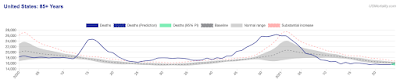
There is no disputing the fact that the death rate among those age 65 and older have dropped significantly since the vaccines have been introduced.

These are the age groups in which the vaccination rate ranges from 89.9% for those age 65-74 to 86.0% for those age 75+.

We would all like to think the vaccines are responsible.

All the mortality data below is from USMortality.com. Predicted deaths are based on CDC data projections.

Death rates for ages 65-74 from January, 2020 forward.

Source:https://www.usmortality.com/

Death rates for ages 75-84.


Source: https://www.usmortality.com/

Death rates for ages 85+.


Source: https://www.usmortality.com/

Deaths for those age 75 and older are now below the long-term averages. 

This appears to be proof of the success of the vaccines for the most vulnerable.

However, could it be that some of the deaths we experienced in December and January were merely pulled forward by a few months?

The same argument might be made at the beginning of the chart. Deaths among these age groups were running below average right before Covid hit. Were some of the people who died living on borrowed time?

This is why I think it is difficult to make definitive statements about much of what is going on with Covid.

More troubling is looking at the death statistics for younger ages.

While deaths are declining for the old, excess deaths are rising for those 44 and younger.

These are not Covid deaths. Something else is driving these.

Mental health? Drugs? Adverse effects of the vaccine?

What is it? Why is there not much attention being directed to it?

Overall deaths for those ages 0-24 generally were generally within long-term averages since January, 2020. Since April they appear to be trending up. These numbers are not final but it is disturbing nonetheless.


The age 24-44 age group has seen a consistent pattern of excess deaths since March, 2020. It has never come down. In fact, it appears to be accelerating in the last two months with the CDC's preliminary data. Again, these are not Covid deaths. What is causing this?


Where are we going with Covid?

I wish I knew.

As referenced above, there is still much that we really don't know about why and what has already happened with Covid.

Did lockdowns save lives or cost lives?

Are masks just a device to make people feel that they have a sense of control?

Are Ivermectin and other drugs that were already in use, and available, effective therapeutics against Covid?

Are the vaccines as effective and safe as advertised and promoted for all ages or is there a point at which the risk outweighs the benefit?

I don't know the answers to these questions. I just look at the data and try to make sense of it. And the data raises a lot of questions in my mind. The experts are trying to convince us they have all the answers. It seems they should spend more time pondering the questions than telling us they have all the answers.

Let's all hope that where we are going with Covid we will get better answers to these questions.