Monday, October 16, 2023

How Can I Become Rich?

"How can I become rich?"

That is a question I often hear from young people.

In my career I have had the good fortune to meet and know many wealthy and successful people. I have observed these people closely and I have also studied the available research on what separates the rich and successful from everyone else.

At the core of anyone that has achieved success is someone who has good habits. They utilize their time wisely. They are disciplined and work hard.

Despite the popular narrative, the wealthiest Americans are not living on trust funds that were handed to them along with a silver spoon when they were born. Most got rich by simply working hard for it. In fact, wealthy households contain on average more than four times as many full-time workers as do poor households---2 workers per rich household compared to .4  earners per poor household. The fact is that there are not many "idle rich" folks in this country.  There are, however, a lot of "idle poor".

If you don't believe it takes work to get to the top of the economic ladder just consider the differences in the traits between those that are wealthy and those that are poor in this research that compared the habits and traits of the two groups.  Almost every one of these traits requires some work, effort or discipline on the part of the individual.  It does not necessarily occur naturally in the human condition.


What you see is that those that succeed use their time more productively.


                                                                     Wealthy                    Poor


Maintain a to-do-list                                             81%                        9%
Wake up 3+ hours before work                          44%                        3%
Listen to audio books during commute            63%                        5%
Network 5+ hours or more each month           79%                       16%
Read 30+ minutes or more each day                88%                        2%
Love to read                                                           86%                       26%
Watch 1 hour or less of TV everyday                 63%                       23%
Believe good habits create opportunity            84%                         4%


If you work hard and use your time wisely it is difficult to not find success in life if you live in the United States of America. As you see above, the wealthy believe that good habits create opportunity. They should know better than anyone.

You can be successful but that does not guarantee that you will be wealthy. There are many things in life that are rewarding that do not necessarily translate into increasing your financial net worth.

Becoming wealthy usually requires that you do at least two of these three things.

1. Get people working for you
2. Get your money working for you
3. Stay out of debt


Why is it difficult to become wealthy simply by your own labor and talents?

It is a question of time. We all only have so many hours in the day. We may be very productive but time is a finite resource. It is a limiting factor in utilizing our labor.

The amount that any one person is willing to pay another for their labor is also limited. For these reasons, it is hard to grow rich simply by your own individual labor.

Entertainers and professional athletes are exceptions to this rule. They are able to showcase their talents and labor to a broad audience and are able to get many, many people to pay them for it in the form of ticket prices or a media audience. However, each member of that audience is paying just a small price that gets leveraged with the size of the audience.

Inventors and authors are similarly advantaged. An invention that is used by millions of people or a best selling book creates large royalty payments that allow them to leverage their sole labor effort.

Most of us are not so fortunate. Therefore, if we are to become wealthy we have to leverage our time by getting other people to work for us whereby we gain a portion of their labor for our own benefit. Starting a business is the path that entrepreneurs follow to gain this advantage.

The other path is to simply work, save and invest and begin to get your money working for you through compound returns. As your money begins to work for you the need for you to labor to support yourself is reduced. If you can get enough money saved and invested you eventually do not have to labor at all. Your money does all the work to support your lifestyle.

It is hard to become wealthy carrying debt. Your lender may become wealthy. You will not. Borrowers are on the wrong side of compound returns. Getting compound returns to work for you is a path to riches. Paying interest on compounding debt leads to the poor house.

If you doubt any of this, consider this chart that compares the percent of assets and liabilities held by the wealthiest 1%, next 9% and the remaining 90% compiled by Edward Wolff of New York University.


The top 1% has 63% of business equity (other people working for them), 55% of financial securities and 50% of stock & mutual funds (money working for them) but only have 5% of the debt (stay out of debt).

The bottom 90% has only 6% of business equity, 6% of financial securities, 9% of stocks & mutual funds but holds 74% of the debt. They also have 59% of the value of all personal residences. That may explain why the 2008-2010 period was so devastating for this group when housing prices collapsed in much of the country. It is also suggests that this risk could also form again---in particular if mortgage rates continue at their current levels or go higher.

This data conforms with a chart I put together a few years ago from IRS statistics (2013 data) comparing the sources of before-tax income based on the distribution by income groups (by quintiles plus the top 1%).


Notice that only 35% of the income of the Top 1% comes from labor income. 61% of their income is derived from business income (other people working for them) or investment income (their money working for them).

On the other hand, in the 3rd and 4th quintiles (the heart of the middle class), labor income makes up 66% of total income. Business and investment income are almost non-existent.

The rich become rich by building a business and/or saving and investing to get their money working for them. They also are careful in their use of debt.

Keep these lessons in mind if you want to become rich.

Use your time wisely.

Develop and maintain good habits.

Have a strong work ethic.

Get other people working for you or get your money working for you.

Be careful about debt.

Thursday, October 12, 2023

Nikki, Vivek and a Lot of Success

I recently wrote about household incomes broken down by various factors.

Median household income for Americans was about $71.000 in 2021 which is the latest year in which the U.S. Census Bureau reported the data.

However, Asian Americans had a median household income of over $101,000.

Indian Americans have the highest individual median income within the Asian ethnic group.

Their median household income was $138,418.

Taiwanese Americans were next at $117,652.

Here is a list of all of the Asian ethnicities that have higher median households income than the average American ($70,784) and the average White American ($77,789) according to Census Bureau data.


Source: https://en.wikipedia.org/wiki/List_of_ethnic_groups_in_the_United_States_by_household_income


The success of Indians who have immigrated to the United States is a remarkable story that underscores an  important lesson.

The United States truly is a land of opportunity for those who are willing to use their natural abilities and are willing to work hard.

When you consider that most of the Indians that compose that high median household income have been here no more than a single generation the story of success is even more impressive.

They were uprooted from friends and family to a foreign country far from home with large numbers having limited English language skills when they arrived.

Many in the first generation took jobs that others did not want to do or established themselves as entrepreneurs in businesses with long hours in the convenience store sector, restaurant or hotel industry.

The impact of these Indians is not just felt with small businesses. 

Take a look at the number of CEO's of Indian ethnicity that are now running the show at major brand name companies.


Source: https://twitter.com/stats_feed/status/1695449932277186798


I have also written in the past about how Eastern Asians, particularly Indian Americans, have come to dominate the National Spelling Bee.

In a blog post I wrote in 2017 I pointed out the 15 finalists in the Scripps National Spelling Bee.

From what country and ethnic group were most of the 15 finalists from?


The final six, as was the ultimate winner (Ananya Vinay), were all immigrants or children of immigrants from India.

English was likely not the native language of their parents. However, the six best spellers of English words in American schools all had Indian heritage.

So it has been for most of the last 20 years at the National Spelling Bee,

We hear people throw around the term "white privilege" and statements like the "deck is stacked" against minorities and immigrants in this country. We hear that the color of your skin defines you and makes it hard to succeed in America.

These students did not listen. They dedicated themselves and worked hard. They did not allow anything to define them other than their results.

I would guarantee that they also had supportive parents who encouraged their hard work. They did not tell them that the system was stacked against them. They told them that in America you could achieve anything you set your mind to.

Let's not forget that two of the Presidential contenders on the Republican side are also children of Indian immigrants. The parents of both Nikki Haley and Vivek Ramaswamy were born and raised in India and did not immigrate to the United States until they were in their 20's.

The mother of Kamala Harris also immigrated to the United States from India when she was a 19 year old student.

Harris likes to identify as African American, just like Barack Obama does, even though both had a lot of other ethnic blood coursing through their veins. The father of Kamala Harris was Jamaican.

We often hear about how white privilege means that it is difficult for immigrants or people of color to get ahead in the United States.

It is difficult to square that narrative with the success that so many Indians have found in the United States.

It suggests that the American Dream is still very much alive for those who are willing to seize opportunity and work to achieve their goals.


Monday, October 9, 2023

Where Do I Find Income And Wealth?

Who has the money in the United States?

Where is it?

The U.S.Census Bureau does annual surveys that answer these questions.

The latest data is from 2021 and it shows that the median household income in 2021 was $70,784.

However, there are large variations in that income based on a number of factors.

One of the narratives that we often hear is that the “middle class is disappearing" in the United States.

Census Bureau data does show that the middle class is smaller ($35,000 to $100,000 in 2022 dollars) today (39.1% of all households) compared to 54.6% in 1967.

However, the data shows that those who have left the middle class have not regressed. They have moved up to higher incomes. 

37.5% of American households have incomes of $100,000 or more today. In 1967 only 13.1% did adjusted for inflation.


Let's look at household income by race.

We are told that the United States is a racist society and people of color have limited opportunities to get ahead. The deck is supposedly stacked against minority populations and immigrants.

However, Asians have the highest levels of income by a large margin.

Asian households are earning 30% more than White households.


Credit: https://www.pgpf.org/blog/2023/02/income-and-wealth-in-the-united-states-an-overview-of-recent-data


The Asian advantage has been there for some time but over the last decade it has accelerated.

Credit: https://www.pgpf.org/blog/2023/02/income-and-wealth-in-the-united-states-an-overview-of-recent-data


It should come as no surprise that higher household incomes are correlated with more education.

A household with a head of household with a college degree has a median income of $115,456.

A household in which there is no high school diploma is earning a median of $30,378.


Credit: https://www.pgpf.org/blog/2023/02/income-and-wealth-in-the-united-states-an-overview-of-recent-data


One reason that Asians have higher household incomes is the fact that education is given such a high priority in Asian American families.

66% of Asian Americans in the United States have a college degree in the age 25-64 age cohort compared to an overall average of 46%.


Interestingly, 35% of Blacks have college degrees compared to 28% of Hispanics. This is clearly related to the large number of Hispanic immigrants (legal and illegal) who did not have the opportunity or access to college in their home countries.

However, Hispanics still have higher median incomes than Blacks despite the educational disadvantage.

The accelerating advantage of Asian Americans in income looks like it can be partially explained by looking at recent college enrollment trends.

It also does not appear that this advantage is going to disappear anytime soon based on current college enrollment rates.

More than 80% of Asians graduating from high school in the United States enroll in college. It is around 60% for other races.


Credit: https://hechingerreport.org/proof-points-new-higher-ed-data-by-race-and-ethnicity/#:~:text=But%20racial%20gaps%20continue.,34%20percent%20have%20college%20degrees.


The benefits of education are even more pronounced when looking at household wealth.

A household that contains someone who has a graduate or professional degree has a median net worth that is 100 times that of a household where there is no high school diploma.

The graduate or professional degree equates to 10 times the net worth of high school degree.

Likewise, a high school graduate has, on average., almost ten  times the net worth of someone who did not graduate from high school.

Credit: https://www.pgpf.org/blog/2023/02/income-and-wealth-in-the-united-states-an-overview-of-recent-data


Consider these net worth and income numbers and ask why those with student debt believe their loans should be forgiven?

Maryland and D.C. have the highest median household incomes in the United States at over $90.000.

That is over 25% higher than the national average.


Source: https://worldpopulationreview.com/state-rankings/median-household-income-by-state


I don't think it is a coincidence that most federal government workers reside in Maryland, D.C and suburban Virginia.

Is it also a coincidence that 5 out of the 10 counties in the United States with the highest median household incomes are suburbs of Washington, D.C.?


ZipRecruiter.com calculates the average federal government worker in the D.C. area makes $106,688 per year.


Source: https://www.ziprecruiter.com/Salaries/Federal-Government-Salary-in-Washington,DC


The bottom 10 states for median household income are as follows.


Source: https://worldpopulationreview.com/state-rankings/median-household-income-by-state


In other words, the median household in Maryland or D.C. is making almost twice as much as in Mississippi.

Are you looking to find someone with income and wealth?

Where would you start your search?

My advice is to go to the D.C. area, find an Asian American with at least a college degree who also works for the federal government.

You are likely to find someone with money in their pocket.

Thursday, October 5, 2023

The Compounding Effects of Life

One of the principal reasons that I am a fiscal conservative is that I understand the power of compound interest. If it is working for you, it makes your life easy.  If it is working against you, it will ultimately bury you.

A wise friend of mine believes the power of compounding also applies to relationships. Developing friends, friendships and a network of relationships has tremendous compounding power. One connection leads Z X to two. Two to four. Four to eight. Those relationships can add a lot to your life and your career. They can nourish and nurture you. They can inform, inspire and increase your sphere of influence. They can be a real force multiplier in your life.

As I have thought about it some more, the reality is that the power of compounding in life is even much bigger than that. Compounding effects actually explains a lot about success (or the lack of it) in life.

All things in our lives are subject to the effects of compounding. One thing most often leads to another---good or bad. And those compound effects add up as tremendous force multipliers over time in our lives.

I have written before of the Brookings Institution study that found if you simply finish high school, marry before having children and have a full time job, you only have a 2% chance of ending up in poverty in the United States. At the same time, your chances of living in the middle class are 74% if you do these three things. That is pretty compelling evidence of compounding effects.

If you drop out of high school you greatly limit your choice of jobs. You also are competing for those jobs with others who did graduate. Compounding effects. If you have a child out of wedlock your choices get even more limited. You may have to limit your job choices due to child care concerns. You may not be able to work full time or take a job that requires any overtime or travel. Compounding effects.

If you drop out of high school it also affects your friendships. Who are you most likely to hang with when most of your contemporaries are in school? It most likely will be with other drop-outs going nowhere. You end up at the same destination that they are heading to. Compounding effects.

And these effects compound over a lifetime. One bad thing leads to another and another and another. It is not easy to get out from under a series of poor decisions that compound. It is much like a debt load that gets too large. The interest on that debt will eventually bury you.

On the other hand, doing the right thing at the right time with the right people leads to success in life. Studying hard, working hard, hanging with friends who have purpose, values and goals will compound to great things. Compounding effects. Selecting the right spouse. Spending less than you earn. Saving for a rainy day and retirement. Staying away from drugs and the use of alcohol to excess. Compounding effects.

A recent American Enterprise Institute analysis looked at the income characteristics of U.S. households based on various demographic factors such as education, married status, work status and age.

Looking at this data you can see the tremendous impact that demographic factors have on income.  I might add that most demographic factors are choices. You have no control over when you were born but choices are made about graduating from high school, going to college, marriage, children born out of wedlock and the like.  These choices are also not fixed over a lifetime and certainly are not fixed from generation to generation.  People have the opportunity in this country to change their situation.


Credit: https://www.aei.org/carpe-diem/explaining-us-income-inequality-by-household-demographics-2020-update/


The first thing you notice in looking at the chart is those that are in the highest fifth of U.S households have earned that status by working.  In fact, 2.0 is the mean numbers of earners per household in the top quintile. There are a lot of two earner households in that top quintile. The lowest quintile only has .4 earners per household. Compounding effects.

Only 4.5% of the well-off households have no earners.  The rich are not people clipping coupons, they are working and earning a living. On the other hand, 64.7% of those in the lowest quintile had no one in the household with earnings.  No one is going to get rich on government programs. Compounding effects.

70.4% of those in the richest category worked full-time. At the same time, 70.4% of the poorest group did not work at all.

77.3% of the high income households are married. Only 16.7% of the poorest group is married. Conversely,   83.3% in the lowest quintile of incomes are single parent families or single adults. Compounding effects.

It is no surprise that education stands out as a key demographic factor.  Only 1.4% of the highest earners failed to graduate from high school but 19.2% of the poor failed to get that basic educational attainment despite the fact that a free high school education is available to everyone in the country. 56.4% of the those in the lowest quintile had no more than a high school education. On the other hand, 69.3% of the richest Americans have graduated from college. Compounding effects.

As you can see, in most of the selected characteristics there is a direct correlation that corresponds with moving up the income scale whether it is number of earners per household, marital status, work status or education. Compounding effects.

There is an old saying, "The rich get richer and the poor get poorer." I think this really describes the compounding effects of life.

However, it is too often the case that people are led to believe that they are victims of their circumstances rather than masters of their fate.

A good example is Donald Trump and his brother Fred, eight years his senior. Fred also carried his father's name into life. Fred, Jr. should have been the heir apparent to the Trump real estate business but a series of poor life decisions destroyed any advantages he had by birth. Fred smoke, partied and eventually drank himself to death at the relatively young age of 43.

Donald Trump learned by watching his brother and saw how the compounding effects of bad life decisions could bring even those with talent and advantage down. Seeing his brother's downward spiral was the main reason that Trump has never smoked or drank in his life.

On the other hand, Dr. Ben Carson overcame an impoverished childhood while being raised by a single mother who could not even read. He was heading in the wrong direction but his mother pulled him back on track. She turned off the television and told him to read. The young Ben Carson studied. He worked hard. He got into Yale and that led to medical school and a residency in neurosurgery at Johns Hopkins where he eventually ended up as Director of Pediatric Neurosurgery with a worldwide reputation. 

Compound effects.

They explain a lot about life.

Make sure they are compounding the right way in your life,

Monday, October 2, 2023

The Case for Cash

When I was growing up in the 1950's and 1960's credit cards were a rarity.

You had American Express and Diner's Club cards but they were generally the domain of the wealthy and only used at restaurants and high end retailers.

Credit cards for the middle class were generally only issued by gasoline retailers or department stores.

Most payments made by people were made in cash or by check.

When I was in college in the early 1970's one of my Finance professors spoke about the coming adoption by most retailers of universal credit cards named Master Card or BankAmericard.


Of course, it was only later that those brand names were changed to MasterCard and Visa.

In 1971 I remember thinking about the convenience of one piece of plastic in my pocket to take care of most of my needs and was blown away by the thought.

The advice that Dustin Hoffman's character in The Graduate (1967) received shortly after he graduated was really on point.

However, he surely was not talking about plastic credit cards at the time.


It was not until 1973 that the first computerized authorization, clearing and settlement process was developed.

The magnetic stripe on the back of a credit card did not come about until 1974 that made authorizations more efficient and reduced the chances of fraud.

In 1975 Americans with a credit card were in the minority.

Cash was king when people wanted to make purchases.

84% of American adults have at least one credit card today. The average adult has three.

Only 9% of all purchases are now made by cash or check, The rest are paid for by credit and debit cards.


Source: https://www.forbes.com/advisor/credit-cards/credit-card-statistics/


The one thing that distinguishes a credit or debt purchase from a cash purchase is that there are significant transaction fees attached to the former that do not exist with cash sales.

Retailers are typically charged from 1.5% to 3.5% on all credit transactions by the credit card issuer. Debit card fees are less but still average a .75% cost to the retailer.

Of course, none of these costs exist with a cash sale.

Consider how things have changed compared to 60 years ago when most everyone paid in cash.

(Hat tip to https://twitter.com/WallStreetSilv/status/1673704009213911040)

In 1963 if you took your spouse for dinner and drinks at a high end restaurant you would pay the tab with a $50 bill.

The restaurant owner takes the $50 and pays his food supplier the next day.

The food supplier uses the $50 to buy some clothes at a local clothier.

The clothier takes the $50 to pay a year end bonus to one of his employees.

After an unlimited number of payments through the economy, the $50 retains its value to each successive person in the chain of commerce.. 

$50 is still $50 in the economic system for those who buy and sell goods and services.

Fast forward to today.

If you go to a restaurant and pay with a credit card, the restaurant owner only retains $48.50. 3% goes to the credit card company.

In each successive credit card transaction the original $50 shrinks by 3%.

After 30 transactions the initial $50 in the economic system will have been reduced to only $5 and the remaining $45 will have become revenues to the financial services sector.

As the credit card industry grew is it just a coincidence that the financial services industry grew by leaps and bounds?

Getting a cut of an increasing number of retail transactions has undoubtedly been like high octane fuel for the financial services sector.

For example, in 1947 when there were almost no credit cards of any type, the U.S. finance industry comprised only 10% of total non-farm business profits in the U.S. By 2010 it had grown to represent 50% of all non-farm profits in the economy.

Over the same period, the income of the finance industry as a proportion of GDP tripled--from 2.5% to 7.5%.

There is considerable talk right now around the world of replacing cash currency with a Central Bank -issued digital currency (CBDC).

That includes discussions at the Federal Reserve in the United States.

Does anyone honestly believe that this digital currency would not also carry with it some type of transaction fee?

Do you think the credit card companies, banks and the U.S. government would introduce any digital currency unless it also carried transaction fees at least comparable to the level which now exists with credit and/or debit cards?

This is also not to mention the fact that a digital currency would allow the issuer the power to decide whether you would be allowed to spend your digital currency or not.


( Click here to view the video clip)


I expect discussions involving the introduction of a CBDC to become one of the biggest political issues in the United States over the next few years.

Governor Ron DeSantis has been the most vocal and visible opponent of the CBDC concept among the Presidential candidates.. 

DeSantis actually signed legislation in Florida earlier this year that prohibits the use of a federally adopted central bank digital currency (CBDC) in the state by excluding it from the definition of money within Florida’s Uniform Commercial Code. 


Source: https://www.flgov.com/2023/05/12/governor-ron-desantis-signs-first-in-the-nation-legislation-to-protect-against-government-surveillance-of-personal-finances/


Vivek Ramaswamy has also been a vocal opponent of CBDC.

As has Democrat candidate Robert F. Kennedy, Jr. proving that it is not just a partisan issue.

The positions of Biden and Trump on this issue are a little murkier.

The Federal Reserve spent money under both administrations to research and develop some infrastructure to support a CBDC and a crypto asset manager has stated that it believes both Biden and Trump would back a CBDC even though neither are fans of Bitcoin and other crypto currencies.

A Fed-backed U.S. digital currency is a different matter.


Source: https://cointelegraph.com/news/cbdc-supporter-likely-white-house-next-term-crypto-divide-not-red-v-blue-grayscale


Keep your eye on this issue and keep an eye on your cash.

There are a lot of arguments for retaining  cold, hard cash as our currency.

The big argument against cash is that the elites don't seem to want you to have it or spend it as you wish.

Cash does not allow them to get a piece of the action nor does it allow them to hold power over you.

As a result, it may become an endangered species in the not to distance future.

Keep these facts in mind as the debate about CBDC and cash gets more attention.


Thursday, September 28, 2023

What Have We Gotten For $30 Trillion In Debt?

When the next President is inaugurated in less than a year from now the United States will have added $30 trillion in debt within a generation.

In fact, almost $2 trillion in additional debt has been added just since the debt ceiling limit was suspended by legislation passed in June.

The United States had just over $4 trillion in debt in 1992. Just over 30 years later we will have hit $34 trillion in debt.


Louis Gave is an economic and market research analyst from France who speaks and writes about global markets and trends.

He recently asked the question as to '"What has the United States gotten for $30 trillion in debt?

It is a great question.

Let's break it down and put some context around it.

The United States got a lot for the $4 trillion in debt in the seven generations or so from the nation's founding until the early 1990's.

We completed the Louisiana Purchase that doubled the land mass of the U.S. We opened up the West through railroads. The union was saved in the Civil  War. We purchased Alaska. We established most of the nation's national parks. We won two World Wars and saved the world from despotism. We overcame the Great Depression. We built the Hoover Dam. the Tennessee Vally Authority was established and we have an interstate highway system to show for it. We put men on the moon. The debt we took on to achieve those results looks like a bargain today.

It is harder to point out anything real tangible that we have to show for the $30 trillion of debt we have added in the last generation.

We spent a bunch of money in Afghanistan over a couple of decades and then abandoned it and a whole bunch of military equipment to Muslim extremists. We paid a lot of people to not work during the Covid lockdowns. We funded a vaccine that turned out to be ineffective and mandated that people had to take it or lose their jobs. We spent a pile of money on green energy projects that have largely not panned out. For the most part, we funded a lot of social programs with trillions of dollars of borrowed money only to see little change in levels of  poverty, homelessness, out of wedlock births and the health of the American people.

Debt is constructive when it is used to produce something that will provide a continuing return on that investment. Debt is destructive when the money is spent but there is nothing to show for it that produces a return that can be used to pay off the debt and interest in the future.

What have we gotten for $30 trillion in debt?

It does not look to have given us much of tangible value.

To put this in further context consider the fact that the amount of money that the federal government spent on Covid initiatives and relief payments through borrowed money was more than the total cost (inflated into current dollars) to fight and win World War II.


Source: https://www.nasdaq.com/articles/covid-costs-more-than-world-war-impacting-securities-markets-2021-03-18


Considering that almost all of these Covid costs were the result of the economic lockdowns I doubt that there has ever bern more spent for less result in the history of mankind outside of failed war efforts.

The result of all of this is that future generations have gotten stuck with paying off an enormous amount of debt with little to help them pay the bill.

This is also debt, unlike student loans, that Joe Biden and the Democrats cannot just cancel.

In fact, every student debt that is cancelled just makes the U.S. debt even larger.

I doubt that $30 trillion is going to look like a bargain in a few years.

The next generation is going to face some unique challenges and difficult choices because of this debt.

You can take that to the bank.

Monday, September 25, 2023

Time For Age Limits

We have all seen many cringe worthy moments with Joe Biden over the last three years.

Does he know where he is?

Does he know where he is going?

What did he just say?

This is a man who will turn 82 years old just after the 2024 election.

It is frightening to think of what another four years could be like with that much more mileage on good old Joe.

We have seen the spectacle of 90 year old Senator Diane Feinstein of California where she was told by another senator to just say "aye".


Source: https://www.nbcnews.com/politics/congress/sen-dianne-feinstein-told-just-say-aye-awkward-senate-committee-moment-rcna96697


We have recently seen Senate Minority Leader Mitch McConnell freeze up twice in front of the cameras seemingly unable to speak.


Source: https://www.usatoday.com/story/news/politics/2023/08/30/mitch-mcconnell-freezes-again/70719637007/


83-year old Nancy Pelosi recently announced that she is going to see another Congressional term next year.

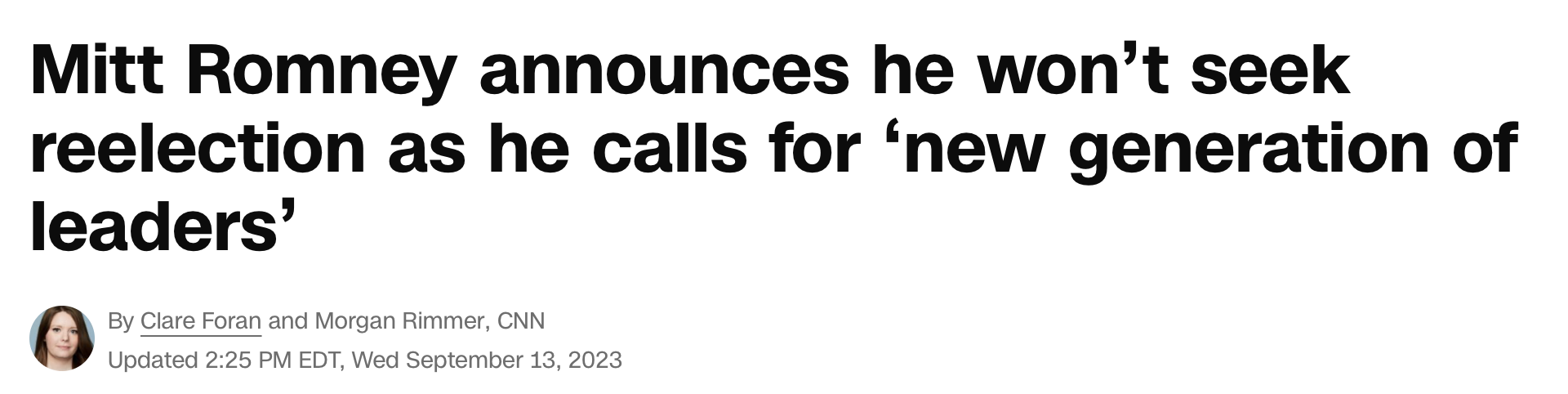
Kudos to Utah Senator Mitt Romney who recently announced he would not run for re-election year year.

The major reason was the fact that the would be in his mid-80's. by the end of the next term and and says it is time for a new generation of leaders.


Source: https://www.cnn.com/2023/09/13/politics/mitt-romney-not-running-reelection/index.html


If you read between the lines you can see that Romney is also suggesting that Biden and Trump step aside.

Donald Trump will be 78 years old in November, 2024. The is the same age Biden was on Inauguration Day in 2020.

Are we really going to see a Presidential election in 2024 that pits an 82 year old and a 78 year old for President of the United States?

The Vegas oddsmakers say yes right now.

However, BeeLine has put the odds of both Trump and Biden being on the general election ballot in 2024 as less than 1%.

This is the prediction I made on January 16, 2023 in these pages.

I don't like making political predictions because it is too easy to be wrong. I prefer analysis based on data.

However, if I were to place odds on Biden 2.0 vs. Trump 2.0 right now, I would suggest there is only a 1% chance that both Biden and Trump will be the candidates on the final ballot in 2024.

We will find out once again whether I should stay out of the prediction business.

We also have the interesting chart on the aging of our politicians that follows below.

This shows the percentage of those in Congress who were 70 years of age or older in all years dating back to 1800.

It shows that the percent who were 70 or older jumped from 8% in 2002 to 23% in 2022.


Credit: https://www.businessinsider.com/congress-oldest-history-gerontocracy-lawmakers-2022-9


Many say the answer to aging politicians is term limits.

I disagree.

I believe it would make much more sense to implement age limits for all federal elected offices through a constitutional amendment.

I wrote about this in 2018 well before we knew we knew we might be facing the prospects of an 80+ year old President.

My proposal is simple.

An age limit of 65 years of age for a member of the House of Representatives.

An age limit of 70 years for the U,S. Senate.

An age limit fo 75 years for the Presidency.

These are calculated using the minimum age for each office as established in the U,S. Constitution plus 40 years.

If this had been adopted in 2018, when I proposed it. we would not be looking at Biden vs. Trump in 2024. They would both be ineligible.

Feinstein and McConnell would not now be in the U.S. Senate.

Take a look at what I wrote in 2018 for more depth and context on why I think age limits deserve consideration.


Age Limits Rather Than Term Limits?

(originally published May 20, 2018)

We hear a lot about the need for term limits for our elected representatives.

In fact, President Trump recently reiterated his support for Congressional term limits.


I have mixed feelings about term limits. I like the fact that it forces new blood and new ideas into our political system but I also see value in having those with institutional experience in charge to provide the necessary leadership and perspective to the legislative process.

We have had legislative term limits in Ohio since 1992 (limit of no more than four 2-year terms in the House and two 4-year terms in the Senate) but I have seen little evidence that it has had much effect on the political class. It seems to have mainly created a lot of political gamesmanship. A House member is term-limited and then moves to the Senate. A Senator becomes a County Commissioner and then comes back and runs again for the Senate.

As I wrote in "It's All In The Name", the largest asset a politician has is their name identification. The substantial "asset value" that a politician has in his or her name is also the reason why so many politicians have a hard time stepping away. They know they have an "asset" and they want to use it. It really becomes a question of "use it or lose it."

The Toledo Blade did a story in 2015 on why "Term limits do little to oust Ohio lawmakers"  where it reported on the political games being played because of those term limits.

It's been two decades since Ohio voters amended their constitution to cap the number of consecutive years a state lawmaker can hold his office.
But today, five state representatives and a senator who were here in the General Assembly when the term-limits clock first started ticking are still here, their service uninterrupted as they've jumped from one chamber to the other and back again.
Two will have 30 or more years under their belts by the end of the current session.


Term limits were very popular in the 1990's. 14 of the 15 states that now have term limits on the books enacted that provision during that decade. Nebraska was the last to enact term limits in 2000.

After thinking about all of this I believe that it might make more sense to consider age limits or a mandatory retirement age rather than Congressional term limits.

I know that it would spark cries of ageism and all the rest but it would prevent some of the problems with term limits while also providing the opportunity to infuse new blood into Congress from time to time.

It seems that I am not the only one thinking about this. Consider this question that was put to Democrat House Minority Leader Nancy Pelosi on the CNN Town Hall this week that was hosted by Chris Cuomo.


CUOMO: "I have something for you along these lines. You gave as you good segue there. I want to bring in Mary Pat, retired, lives in Maryland. Mary Pat, what is your question? A beautiful scarf you have on."MARY PAT: "Leader Pelosi, quorum.us says more than half the senators running for re-election this year are over 65 years old. If they win, their term of service will be six years. Their constituents are about 20 years younger. Isn't it time for some members to return to private service and to encourage younger folks run for office so --"[ applause ]


I am certainly not suggesting that there is a certain age at which someone is not fit to serve. For example, consider this story and video of 83-year old Senator Chuck Grassley pounding out 19 push ups to best a teenage student at an Iowa school meeting. No one should say that Grassley is not fit to serve.

It just seems logical that at some point the decisions affecting the nation and its future should be turned over to the next generation. Does it make sense for an 80-year old to be voting on legislation that will affect the lives of those much younger who will have to live under those laws for a much longer time than that Senator?

It should also be remembered that the U.S. Constitution already has an established minimum age criteria for the U.S. House (25 years), Senate (30 years) and President (35 years). Our Founders saw the wisdom of that minimum age to insure that there would be a basic level of maturity and life experience in our elected leaders. Perhaps there should also be a maximum as well?

It is also not uncommon to see required retirement ages in the corporate world for CEO's and Board members. It seems to be understood that at some point there comes a time when you should step aside for the good of the organization to let a new generations of leaders have their opportunity.

My suggestion would be to cap the maximum age at which a federal elected official could be sworn into office at 40 years from the minimum age to serve that is currently established in the U.S. Constitution. Thus, a House member could not be more than 65 years of age or a Senator older than 70 when beginning a new term of service. I would add an age 75 limit to the President in addition to the term limit already in place. This effectively would mean that there would be no House members older than 67, Senate members older than 76 or a President who was 79 or older based on the required retirement age limit.

What effect would this have if it was in place right now?

President Trump would still be eligible to run for re-election in 2020 as he would  be under the age 75 age limit on Inauguration Day January 20, 2021. (Trump will not be age 75 until June 14, 2021)

Interestingly, not one of the 45 Presidents we have had would have been precluded from serving if this provision had been in place from the beginning of the nation's founding.

However, this provision would prevent Bernie Sanders or Joe Biden from running for President in 2020 if it were in effect. It would also mean that Hillary Clinton or Elizabeth Warren could run in 2020 but each would be precluded from running for re-election in 2024 as they would be beyond the age limit on Inauguration Day 2025. If you are a Democrat can you honestly say that it is a bad idea to have these people step aside and allow for some fresh faces in the party?

The biggest effect would be on the U.S. Senate.

There are currently 7 Senators that are at least 80 years of age. (Shelby-AL, McCain-AZ, Feinstein-CA, Grassley-IA, Roberts-KA, Inhofe-OK, Hatch-UT.

There are an additional 18 Senators that are at least 70 years of age.

The average age of a Senator right now is 61 and the U.S Representative average is 57. These are both about the oldest averages in our nation's history. By comparison, as recently as 1981, the average Senator's age was 53 and the average Representative was 49. On average, both are now 8 years older than they were 35 years ago.

Quorum recently did a study for the 115th Congress and found that in 44 of U.S House districts the age of the Representative was at least double the median age of those they represented. In 38 of the 44 districts the Representative won re-election with at least 60% of the vote. Name ID is everything and the reality is that most of these politicians are not leaving the pay, privileges and perks of Congress voluntarily. It is almost as if they have a lifetime taxpayer-paid annuity.


There are merits to term limits but they also have inherent limitations.

Perhaps it is time to start thinking about retirement age limits instead?

Thursday, September 21, 2023

Why Would You Want To Be A Male?

I recently came across some interesting global data on intentional homicides published by the United Nations.

When you see the data you wonder why any woman would want to become a transgender male.

Here are the numbers for the United States for 2021 (the most recent year reported),

Males are almost four times more likely to be murdered as females in the United States.


Here are the numbers for Mexico.

There are many more homicides in Mexico than the United States despite the fact that the population of Mexico is only about 38% that of the U.S.

Males are almost 8 times more likely to be murdered in Mexico as are females.


You see similar ratios in various South American, Central American and Caribbean countries.


The data also shows that the perpetrators of these intentional homicides (as measured by those arrested or convicted in intentional homicide cases) is even more skewed towards males.

For example, in Honduras 97% of those arrested and/or convicted of intentional homicides (in 2016 the latest year data is available) were males.

In Guatemala, the number is 96%.

Where do you think most of the illegal immigrants flooding across the southern border are coming from?  

Do you think most are males or females?

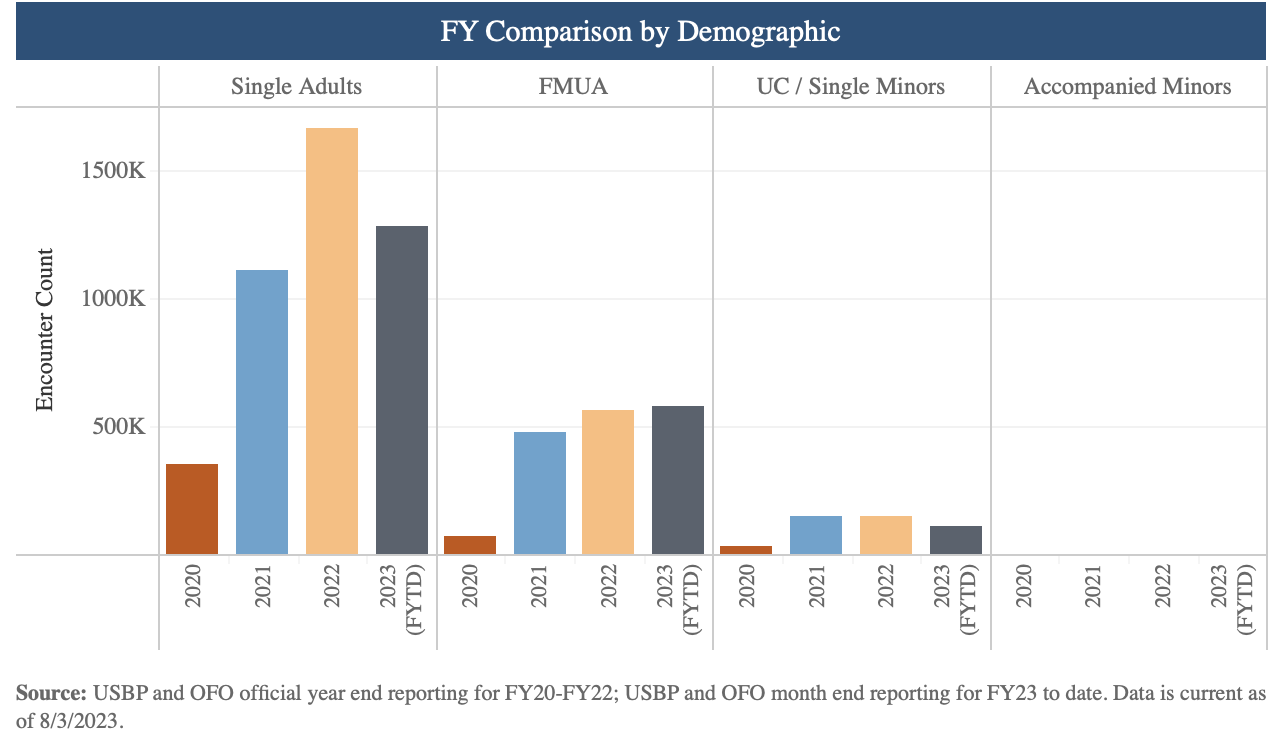
If you doubt there is an open border policy just look a the data from the U.S. Customs and Border Border Patrol on Southwest Land Border Encounters.

The number of illegal aliens crossing the border has been consistently averaging around 200,000 per month the last three years.

It was below 50,000 per month the last year of the Trump administration.


Source: https://www.cbp.gov/newsroom/stats/southwest-land-border-encounters


Where are the largest numbers of illegals coming from according to the CBP?

Mexico, Honduras and Guatemala.

In July alone, 54,000 illegals came in from Mexico, 26.000 from Honduras and 22,000 from Guatemala.

Look again at the numbers on intentional homicides above and ask whether the Biden border policy is in the best interests of Americans.

CBP data also shows that the overwhelming number of illegals entering the country are single adults or minors. These singles are  almost exclusively males.


Source: https://twitter.com/EndWokeness/status/1696930758009516218


What more evidence is needed to know that the open border policy of the Biden administration is misguided and dangerous?

In addition, why would you want to be a male when you look at these statistics?

Monday, September 18, 2023

Am I The Only Person In America Who Likes Both Trump and DeSantis?

We live in a world today in which there is no middle ground.

It seems everything has become black or white.

There is no nuance.

You are either totally pro-life with no exceptions or pro-choice up to the minute of birth.

You have to believe that Covid is nothing more than a cold or it is so dangerous you need six vaccine shots and be wearing an N-95 mask wherever you go.

You need to be for abolishing the IRS or be in favor of hiring 97,000 new IRS employees.

The same seems to also be true as people in the Republicans party state their preferences between Donald Trump and Ron DeSantis.

This is particularly the case if you spend any time on social media platforms.

If you favor Trump, DeSantis is the worst candidate of all time. He is boring, inauthentic, lacks charisma and does not make connections with voters.

It is Trump or bust with them.


Trump is the biggest loser around if you favor DeSantis, Haley or another GOP candidate the next time around.

For example, this guy was probably the biggest cheerleader in the country for Trump on Twitter in the 2016 election and in his four years in office. He now has decided that Trump is a loser and does nothing but screw things up. He now loves DeSantis.


Am I the only persons in America who likes both Trump and DeSantis?

I can get behind any of the other Republican candidates as well.

As I have said before, there has never been a President in my lifetime who governed more consistently in comparison to what he said he would do when he was a candidate than Donald Trump.

There was no bait and switch.

Yes, I wish Trump toned down his personality and was not as bellicose and bombastic. It wouldn't hurt if he was a little less authentic.

However, I have watched Trump closely over the years and what he says is largely an act to give himself some strategic or negotiating advantage.

The stuff he says may be over the top but what he actually does when it counts is not.

He doesn't make crazy decisions. He makes practical ones that are well grounded in reality.

Look at his Supreme Court picks. His dealings with North Korea. The negotiations on NAFTA. The deal he worked out with Mexico on the border. When it came down to doing a deal he was practical and reasonable.

Despite all the predictions that Trump was going to be a disaster as President, none of it proved true. The economy flourished, energy supplies were abundant, ISIS was destroyed and he made significant inroads in brokering peace in the Middle East and with North Korea.

It is hard to see how Trump would not have been easily re-elected if if was not for Covid.

If I have anything to fault Trump about during his time as President it would be his handling of Covid. His instincts were clearly correct that locking down the country over Covid was insane. However, he deferred to Fauci and the so-called experts. He took the mainstream position to avoid controversy and he made the wrong call.

One of the things I like about DeSantis is that he did not fall into that trap. He initially followed the consensus but soon analyzed the data and listened to other experts who disagreed with Fauci. As a result, Florida came through Covid better than almost any other state. He opened the economy and schools faster than most everyone else and Florida benefited as a result.

DeSantis has also been ahead of the game on challenging much of the liberal woke agenda. I don't know of another governor who has pushed back harder.

The 20-point win that DeSantis produced in Florida, which used to be considered a swing state, is a strong endorsement of the job he has done in Florida.

Many make the argument that Trump can't win because he is not popular with suburban women.

Trump is weak with this demographic and it is concerning.

DeSantis may be a more attractive candidate for this group.

However, it is also clear that Trump has a unique ability to connect and bring out the vote of disaffected voters who don't normally see the need to vote. Many of these voters are traditional working class Democrats.

That is why you see general election poll results that do not show much difference in how Trump or DeSantis perform against Biden.

This is the most recent CNN poll.


This is a poll from Echelon Insights.


From Morning Consult.


A poll from Premise Data that shows Trump running much stronger against Biden than DeSantis would.


As I said, I like both Trump and DeSantis.

I saw what Trump did as President. I have seen what DeSantis did as the Governor in Florida.

I am confident that both would steer the nation in the right direction.

Most importantly, it would be far removed with what we have seen with Joe Biden.

However, as I have written before, I favor DeSantis right now because I don't think Biden will be the Democrat candidate a year from now.

Trump will do better against Biden than any other Democrat candidate for the simple reason that voters can easily compare their lives under Trump to what they have experienced with Biden.

Trump will not have that advantage against a younger potential Democrat candidate that does not have a clear record for comparison and which voters do not have established views about.

Trump has a high level of unfavorability with many voters. However, Joe Biden's  unfavorables are much higher now than when he ran in 2020. 

Trump beat Hillary in 2016 because of her unfavorable rating with many voters. Trump also had a negative approval rating in that election but he was a more attractive option than Hillary in the end.

DeSantis and the other GOP challengers trail Trump badly right now in primary polls but it is a long road to the nomination. A lot can happen between now and the first votes. That is true for both Trump and Biden.

At this time in the primary process for the Democrats in 2008 no one thought Barack Obama would beat Hillary and no one in 2016 was putting money on Joe Biden.

I am content to sit back and watch this play out with the voters confident that the best candidate to take back the country from the Democrats will be identified.

I like both Trump and DeSantis and Haley, Scott, Ramaswamy and the rest.

Even if I am the only person in America who will say it.