Showing posts sorted by relevance for query Beyond Meat. Sort by date Show all posts

Friday, March 14, 2025

Food for Thought

In 2019 I wrote about the emerging trend around plant-based meats.

These food items are more popularly referred to as "fake meat".

I profiled the company, Beyond Meat, which was the leading company in the sector and had recently gone public in an IPO.

The stock was then trading at $235/share and had a market cap of $14 billion.

It had a higher market value at that time than food industry giants Smucker's, Campbell Soup and Conagra.

I was not optimistic about its future in which the main ingredient for its "Beyond Meat" burger is yellow pea protein.


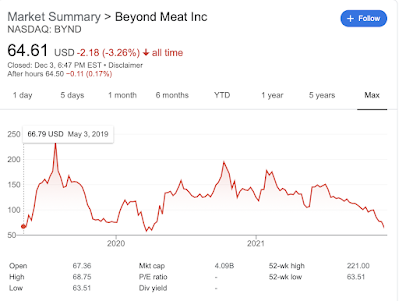
Since I wrote that blog post Beyond Meat's stock price has lost over 95% of its value.

Source: Google Finance

In 2024, Beyond Meat lost $160 million on $327 million in revenues. In other words, it lost about 50 cents on every dollar of sales.

It is reminder than the next great thing is sometimes not great at all.

The blog post that I wrote in 2019 entitled "Will You Eat Fake Meat? follows.

Right now it looks like the answer is no.

Beyond Meat had $465 million in revenues in 2021. In 2024, the company could only sell $327 million in fake meat.


Will You Eat Fake Meat?

(Originally published July 28, 2019)

Are you willing to eat meat that is not really meat?

There is a lot of money being bet that you will.

Fake meat is one of the biggest trends of the year.

Fake meat is a new food group that uses plant based ingredients to make something that looks and tastes like meat.

Two of the big brand names that are attempting to establish themselves in this space are Impossible Foods and Beyond Meat.

Impossible Foods markets the "meat" to make what it calls the Impossible Burger.


Beyond Meat has the Beyond Meat burger.


It looks good but will you eat it?

Here are the ingredients in the Beyond Meat burger. The prime ingredient is pea protein. Fortunately, that is pea with an "a". The Impossible Burger relies on soy protein as its main ingredient.


Beyond Meat is already in some grocery stores and Impossible Foods plans to be in grocery stores by the end of the year with its "meat." Both have already made inroads with various restaurant chains.

I have not yet had the non-meat meat.

However, when I was in law school in the 1970's, my wife and I were watching our pennies very, very carefully. Kroger sold a ground beef product called Kroger Pro that included a 20% soybean filler. It sold at a lower price than regular ground beef making it attractive for a couple trying to get by on $20 per week in grocery spending. 


We would buy it since we had little money and you can only eat so much macaroni and cheese (you could buy a box of Kraft mac and cheese for 15 cents). Adding Kroger Pro to the mac and cheese gave us a casserole. The only problem was that it tasted like eating cardboard. We eventually stopped eating it and Kroger stopped selling it. We must not have been the only ones who thought it tasted like cardboard.

I am sure advancements have been made in food science since that time. However, will enough people eat meat that is not meat?

Beyond Meat went public in May. The IPO price was $25 per share. It closed at $234.90 on Friday. That is +840% since it went public. It was up +33% just last week.

At that stock price Beyond Meat has a market cap of over $14 billion. That was up $3.6 billion in the last week. That is a lot of money being bet on fake meat.

Compare the market cap and product portfolio of Beyond Meat with another food company that has been around for almost 125 years and has a market cap of about $13 billion.

One has Smucker's jellies and jams, Jif peant butter, Crisco shortening and Folgers coffee and many other brands.

The other has fake meat made from pea protein.

Hat tip to @charlebilello for bringing this to my attention on Thursday of last week when the market cap of Beyond Meat was just $12.9 billion.


On Friday Beyond Meat's market cap went up by another $1+ billion so that it is now carries and higher market value than food giants Campbell's Soup and Conagra.

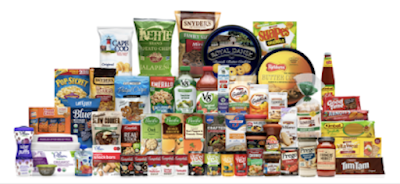
These are the brands that Campbell's Soup owns.


Here are all the brands that Conagra owns.


That ought to give you a perspective on how much money is being bet that you will eat fake meat.

However, will you really eat fake meat?

Count me as someone who is not buying Beyond Meat at $235 per share.

You can also probably count me as someone who is also not going to eat a Beyond Meat burger anytime soon.

Why? My appetite for Fake Meat is about the same as it is for Fake News.


Postscript:
The plant based fake meat of Beyond Meat also reminded me of the 1973 film sci-fi movie Soylent Green in which the plot involves a world in which Soylent Industries controls the food supply of half the world with a soybean and lentil ingredient wafer. Only the very rich can afford natural food as the earth's resources and water have been decimated by pollution, overpopulation and the greenhouse effect. Interestingly, the film is set in 2022. We are almost there!

Sunday, July 28, 2019

Will You Eat Fake Meat?

Are you willing to eat meat that is not really meat?

There is a lot of money being bet that you will.

Fake meat is one of the biggest trends of the year.

Fake meat is a new food group that uses plant based ingredients to make something that looks and tastes like meat.

Two of the big brand names that are attempting to establish themselves in this space are Impossible Foods and Beyond Meat.

Impossible Foods markets the "meat" to make what it calls the Impossible Burger.


Beyond Meat has the Beyond Meat burger.


It looks good but will you eat it?

Here are the ingredients in the Beyond Meat burger. The prime ingredient is pea protein. Fortunately, that is pea with an "a". The Impossible Burger relies on soy protein as its main ingredient.


Beyond Meat is already in some grocery stores and Impossible Foods plans to be in grocery stores by the end of the year with its "meat." Both have already made inroads with various restaurant chains.

I have not yet had the non-meat meat.

However, when I was in law school in the 1970's, my wife and I were watching our pennies very, very carefully. Kroger sold a ground beef product called Kroger Pro that included a 20% soybean filler. It sold at a lower price than regular ground beef making it attractive for a couple trying to get by on $20 per week in grocery spending. 

We would buy it since we had little money and you can only eat so much macaroni and cheese (you could buy a box of Kraft mac and cheese for 15 cents). Adding Kroger Pro to the mac and cheese gave us a casserole. The only problem was that it tasted like eating cardboard. We eventually stopped eating it and Kroger stopped selling it. We must not have been the only ones who thought it tasted like cardboard.

I am sure advancements have been made in food science since that time. However, will enough people eat meat that is not meat?

Beyond Meat went public in May. The IPO price was $25 per share. It closed at $234.90 on Friday. That is +840% since it went public. It was up +33% just last week.

At that stock price Beyond Meat has a market cap of over $14 billion. That was up $3.6 billion in the last week. That is a lot of money being bet on fake meat.

Compare the market cap and product portfolio of Beyond Meat with another food company that has been around for almost 125 years and has a market cap of about $13 billion.

One has Smucker's jellies and jams, Jif peant butter, Crisco shortening and Folgers coffee and many other brands.

The other has fake meat made from pea protein.

Hat tip to @charlebilello for bringing this to my attention on Thursday of last week when the market cap of Beyond Meat was just $12.9 billion.


On Friday Beyond Meat's market cap went up by another $1+ billion so that it is now carries and higher market value than food giants Campbell's Soup and Conagra.

These are the brands that Campbell's Soup owns.


Here are all the brands that Conagra owns.


That ought to give you a perspective on how much money is being bet that you will eat fake meat.

However, will you really eat fake meat?

Count me as someone who is not buying Beyond Meat at $235 per share.

You can also probably count me as someone who is also not going to eat a Beyond Meat burger anytime soon.

Why? My appetite for Fake Meat is about the same as it is for Fake News.


Postscript:
The plant based fake meat of Beyond Meat also reminded me of the 1973 film sci-fi movie Soylent Green in which the plot involves a world in which Soylent Industries controls the food supply of half the world with a soybean and lentil ingredient wafer. Only the very rich can afford natural food as the earth's resources and water have been decimated by pollution, overpopulation and the greenhouse effect. Interestingly, the film is set in 2022. We are almost there!


Wednesday, May 18, 2022

Beyond Meat, Bitcoin, Boom and Bust

I wrote a blog post three years ago on what was the emerging fad involving fake meat.

A company named Beyond Meat had recently gone public in an IPO.

When I wrote about Beyond Meat it had a total stock market value of $14 billion.

It had $95 million in annual revenue and had a net loss of $27 million in the most recent year.

To put that $14 billion market value in context I pointed out that made Beyond Meat more valuable than two giants in the food industry---Campbell's Soups and Conagra.

These are the brands that Campbell's owns.


These are the major brands that Conagra owns.


Beyond Meat was going to need to convince a lot of people to eat fake meat to justify that valuation.

I wrote at the time that my guess was that this was not going to end well for Beyond Meat shareholders.


That ought to give you a perspective on how much money is being bet that you will eat fake meat.

However, will you really eat fake meat?

Count me as someone who is not buying Beyond Meat at $235 per share.


How has Beyond Meat done the last three years in selling fake meat?

How have its shareholders done?

Beyond Meat reported revenues for the first quarter, 2022 of $110 million.

However, the company lost $98 million on those sales.

That amounts to an operating loss of an astounding 92% of sales!

It doesn't get much worse than that.


Source: https://www.fool.com/investing/2022/05/17/how-beyond-meats-losses-hit-a-jarring-92-of-sales/


How have the shareholders of Beyond Meat done?

I wrote that blog post right after Beyond Meat had hit almost $235/share.


Beyond Meat (BYND)

 
The stock is now trading at below $27/share. You are down over 88% if you bought stock in Beyond Meat in July, 2019.

It is down almost 60% just since January 1, 2022.

Ouch!

Of course, there are many other stocks like Beyond Meat which have been annihilated in the current market environment.

Some of these have much better track records and performance than Beyond Meat.

A few examples of big stock losses YTD.

Coinbase Global    -73%

Netflix   -68%

Caesar's Entertainment.   -45%

Intuit   -41%

Tesla    -37%

The stock market has not been the only investment sector that has been hit hard in 2022.

Crypto currencies have also fallen.

One of the arguments given by those who are fans of cryptos such as Bitcoin was that it was a store of value and that it would have little correlation with traditional investment classes making it an ideal asset to protect one's wealth.

Bitcoin is down 36% since the first of the year.

It was as high as $67,000 last November. It is around $30,000 right now.

What is particularly interesting to me, contrary to the argument that Bitcoin has little correlation to other investment classes, is that Bitcoin has fallen almost in lockstep with the NASDAQ index.

In fact, it is a .95 positive correlation.


Bitcoin doesn't look like a store of value right now.

It looks like just another risky asset class.

The New York Times prepared this chart that compared the performance of gold, NASDAQ and Bitcoin thus far this year.


Bitcoin and the stock market did well when interest rates were low and the Federal Reserve was supplying all sorts of liquidity to the markets.

The question is how well will Bitcoin, Beyond Meat and a bunch of other investment do when the Fed is no longer filling up the punch bowl at the party?

The early returns are not encouraging.

In fact, at Bitcoin's current value about 50% of the owners of this crypto are already underwater on their investment.

It has always been true that as interest rate yields get more attractive, riskier asset classes have a harder time attracting buyers.

For more than a decade the Federal Reserve kept interest rates at historically low levels in order to entice more and more people to put their money in riskier asset classes in order "to help the economy".

If we look at the high prices that some investors paid for Beyond Meat, Bitcoin and other names they succeeded in what they set out to do.

The further question is what type of damage did the Fed do to those investors and the economy in the long term?

We will find out together.

In the meantime, Warren Buffet recently made these remarks about Bitcoin and other cryptocurrencies.

You can read the entire quote below but the essence is that Buffett would not pay $25 for all the cryptocurrency in the world.

I would not call that a vote of confidence from someone who is arguably the greatest investor of all time.

“If you said … for a 1% interest in all the farmland in the United States, pay our group $25 billion, I’ll write you a check this afternoon,” Buffett said. ”[For] $25 billion I now own 1% of the farmland. [If] you offer me 1% of all the apartment houses in the country and you want another $25 billion, I’ll write you a check, it’s very simple. Now if you told me you own all of the bitcoin in the world and you offered it to me for $25 I wouldn’t take it because what would I do with it? I’d have to sell it back to you one way or another. It isn’t going to do anything. The apartments are going to produce rent and the farms are going to produce food.”

Beyond Meat might still be a potential investment for Buffett.

You just have to get people to want to eat fake meat.

If things continue as they are right now, we may get to that point much sooner than we want.


Source: https://www.ft.com/content/17d7e07f-46c6-4c41-9202-e445928a405a

Monday, December 6, 2021

Monday Meanderings-12/6/21 Edition

Another edition of Monday Meanderings with focus on seasonality and Covid, the November jobs report, inflation and what has happened to the stock price of Beyond Meat.


Seasonality Overwhelms Everything Else With Covid

Over most of the last month Michigan has been leading the nation in new Covid cases. It has now dropped to third behind New Hampshire and Minnesota.

89% of every man, woman and child in New Hampshire has had at least one dose of the vaccines according to The New York Times  

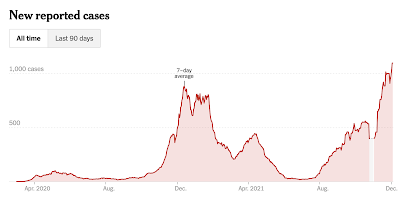
The 7-day average of 1,096 new daily confirmed cases is 24% higher than the previous high that was reached December 13 of last year before vaccines were available.


New Reported Cases in New Hampshire
Credit: https://www.nytimes.com/interactive/2021/us/new-hampshire-covid-cases.html


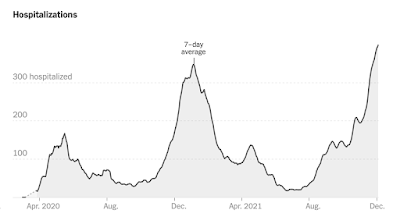
Hospitalizations with Covid have also hit record levels in New Hampshire.


Hospitalizations with Covid in New Hampshire
Credit: https://www.nytimes.com/interactive/2021/us/new-hampshire-covid-cases.html


This seems to be at odds with the claims that the vaccines prevent severe illness even if they do not prevent someone becoming infected with Covid.

In looking at the New Hampshire data above, you might notice the amazing seasonal congruence of waves of Covid in the state. Daily cases this year are reaching a peak at almost at the same exact time that the peak was reached last year. The same with hospitalizations. It is quite remarkable.

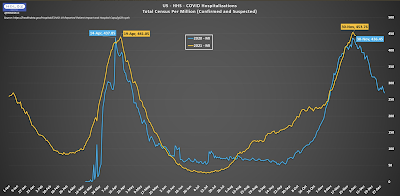
You see this seasonal congruence even more starkly when looking at this HHS graph of Covid hospitalizations in Michigan that compares 2021 vs, 2020.


Credit: https://twitter.com/Hold2LLC/status/1467153137752543232/photo/1


The peaks in hospitalizations in the state are falling on almost the same dates in 2021 as they were in 2020.

Doesn't this raise some questions as to whether any of the interventions (masks, lockdowns, vaccines) are making a substantial difference against the nature of the virus?


Jobs and Unemployment

Employment numbers were released last week for November and Joe Biden and the Democrats were attempting to spin the numbers to suggest that we are in the midst of the greatest economic recovery in history.

Biden highlighted the fact that the unemployment number had dropped to 4.2%.

However, the fact is that the economy only produced 210,000 jobs in November. Economists had predicted 550,000 new jobs after 546,000 jobs had been added in October

Even CNN's fact checkers called out Biden for promoting at least four significant false claims he made in his speech on Friday.


When CNN is fact-checking a Democrat you know that the claims are getting pretty outrageous.

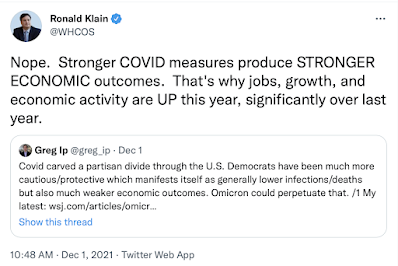
A big part of the narrative that Biden and the Democrats have been pushing is that stronger Covid measures (vaccine mandates, mask mandates etc) are what is necessary for a strong economy.

In fact, here is Biden's Chief of Staff, Ron Klain, on Twitter recently challenging a Wall Street Journal reporter who wrote an article stating that the Covid measures in Democrat states were hurting the economy.


What does the data say?

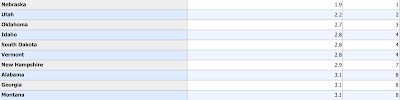
According to the Bureau of Labor Statistics, below are the 10 states with the lowest unemployment rates. (these rates are from October since state breakdowns have not yet been made available for November).

These ten states are averaging 2.7% unemployment.

Every one of these 10 states is led by a Republican governor.


Source: https://www.bls.gov/web/laus/laumstrk.htm#laumstrk.f.p


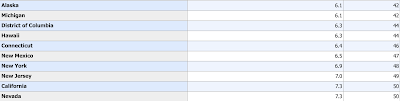
These are the 10 states with the highest unemployment rates.

These 10 states are averaging 6.6% unemployment.

9 of these 10 states are led by a Democrat governor. Alaska is the exception.


Source: https://www.bls.gov/web/laus/laumstrk.htm#laumstrk.f.p


Does anyone doubt that the Covid measures are much, much stricter in states with Democrat governors and the highest unemployment rates are in these states?

Biden and Klain appear to be claiming credit for things that they have had nothing to do with and trying to defend mandates which are hurting, rather than helping, the economy.

Never mind the facts. The strategy seems to be to just keep repeating the narrative and hope that people will believe it.

However, it has gotten to the point that even CNN is not buying it.


Inflation

A simple explanation for inflation is that it occurs when there is too much money chasing too few goods.

Demand outpaces supply and this results in prices of goods (or labor) increases.

A few charts that provide context as to why we may be seeing inflation in so many sectors of the economy right now.

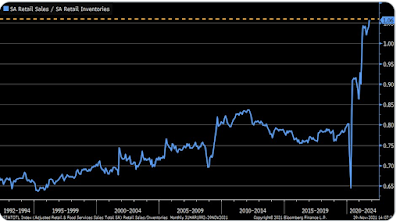
The retail sales-to-inventory ratio has never been higher. This indicates there is very little inventory supply supporting what is being sold. Low auto inventories are a big factor in this number but shortages are appearing in a number of sectors.

Not enough supply to meet demand.


Credit: https://twitter.com/LizAnnSonders/status/1465657385821818884


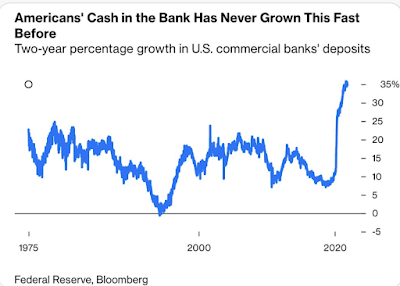
In the meantime, Americans have never seen larger increases in the cash they have in the bank. 

There is a lot of cash awash in the system to push consumer demand.


Credit :https://twitter.com/bpmehlman/status/1466434486971871238/photo/1

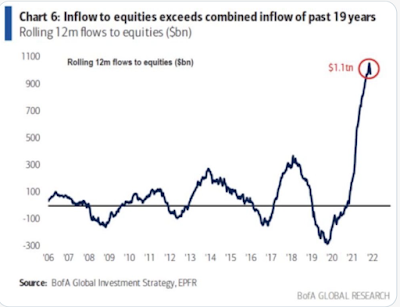
The cash in bank accounts does not include another $1.1 trillion that has flowed into the stock market in the last 12 months.

That inflow to equities exceed the combined inflow of the past 19 years!


Source: https://twitter.com/bpmehlman/status/1465652531921670149


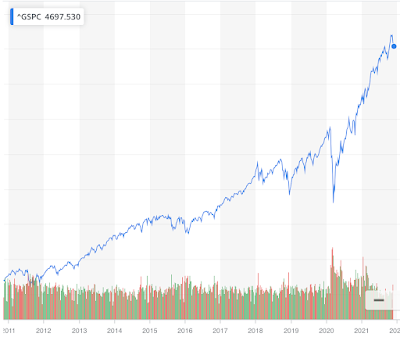
The principles of supply and demand also drive stock prices.

A lot of money chasing a limited number of equities to invest in.

That is how you end up with a chart of the S&P 500 that looks like this.


Source: https://finance.yahoo.com/


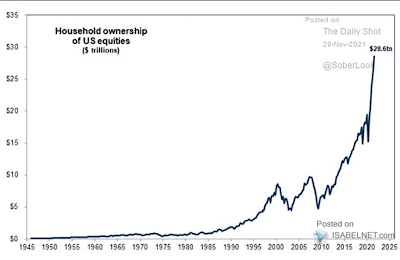
American households now have almost $29 trillion invested in U.S. equities. 


Credit: https://twitter.com/ISABELNET_SA/status/1465644231809282055


That is double what it was after the initial Covid crash in March, 2020 and almost triple what it was six years ago.

A lot of people must be feeling rich.

Of course, I find it interesting that the $28.6 trillion in household ownership of equities is not even equal to the amount of federal debt right now.

It has just gone over $29 trillion.

Source: https://www.usdebtclock.org


Of course, it is guaranteed that the U.S. national debt is going to be much higher day after day into the future.

The interest on the debt alone assures us of that.

There is no such guarantee that the values of U.S. equities will do the same. What goes up has been known to come down.

Despite all of these facts, the Democrats want to pass legislation to spend another couple of trillion dollars so we can "Build Back Better?

Is what we are seeing right now anywhere close to "better"?


Beyond Meat

In July, 2019 I wrote a blog post about all of the hype going on at the time about "fake meat".

The biggest name in the sector, Beyond Meat, had gone public in May, 2019 and the stock price had advanced 840% in the two months since its IPO. 

I pointed out in "Will You Eat Fake Meat?" that Beyond Meat  had a market cap of $14 billion and had gone up $3.6 billion in the last week alone.

That meant the fake meat company had reached a value that made it more valuable than other food giants like Smucker's, Campbell's Soup and Conagra at its stock price at the time of $235/share.

For perspective, all of these brands are owned by Campbell's.


These are the food brands that Conagra owns.


A company with a meat that is not meat of which the prime ingredient is "pea protein" was valued at more than companies with all of these established brands?

All of this told me that the narrative about Beyond Meat had gotten very far beyond reality.

That ought to give you a perspective on how much money is being bet that you will eat fake meat.

However, will you really eat fake meat?

Count me as someone who is not buying Beyond Meat at $235 per share.

You can also probably count me as someone who is also not going to eat a Beyond Meat burger anytime soon.

Why? My appetite for Fake Meat is about the same as it is for Fake News.

What has happened to the stock price of Beyond Meat since?

The stock price of Beyond Meat is now below the price of its initial public offering in May, 2019.


There are a few lessons here.

What goes up can come down.

Reality eventually controls over the narrative.

It is not easy to fool Mother Nature---that applies to Fake Meat or Viruses.

Wednesday, January 1, 2020

Best Decade Yet?

We have not only welcomed a new year this week but also a new decade.

Before we consider the decade of the 2020's, I think we ought to take a look back at the 2010's.

It was a most remarkable decade.

It began with the United States struggling to pull out of the most severe recession since the Great Depression. It ended with the strongest economy in the United States in over 50 years.

This is a chart that shows the unemployment rate trend during the decade. It started at almost 10% and ended at 3.5%.


It began with a career politician and liberal Democrat President who spent a lot of his time telling us that the United States was not that great a place to live.

It ended with a businessman and populist Republican President who believes that there is no greater place to live than in the United States of America.

In fact, it is particularly interesting looking at the predictions that Barack Obama's Energy Department made at the the beginning of the decade compared to what actually occurred. These charts are all from an article in Axios by Andrew Witherspoon "The decade that blew up energy predictions".


CO2 emissions were projected to rise. They decreased.


We were supposed to be importing 8 million barrels of oil per day now. Instead, we have become a net exporter of oil.


A big reason for this is that U.S. oil production is double what was projected at the beginning of the decade.


Natural gas production in the U.S. was projected to be flat over the decade. Instead, due to new technologies such as horizontal drilling and fracking, and the discovery and development of new fields, natural gas production has increased by more than 50% since 2010.


That massive increase in natural gas production has led to this fuel soaring as a source for electricity generation while coal use has plummeted thereby defying the predictions of the Obama Energy Department.


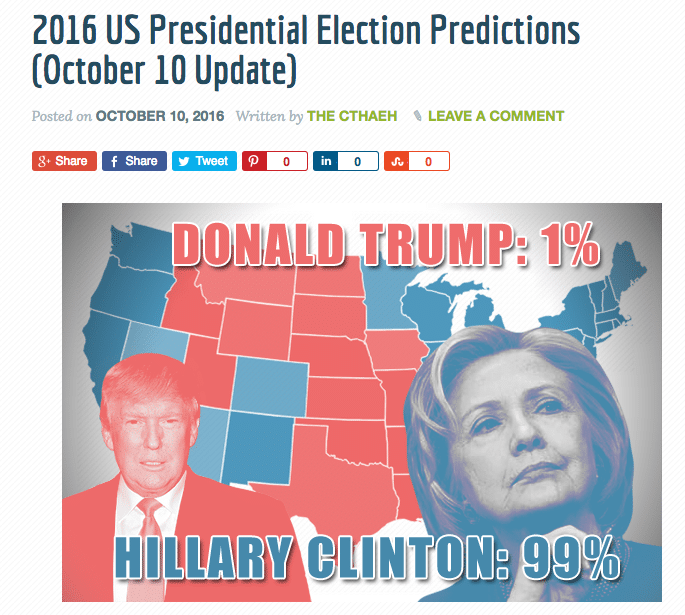
Looking at these charts should also serve to remind us one again to take the predictions of "experts" with a grain of salt.


Source: www. probalisticworld.com


Credit: The New York Times on Election Day


The decade also began with Americans stating that the two biggest problems facing the U.S. were the economy and jobs.

It ended with Americans citing government and immigration as the two biggest problems. Interestingly, neither the economy or jobs were mentioned by more than 6% of Americans in the 2019 survey.


Credit: Gallup


It started with the Dow Jones Industrial Average at 10,430. It ended with the DJIA at 28,538.

It started with the NASDAQ at 2,147. It ended at 8,973.

In fact, the NADAQ did not have one negative year in the entire decade. The Dow and
S&P only had one down year in the decade (including reinvested dividends)---2018.

Look at Charlie Bilello's summary of the NASDAQ over the last 10 years.


If you started with $1,000 on January 1, 2010 and compounded that money with these returns you would now have $5,282 ten years later.

It also appears to be the case that the 2010's was the first decade since 1850 (when reliable data is available) that the United States did not experience a recession.

The biggest mega tech trends during the 2010's were the increased use of mobile devices and streaming content.

This graph shows the accelerating use of mobile devices during the last decade.


Take a look as well at the dramatic increase in the use of streaming services in the 2010's.


Consider as well that a number of things that we take for granted today that were not in existence when the past decade began.

A partial list.

iPad

Smartwatches

Siri

Alexa

Instagram

Snapchat

Alibaba

Tesla S model introduced bringing electric cars legitimacy in the auto market

Self driving car features introduced

Tinder and the rise of online dating sites

Blue Apron and other meal kit deliveries

Door Dash and other restaurant food deliveries

Grocery deliveries and pick-ups

Lyft (Uber was first introduced in San Francisco in 2009)

Drones that consumers can use

Meatless meat such as Beyond Meat and Impossible Burgers

Hoverboards

Nest and SimpliSafe wireless home security systems

The best decade yet? There is a good argument to be made for it.

What about the next decade we are embarking on?

The American public is very optimistic as the decade begins. A Rasmussen survey found excitement about the new year at a hew high in their polling. 72% of Americans think it will be a good or great year. That number was only 54% a year ago and 47% in 2015.

I never want to discount the potential of the ultimate resource---human ingenuity and innovation.

However, I doubt that economic cycles are extinct. Bad times have historically followed good times.

And we have been living on borrowed time. We are now in the longest economic expansion in American history.

We have also been living on a lot of borrowed money. Those that rely too much on leverage eventually find themselves on the wrong side of that leverage.

We added over $10 trillion of debt in the last ten years at the federal level.


Debt by S&P 500 companies increased by over 50% in the last decade.


All of this was facilitated by a very accommodative Federal Reserve monetary policy over the last decade and historically low interest rates.

The Federal Reserve started reversing the QE (money printing) in 2018 that it had initiated as a response to the recession only to reverse course in late 2019 and start printing again.


Credit: https://seekingalpha.com/article/4314482-hour-is-getting-late

It was no coincidence that the stock market struggled in 2018 as this liquidity was being pulled from the system. The recent Fed action also goes a long way to explaining the late 2019 stock market "melt up".

As a result, the new decade begins on a very precarious precipice of debt as well as political division and uncertainty. President Trump has been impeached by the House and there are currently no plans for a Senate trial. The upcoming national election also looms large on the horizon. The decision that voters make in that election could go a long way in determining how the next decade will unfold.

No matter what happens on the big stage I suggest you take the advice of a great friend of mine and commit to personally making the 2020's "your best decade." Take heed of those things that you have the greatest control of personally and commit to making it great for you.

Here's to you having the 20/20 vision to make it happen.

Happy New Year and  may Your Best Decade be ahead of you!